
How to Build Muscle After 40 in Hale – What Actually Works?
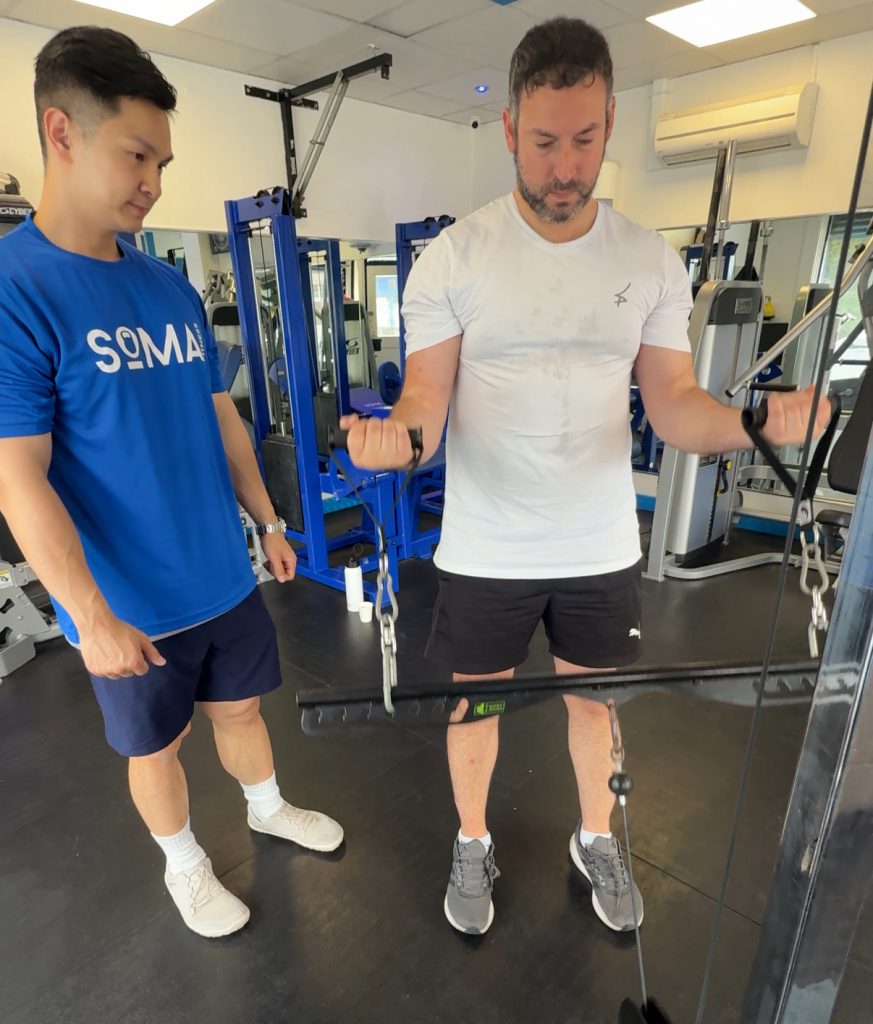
“I’m over 40 now. Is it too late to build muscle?”
No.
But you might need to train a little more intelligently than you did at 20.
For many men and women, their 40s are the point where they begin noticing physical changes.
They’re not as strong as they once were.
Their waistline has increased.
Recovery feels slower.
They’re stiffer.
They’ve lost some of the muscle they had when they were younger.
And often, this hasn’t happened because they turned 40.
It’s happened because life changed.
Careers became more demanding.
Children came along.
Sport disappeared.
Daily movement decreased.
Training became inconsistent.
At Soma Fitness, we’ve spent almost twenty years helping men and women across Hale, Altrincham and the surrounding areas build stronger, healthier bodies.
If you want to build muscle after 40 in Hale, here’s what you actually need to know.
Can You Really Build Muscle After 40?
Absolutely.
Your ability to adapt to resistance training doesn’t suddenly disappear when you turn 40.
Muscle growth occurs when you provide your muscles with an appropriate training stimulus, support that training with adequate nutrition and allow sufficient recovery.
Age can influence certain aspects of the process.
But being over 40 doesn’t prevent you from:
- Building muscle
- Increasing strength
- Improving body composition
- Improving physical function
- Becoming fitter
- Developing a better physique
In fact, if you’ve never trained properly before, you may have considerable room for improvement.
Why Do We Lose Muscle as We Get Older?
Age-related muscle loss is often discussed as though it’s completely unavoidable.
The reality is more complicated.
Ageing itself plays a role, particularly later in life.
But lifestyle matters enormously.
Think about what often happens between 25 and 45.
At 25, you might have:
Played football.
Gone to the gym.
Walked everywhere.
Had an active social life.
Moved considerably more.
At 45?
You’re sitting behind a desk.
Driving to work.
Taking meetings.
Managing a business.
Looking after children.
Then sitting on the sofa because you’re exhausted.
The body adapts to what you ask it to do.
If you stop giving your muscles a reason to remain strong, you shouldn’t be surprised when they gradually become weaker.
Muscle Is About More Than Appearance
This is where our philosophy at Soma Fitness differs from a lot of fitness marketing.
Building muscle isn’t just about looking better on holiday.
Muscle is physical capacity.
It contributes to your ability to:
Carry.
Lift.
Push.
Pull.
Run.
Play sport.
Get off the floor.
Carry your children or grandchildren.
Remain independent as you age.
The physique benefits are great.
But your long-term physical capability matters even more.
Strength Training Is the Foundation
If you want to build muscle, your muscles need an appropriate resistance-training stimulus.
Walking is excellent.
Cardio is excellent.
Mobility work can be useful.
But none provides exactly the same stimulus as progressive resistance training.
Your program might use:
- Dumbbells
- Barbells
- Cables
- Resistance machines
- Bodyweight exercises
The equipment is simply a tool.
What’s more important is how the program is structured and progressed.
Stop Training Like You Did at 20
This doesn’t mean training needs to become easy after 40.
That’s the wrong message.
You still need to challenge yourself.
But there’s a difference between training hard and training recklessly.
When you were 20, perhaps you could:
Train six days per week.
Sleep five hours.
Eat whatever you wanted.
Go out Saturday night.
Then somehow train again Sunday.
At 40 or 50, you may have a career, family, poorer sleep and significantly more life stress.
Your program needs to acknowledge that.
The answer isn’t necessarily lower effort.
It’s better fatigue management.
Progressive Overload Still Drives Results
Muscle growth requires progression.
If your training never becomes more challenging, eventually your body has little reason to continue adapting.
This is where progressive overload comes in.
Progress can involve:
- Increasing weight
- Increasing repetitions
- Improving exercise execution
- Increasing range of motion
- Adding appropriate training volume
- Improving control
This doesn’t mean you need to break a personal record every Monday.
Progress isn’t perfectly linear.
But over time, your training performance should generally improve.
You Need to Train Hard Enough
One of the biggest mistakes we see is people training consistently but never actually challenging the muscle.
They perform:
10 repetitions.
Put the weight down.
But could probably have performed another 10.
That may not provide a particularly strong stimulus for muscle growth.
You don’t necessarily need to take every set to complete failure.
But your working sets should be sufficiently challenging.
There’s a reason they’re called working sets.
More Training Isn’t Automatically Better
Then there’s the opposite person.
Twenty sets for chest.
Fifteen sets for arms.
Every set to failure.
Five or six training days every week.
More exercises.
More volume.
More fatigue.
Eventually performance stops improving.
Muscle growth isn’t determined by how destroyed you feel after training.
You need enough training to stimulate adaptation.
Then you need the ability to recover from it.
The objective isn’t maximum fatigue.
It’s maximum productive training.
Exercise Selection Matters
There isn’t one compulsory exercise for building muscle.
You don’t have to barbell back squat.
You don’t have to conventional deadlift.
You don’t have to bench press.
These can all be excellent exercises.
But the right exercise depends on the person.
At Soma Fitness, we consider:
- Your structure
- Training experience
- Mobility
- Injury history
- Goals
- Exercise execution
- Equipment available
The best exercise is one that effectively trains the target muscles, can be performed appropriately and allows meaningful progression.
Technique Matters More as Loads Increase
Good technique doesn’t mean every repetition needs to look artificially perfect.
But you should understand what you’re trying to achieve with an exercise.
If you’re trying to train your chest but every bench press becomes a full-body wrestling match, increasing the load might not be the answer.
Sometimes better execution produces a better training stimulus without adding another 20kg to the bar.
This is one area where working with an experienced Personal Trainer in Hale can be particularly valuable.
A coach can actually see what you’re doing.
Instagram can’t.
Protein Matters
Training provides the stimulus.
Nutrition provides the building blocks.
Protein supplies amino acids that support muscle repair and growth.
Good protein sources include:
- Chicken
- Turkey
- Lean beef
- Fish
- Eggs
- Greek yogurt
- Cottage cheese
- Milk
- Tofu and soy foods
- Beans and pulses
- Protein powders where useful
You don’t need to eat chicken and broccoli six times per day.
But consistently under-eating protein isn’t going to maximise your ability to build muscle.
How Much Protein Do You Need?
For people regularly resistance training, a useful evidence-based range is often around 1.6g of protein per kilogram of body weight per day, with individual needs varying depending on factors such as total energy intake, training and goals.
You don’t need to obsess over hitting an exact number to the gram.
But you should have a reasonable idea of whether you’re eating enough.
For many people, simply including a meaningful protein source in each main meal makes a considerable difference.
Do You Need a Calorie Surplus?
If maximising muscle growth is the goal, having sufficient energy available matters.
But this doesn’t mean:
“I’m bulking, so I can eat everything.”
An enormous calorie surplus doesn’t automatically create more muscle.
It can simply create more body fat.
For many people, particularly those who aren’t already very lean or highly trained, muscle gain can occur without an aggressive surplus.
Nutrition should reflect your:
- Starting body composition
- Training experience
- Goal
- Appetite
- Lifestyle
The strategy should fit the individual.
Carbohydrates Aren’t Your Enemy
If you’re training hard, carbohydrates can be extremely useful.
They provide energy for higher-intensity exercise and help support training performance.
Rice.
Potatoes.
Oats.
Fruit.
Bread.
Pasta.
These foods don’t suddenly become bad because you’ve turned 40.
Your overall calorie intake matters.
Food quality matters.
Protein matters.
But there’s no reason to unnecessarily fear carbohydrates.
Creatine Can Be Useful
Unlike many supplements marketed for muscle growth, creatine monohydrate has a strong evidence base.
It can help support improvements in strength and high-intensity exercise performance when combined with resistance training.
It isn’t a replacement for good programming.
It isn’t a steroid.
And it won’t compensate for poor nutrition.
It’s simply one potentially useful tool.
Build the foundations first.
Then worry about supplements.
Sleep Becomes Increasingly Important
This is one of the biggest challenges for busy professionals.
You’re training.
You’re eating well.
But you’re sleeping five hours because you’re answering emails at midnight and getting up at 5:30am.
Training creates fatigue.
Recovery allows adaptation.
If recovery is consistently poor, your ability to perform well in subsequent sessions can suffer.
You don’t need a perfect sleep routine.
But continually sacrificing sleep while increasing training volume is a poor trade.
What About Testosterone After 40?
This topic gets abused by fitness marketing.
Yes, hormones matter.
But men shouldn’t automatically assume that every loss of strength, muscle or energy after 40 is caused by low testosterone.
Often, we need to look at the obvious variables first:
Are you resistance training consistently?
Are you eating appropriately?
Are you sleeping?
Are you carrying excessive body fat?
Are you drinking heavily?
Are you managing stress?
Are you physically active?
If you have genuine symptoms that concern you, speak to an appropriate medical professional rather than diagnosing yourself through social media.
Women Can Build Muscle After 40 Too
Absolutely.
And resistance training becomes particularly valuable for women approaching perimenopause and menopause.
Maintaining muscle, strength and bone health becomes increasingly important as we age.
Women shouldn’t be afraid of lifting challenging weights.
For the overwhelming majority, resistance training isn’t going to suddenly create a huge, bulky physique.
Building substantial amounts of muscle takes considerable time.
The more realistic outcome is becoming:
Stronger.
More capable.
More confident.
And physically better prepared for later life.
What If You’ve Never Trained Before?
Then your 40s can be an excellent time to start.
You don’t need to “get fit first.”
That’s backwards.
Your training program should meet you where you currently are.
A beginner program might initially focus on:
- Learning fundamental movements
- Developing exercise technique
- Building confidence
- Establishing consistency
- Gradually increasing training effort
- Tracking progression
You don’t need complicated workouts.
You need good fundamentals executed consistently.
What About Previous Injuries?
By 40, many people have accumulated a few physical issues.
An old shoulder injury.
Back problems.
Knee pain.
Previous surgery.
That doesn’t automatically mean you can’t resistance train.
But your program may require modification.
Our coaching team at Soma Fitness has additional qualifications in injury rehabilitation, helping us appropriately adapt training around previous injuries and individual limitations.
Where symptoms require assessment from a doctor, physiotherapist or other healthcare professional, we’ll recommend that.
Good coaching means knowing when to coach—and when something needs clinical assessment.
How Often Should You Train to Build Muscle After 40?
There’s no magical frequency.
For many people, somewhere around two to four resistance-training sessions per week can work extremely well.
A busy 45-year-old business owner doesn’t necessarily need a six-day bodybuilding split.
What matters is:
- Sufficient training stimulus
- Appropriate weekly volume
- Progression
- Recovery
- Consistency
The best program isn’t the one that looks most impressive on paper.
It’s the one you can execute consistently while continuing to progress.
You Don’t Need Two-Hour Workouts
This matters for Soma’s typical client.
Most people have jobs.
Families.
Businesses.
Responsibilities.
You can achieve an enormous amount in a well-structured 45–60-minute resistance training session.
When time is limited, remove the nonsense.
Focus on productive exercises.
Track them.
Progress them.
Go home.
Building Muscle While Losing Fat
Can you build muscle and lose fat simultaneously?
Under certain circumstances, yes.
This is often more achievable for:
- Beginners
- People returning after a long training break
- Individuals carrying higher levels of body fat
As training experience increases and body fat decreases, trying to maximise both processes simultaneously becomes more difficult.
That’s why program design should reflect where you currently are rather than copying somebody else’s strategy.
Don’t Judge Progress Only by Body Weight
If you’re building muscle, the scales don’t tell the entire story.
Track:
- Strength
- Repetitions
- Measurements
- Progress photographs
- Body weight trends
- Clothing fit
- Training performance
If your body weight is relatively stable but you’re stronger, your waist is smaller and your physique looks better, something positive is happening.
Use multiple data points.
Think in Years, Not Weeks
This is probably the most important lesson.
People massively overestimate what they can achieve in four weeks.
And massively underestimate what they can achieve in four years.
Imagine becoming slightly stronger every few months.
Adding some muscle.
Improving your nutrition.
Maintaining cardiovascular fitness.
Keeping your body fat within a healthy range.
Now repeat that throughout your 40s.
The difference between the person who does that and the person who does nothing becomes enormous by 50.
Then even bigger by 60.
Your future body is being built now.
Why Choose Soma Fitness?
Soma Fitness is a private personal training studio based on Hale Road in Altrincham, serving men and women throughout:
- Hale
- Altrincham
- Bowdon
- Hale Barns
- Timperley
- Sale
- Surrounding South Manchester areas
We’ve spent almost twenty years helping people build stronger, healthier bodies.
Our coaching can incorporate:
- Muscle building
- Strength training
- Fat loss
- Nutrition guidance
- Lifestyle coaching
- Progress tracking
- Accountability
- Injury-aware programming
Whether you’re an experienced gym-goer or you’ve never lifted a weight before, the program is built around your starting point.
Frequently Asked Questions About Building Muscle After 40
Is 40 too old to build muscle?
No. Adults can respond positively to resistance training well beyond their 40s. Training experience, program quality, nutrition and recovery all influence the rate of progress.
Is it harder to build muscle after 40?
Age can influence recovery and muscle-building capacity, particularly as we move further into later life. However, many people blaming age are also training inconsistently, sleeping poorly or not eating appropriately.
How many times per week should I train?
For many people, two to four resistance sessions per week can be highly effective. The appropriate frequency depends on programm design, experience, lifestyle and recovery.
Should I lift heavy after 40?
You should use loads appropriate for your goals and ability. Building muscle doesn’t require maximal lifting, but training does need to provide sufficient resistance and effort.
How much protein should I eat?
Individual requirements vary, but around 1.6g/kg/day is a useful evidence-based reference point for many resistance-trained adults. Your total diet and individual circumstances should also be considered.
Can women build muscle after 40?
Absolutely. Resistance training is valuable for women and can support muscle, strength, physical function and bone health as they age.
Can I start if I’ve never lifted weights?
Yes. Beginners often have significant potential to improve. Start with appropriate exercise selection, learn good technique and progressively increase the training stimulus.
Looking to Build Muscle After 40 in Hale?
If you want to build muscle after 40 in Hale, or you’re looking for a Personal Trainer in Hale or Altrincham, Soma Fitness can help.
You don’t need to train six days per week.
You don’t need a complicated diet.
And you haven’t “missed your chance” because you’re no longer 25.
You need:
Good programming.
Progressive resistance training.
Appropriate nutrition.
Recovery.
And enough consistency to allow those things to work.
At Soma Fitness, we’ll assess where you are now, understand what you want to achieve and build a personalised training program around your body, lifestyle and available time.
Book a free consultation with our coaching team and start building a stronger body for your 40s, 50s and beyond.
Recent Comments