
Strength Training for Tennis Players in Hale & Altrincham – Build Strength, Power and Fitness
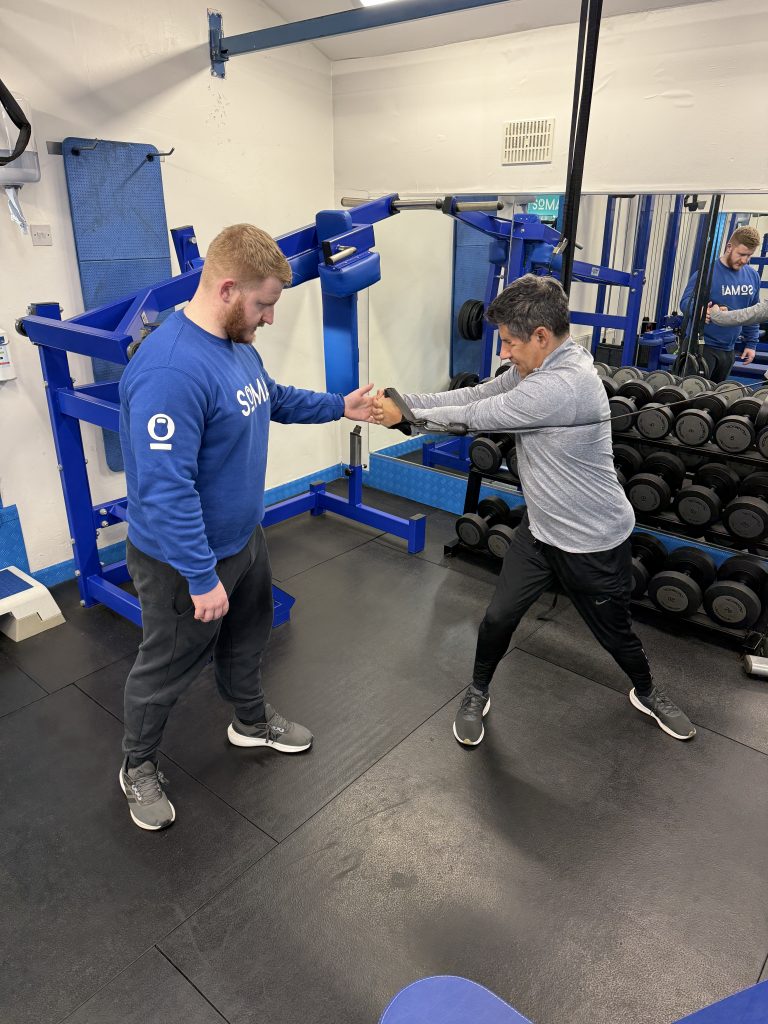
Tennis is a sport that demands far more from your body than simply being able to hit a ball. Whether you’re playing competitive club matches, enjoying social doubles or returning to tennis after several years away, every session involves a combination of movement, coordination, strength, power and cardiovascular fitness.
From accelerating towards a short ball to stopping quickly at the baseline, recovering after a wide forehand or producing an overhead serve, tennis challenges numerous physical qualities throughout a match.
Most recreational players understand the importance of practising their technique. They’ll spend time improving their serve, forehand, backhand and court positioning, yet many give relatively little consideration to how their physical preparation might complement their tennis.
At Soma Fitness, our private personal training studio on Hale Road in Altrincham, we work with men and women who want to become stronger, fitter and more physically capable. For recreational tennis players, this can mean developing a structured strength and conditioning programme that complements their time on court.
You don’t need to become a professional athlete or spend five days per week in the gym. You need a programme that develops relevant physical qualities while accounting for how often you play, your current fitness and your lifestyle.
Why Strength Training Matters for Tennis Players
Tennis involves repeated periods of relatively intense movement, interspersed with opportunities to recover between points and games. The physical demands can vary considerably depending on your playing level, whether you’re playing singles or doubles, the length of the match and your style of play.
A player who regularly competes in demanding singles matches may experience very different training demands from someone who enjoys social doubles once per week.
However, both can benefit from developing general physical qualities such as muscular strength, power and cardiovascular fitness.
Resistance training gives us a structured and measurable way to develop strength, which can contribute to physical preparation for sport and support muscle development and overall physical function.
The important distinction is that becoming stronger in the gym doesn’t automatically improve your tennis technique or guarantee better results in matches. Tennis remains a skill-dominant sport, and technical practice is essential.
Strength training should complement what you do on court, not attempt to replace it.
The Physical Demands of Tennis
If you’ve ever played a long tennis match, you’ll understand how physically demanding the sport can become.
Players repeatedly accelerate, decelerate, change direction, move laterally and recover towards an appropriate court position. Groundstrokes and serves also involve coordinated movements through the lower body, trunk and upper body.
These actions place demands on different parts of the body, and the intensity changes continuously throughout a match.
For that reason, an effective strength and conditioning programme shouldn’t focus exclusively on one muscle group or attempt to recreate every tennis movement using gym equipment.
Instead, we want to identify the physical qualities that could benefit from development and select exercises appropriate to the individual.
That may involve lower-body strength, single-leg capacity, trunk strength, upper-body development, power and general conditioning.
Lower-Body Strength: A Foundation for Court Movement
Your legs play a significant role in producing and absorbing force during tennis.
Every time you push towards a ball, accelerate from a relatively stationary position or slow down before changing direction, your lower body contributes to the movement.
Developing lower-body strength can therefore be a useful part of physical preparation.
Exercises might include squats, leg presses, split squats, step-ups, Romanian deadlifts and other appropriate resistance movements.
These exercises develop strength through different movement patterns, but not every player needs every exercise.
A recreational player with limited gym experience may begin with relatively straightforward movements before progressing towards more demanding variations.
Someone who has strength trained consistently for several years may require a different approach.
At Soma Fitness, exercise selection is based on your current ability, training history and goals rather than a universal list of tennis exercises.
Why Single-Leg Training Can Be Useful
Tennis involves considerable movement in positions where the legs aren’t working symmetrically.
You may push off one leg to reach a wide ball, recover from a lunge or perform an open-stance forehand with different demands placed on each side of the body.
Single-leg and split-stance exercises can therefore be useful additions to a broader strength programme.
For example, split squats, reverse lunges, step-ups and single-leg deadlift variations can challenge the lower body while requiring varying degrees of balance and coordination.
However, this doesn’t mean bilateral exercises such as squats and leg presses are somehow unsuitable for tennis players.
Both bilateral and unilateral movements can contribute to strength development.
The best combination depends on what the player needs and how the programme fits around their tennis schedule.
Acceleration, Deceleration and Changing Direction
Tennis players don’t simply move in straight lines at a constant speed.
A point might require you to accelerate towards a short ball, stop, change direction and then move rapidly towards the opposite side of the court.
The ability to decelerate is particularly relevant because you must repeatedly control movement before changing direction or preparing for the next shot.
General strength training can help develop the force-producing capacity of the lower body. Depending on the individual, additional training may include controlled stopping drills, lateral movements and progressively faster changes of direction.
These activities need to be introduced according to experience and physical capacity.
A player returning to tennis after ten years away shouldn’t automatically perform maximal cutting drills in their first training session.
Similarly, a recreational player who already competes several times per week may not require large volumes of additional movement drills outside their tennis.
The objective is to identify what will complement the player’s existing activity rather than simply create more fatigue.
Power Training for Tennis Players
Strength and power are related but different physical qualities.
Strength refers to the ability to produce force, while power involves producing force quickly.
Tennis contains numerous actions requiring rapid force production, including acceleration, changes of direction and the coordinated movements involved in serving and hitting groundstrokes.
Depending on the player’s experience, a programme may include exercises such as medicine-ball throws, jumps or other appropriately selected power movements.
For example, rotational medicine-ball throws can be used to develop rapid force production through rotational movement patterns.
These exercises don’t need to look exactly like a tennis stroke to be useful.
In fact, trying to copy every tennis movement with resistance can be less productive than selecting exercises based on the physical quality you’re trying to develop.
The tennis court is where you practise tennis. The gym is where you develop physical qualities that may complement your game.
Do Tennis Players Need Rotational Core Training?
Rotational movement is an obvious feature of tennis, particularly during groundstrokes and serving.
However, this doesn’t mean a tennis player’s gym programme should consist entirely of cable rotations, Russian twists or abdominal circuits.
The trunk contributes to transmitting and controlling force between the lower and upper body, while also helping maintain position during movement.
A well-rounded programme might include compound strength exercises, loaded carries, cable movements, anti-rotation exercises and appropriately selected medicine-ball work.
The most useful exercises depend on the individual and the overall programme.
For many recreational players, becoming generally stronger and developing the ability to produce force effectively may be more valuable than performing increasingly complicated core circuits.
Upper-Body Strength and Shoulder Capacity
Although court movement places substantial demands on the legs, upper-body strength also deserves attention.
The shoulder complex, upper back, chest and arms contribute to the physical actions involved in tennis, particularly during serving and overhead movements.
A balanced resistance-training programme may include rows, pulldowns, presses, appropriate shoulder exercises and other upper-body movements.
The exact exercises and loading should reflect your experience, current capacity and any relevant symptoms.
For players who regularly serve or practise overhead shots, it’s sensible to account for the upper-limb workload they’re already performing.
Adding excessive shoulder-training volume simply because tennis involves the shoulder isn’t necessarily beneficial.
Strength training can help develop capacity, but it cannot guarantee that you’ll avoid shoulder problems.
What About Tennis Elbow?
Tennis elbow is a commonly recognised term for pain associated with the outside of the elbow, although not everyone who experiences this problem plays tennis.
Repetitive racket activity can place demands on the forearm and surrounding tissues, but elbow pain has several possible contributing factors.
A strength programme may include exercises targeting the forearm, grip and upper body where appropriate. However, those exercises shouldn’t be presented as a guaranteed prevention strategy or a universal treatment for elbow pain.
If you’re experiencing persistent, worsening or concerning symptoms, appropriate clinical assessment may be necessary.
At Soma Fitness, we can take previous injuries and relevant medical or physiotherapy advice into account when planning training. Our coaching team includes professionals with additional qualifications related to injury rehabilitation and corrective exercise.
We don’t replace medical diagnosis or specialist rehabilitation.
Calf and Ankle Strength for Tennis
Another area worth considering is the lower leg.
Tennis involves repeated pushes, landings, small adjustment steps and changes of direction, all of which place demands on the ankle and calf complex.
Progressive calf training can form part of a strength programme, using appropriate variations and loading.
For some players, that may involve straight-knee and bent-knee calf raises alongside other lower-body exercises.
These movements should be selected according to individual needs, particularly if there is a history of calf or Achilles symptoms.
As with other areas of physical preparation, the aim is to develop capacity rather than promise protection from injury.
Is Cardiovascular Fitness Important for Tennis?
Tennis involves repeated bursts of activity over a match that may last considerably longer than an ordinary gym session.
Although points involve relatively short periods of activity, matches can demand sustained effort, repeated movement and recovery between rallies.
General cardiovascular fitness therefore has a role in physical preparation.
Depending on your current fitness and how frequently you play, you may benefit from activities such as cycling, running, incline treadmill walking or other aerobic exercise.
However, not every tennis player needs additional high-intensity interval training.
If you’re already playing demanding matches several times per week, those sessions are contributing to your overall cardiovascular workload.
Additional conditioning should be selected according to what you need, not simply added because tennis involves intermittent high-intensity activity.
Singles and Doubles Players May Need Different Programmes
Not every tennis player faces identical physical demands.
Singles often involves covering more court space independently, while doubles may involve less total court coverage but still requires rapid reactions, short accelerations and repeated movements.
The difference matters when considering how frequently you’re playing and how demanding those sessions are.
Someone competing in several singles matches each week may need a different balance of gym training and recovery from a player who enjoys two social doubles sessions.
Your training history also matters.
An experienced recreational competitor may tolerate considerably more total activity than someone who has recently returned to tennis after several years away.
That’s why we consider the individual rather than simply prescribing a generic tennis fitness programme.
How Often Should Tennis Players Strength Train?
There’s no universal number of gym sessions that every tennis player should complete.
For many recreational players, one or two structured strength sessions per week may be a practical starting point, while others could benefit from additional training depending on experience, goals and recovery.
A player competing three times per week may need a different schedule from someone playing once on a Saturday morning.
The quality of the programme, consistency and management of training load are often more important than accumulating the greatest number of sessions.
At Soma Fitness, we can organise your personal training around the days you play tennis, rather than expecting your sport to fit around a fixed gym programme.
What Could a Weekly Tennis Strength Programme Look Like?
For a recreational player who enjoys tennis twice per week, an example training structure might involve two full-body strength sessions.
| Day | Example activity |
|---|---|
| Monday | Full-body strength training |
| Tuesday | Tennis |
| Wednesday | Walking or recovery |
| Thursday | Full-body strength training |
| Friday | Rest or light activity |
| Saturday | Tennis |
| Sunday | Recovery or general activity |
This is only an illustration. The best schedule depends on your matches, work commitments, current fitness and response to training.
If you have an important match on Saturday, we may adjust Thursday’s strength-training volume or exercise selection to avoid creating unnecessary lower-body soreness.
Similarly, someone who plays tennis on consecutive days may need a different approach.
The aim is for gym training and tennis to complement one another.
An Example Strength Session for a Recreational Tennis Player
A full-body training session could contain several different movement patterns without becoming unnecessarily complicated.
For example, after an appropriate warm-up, a session might include a squat or leg-press variation, a split squat, an upper-body pull, an upper-body press and some calf or trunk work.
Where appropriate, a small amount of power training could be included earlier in the session.
The exact sets, repetitions and loads would depend on the individual’s experience, goals and current training demands.
A beginner may require fewer exercises and a more conservative progression, while an experienced lifter who competes recreationally may benefit from greater loading or different exercise variations.
The important point is that the session should be structured, coached and progressively developed.
You don’t need twenty different tennis exercises to prepare for tennis.
Tennis Players Over 40 and 50
Many recreational tennis players continue enjoying the sport throughout their 40s, 50s, 60s and beyond.
Ageing can influence muscular strength, power and other physical qualities, particularly when combined with a reduction in general physical activity.
However, age doesn’t remove your ability to respond positively to resistance training.
Adults can continue improving strength and physical capability later in life, provided training is appropriately prescribed and progressed.
For some people, the priority may be rebuilding strength after years without structured exercise. Others may already be highly active and simply want their gym programme to better complement their tennis.
You don’t need an entirely different exercise system because you’ve turned 50.
You need an individual programme reflecting your current capacity, sporting activity and goals.
Returning to Tennis After Years Away
If you played tennis regularly in your twenties or thirties but haven’t picked up a racket for several years, it’s worth approaching your return sensibly.
Your technical familiarity may still be there, but your current physical conditioning may be different.
Rather than immediately returning to long competitive matches, you may benefit from gradually increasing your time on court while developing general strength and cardiovascular fitness.
The appropriate progression depends on your health, recent activity and sporting history.
Strength and conditioning can be introduced alongside tennis practice, with adjustments based on how you’re responding.
The goal isn’t to rush back to your previous level. It’s to build a sustainable return to a sport you enjoy.
Managing Your Training Load and Recovery
One of the most important considerations for recreational tennis players is understanding how much physical activity they’re already performing.
If you play tennis three times per week, run twice and strength train twice, that’s a substantial amount of activity.
Your training programme should account for the total workload, not treat gym sessions as the only exercise that matters.
Recovery is influenced by factors such as sleep, nutrition, training experience, work demands and overall physical activity.
We also need to consider the nature of your tennis sessions. A competitive singles match may create different demands from a relaxed practice session.
A successful programme doesn’t involve making every workout as exhausting as possible.
It’s about delivering an appropriate training stimulus while maintaining the capacity to play your sport.
Why Private Personal Training Can Help Tennis Players
Many recreational players enjoy tennis but have little interest in spending hours planning gym programmes.
You may already have a demanding career, family responsibilities and several tennis sessions in your weekly calendar.
Private personal training can provide a structured approach without leaving you to decide which exercises to perform, how much resistance to use or when to progress.
At Soma Fitness, your coach works with you throughout the session, helping manage exercise selection, technique and progression.
We can also consider your existing tennis schedule when organising training.
For someone who wants to become stronger and more physically capable without turning gym training into another complicated responsibility, this approach can be particularly useful.
Strength and Conditioning at Soma Fitness in Altrincham
Soma Fitness is a private personal training studio located at 37 Hale Road, Altrincham, WA14 2EY, conveniently serving clients from Hale, Bowdon, Hale Barns, Timperley, Sale and surrounding South Manchester.
We’ve been coaching men and women locally since 2007, providing individualised personal training for strength, fitness, muscle development, body composition and physical preparation.
Our one-to-one sessions are 60 minutes, allowing time for appropriate preparation, progressive resistance training, rest periods and individual coaching.
We don’t expect every client to have previous gym experience, and we don’t prescribe identical programmes simply because two people play the same sport.
Your training is developed around your goals, current ability and the other activities you already perform.
Frequently Asked Questions
Should tennis players lift weights?
Strength training can be a valuable addition to tennis because it develops muscular strength and other physical qualities relevant to sporting preparation. It should complement tennis practice rather than replace it.
Will strength training improve my tennis performance?
Strength and conditioning can improve physical qualities such as strength, power and fitness. However, improvements in gym performance don’t automatically translate into better match results. Tennis technique, tactics and regular practice remain essential.
How often should recreational tennis players strength train?
For many recreational players, one or two well-structured resistance-training sessions per week may be suitable. The appropriate frequency depends on how often you play, your experience, goals and recovery.
Is lower-body strength important for tennis?
Yes. Tennis requires repeated acceleration, deceleration and changes of direction, all of which involve lower-body force production and control.
Should tennis players train their shoulders?
Upper-body training can be part of a balanced strength programme. Exercise selection and loading should account for the shoulder demands already created by serving and other tennis activity.
Can strength training prevent tennis elbow?
No exercise programme can guarantee prevention of tennis elbow or other injuries. Persistent or concerning elbow pain may require assessment by an appropriate healthcare professional.
Do I need to do lots of agility drills?
Not necessarily. Some players may benefit from additional change-of-direction training, while others may receive sufficient exposure through their tennis sessions. Programming should reflect individual needs and total training load.
Can I strength train after 50?
Yes. Adults can continue developing strength later in life. Your programme should reflect your current ability, experience, health and recovery rather than age alone.
Can Soma Fitness help if I’m returning to tennis after a long break?
We can provide gym-based strength and conditioning tailored to your current physical capacity and intended tennis activity. A gradual return to court practice remains important.
Do you provide tennis lessons?
Soma Fitness provides personal training and strength and conditioning. Technical tennis instruction, shot development and tactical coaching are separate from our gym-based service.
How long are your personal training sessions?
All our one-to-one personal training sessions are 60 minutes.
Where is Soma Fitness?
We’re based at 37 Hale Road, Altrincham, WA14 2EY, serving clients throughout Hale, Altrincham and surrounding South Manchester.
Looking for Strength Training to Support Your Tennis?
You don’t need to become a professional athlete to take your physical preparation seriously.
Whether you’re playing social doubles, competing in a local league or returning to tennis after several years away, strength and conditioning can form a valuable part of your overall training.
The aim isn’t to make every gym exercise resemble a tennis stroke. It’s to identify the physical qualities that would benefit from development and train them appropriately.
At Soma Fitness, we provide private one-to-one personal training from our studio on Hale Road in Altrincham. We’ll consider how frequently you play tennis, your training history, current fitness and individual goals when discussing your programme.
If you’re looking for strength and conditioning for tennis in Hale or Altrincham, your first step is a free consultation.
Come into our private studio, meet one of our coaching team and discuss how structured gym training could complement your time on court.
Develop your strength in the gym. Practise your skills on the court. Keep enjoying the sport you love.
Book your free consultation at Soma Fitness today.
Telephone: 07769 902 529
Email: info@somafitness.uk
Address: 37 Hale Road, Altrincham, WA14 2EY
Recent Comments