
Personal Training With Knee Pain in Hale & Altrincham – Can You Still Strength Train?
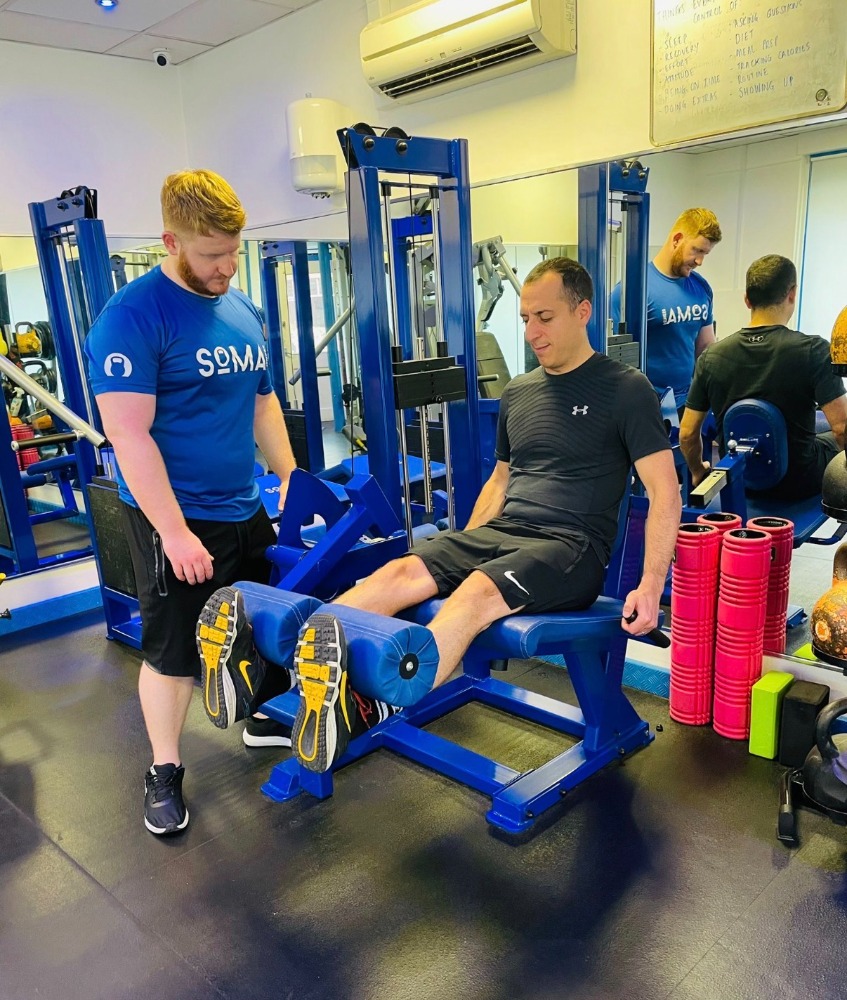
Knee pain is one of the most common reasons people become nervous about exercise.
Perhaps your knees hurt when you squat.
Maybe stairs have become uncomfortable.
Perhaps you’ve previously injured your knee playing sport.
Or you’ve been told you have osteoarthritis and you’re worried that lifting weights will make things worse.
The natural response is often:
“I’d better stop doing anything that loads my knees.”
But avoiding strength training altogether isn’t necessarily the answer.
Depending on what’s causing your symptoms, appropriately selected exercise can form an important part of improving your physical capacity.
At Soma Fitness, our private personal training studio on Hale Road in Altrincham works with men and women from Altrincham, Hale, Bowdon, Hale Barns, Timperley, Sale and surrounding areas.
Many of the people who come to us aren’t completely pain-free twenty-year-olds.
They’re real people with training histories, previous injuries and physical limitations that need to be considered.
So if you’re looking for a personal trainer in Altrincham but you’re concerned about your knees, here’s what you need to understand.
Knee Pain Doesn’t Tell Us the Cause
First, it’s important to understand that knee pain is a symptom, not a diagnosis.
Different people can experience knee pain for very different reasons.
That’s why it would be inappropriate for a personal trainer to simply tell you:
“Your knee hurts because X is weak.”
Without an appropriate assessment, we don’t necessarily know that.
And diagnosing medical conditions isn’t the role of a personal trainer.
If you have significant, unexplained or persistent knee symptoms, particularly following an injury, getting an appropriate clinical assessment may be necessary.
Once we understand what we’re working with, exercise can then be planned appropriately.
Does Knee Pain Mean You Should Stop Exercising?
Not automatically.
There are situations where temporary rest or medical assessment may be necessary.
But there’s a big difference between:
Modifying an activity because it currently aggravates your symptoms
and
Avoiding physical activity indefinitely because you’re frightened of your knee.
The second approach can create its own problems.
If physical activity decreases substantially, your overall strength and fitness can decline.
That can make returning to activity increasingly difficult.
The goal should therefore be to find what you can appropriately do, rather than focusing exclusively on what you currently can’t.
Strength Training Doesn’t Mean Heavy Barbell Squats
This misconception stops many people from training.
They hear “strength training” and imagine:
A heavy barbell.
Deep squats.
Maximum-effort deadlifts.
Someone screaming at them to perform another repetition.
That’s one version of resistance training.
It isn’t the only version.
Strength training simply means using resistance to appropriately challenge your muscles.
That resistance could come from:
- Machines
- Dumbbells
- Cables
- Bodyweight
- Resistance bands
- Barbells
The equipment isn’t the goal.
Creating an appropriate training stimulus is the goal.
You Don’t Have to Squat Deeply to Train Your Legs
Squats are excellent exercises.
But there’s no rule stating everybody needs to perform exactly the same squat.
If a particular squat variation or depth aggravates your knee, we can investigate alternatives.
That might involve changing:
Your range of motion.
Your stance.
The load.
The exercise variation.
The equipment.
The tempo.
Or temporarily selecting a completely different exercise.
The objective isn’t to win an argument about whether squats are good or bad.
It’s to find exercises you can perform productively.
Exercise Selection Should Fit the Individual
This is one of our fundamental coaching principles at Soma Fitness:
We don’t force the individual to fit the exercise.
We select exercises to fit the individual.
Imagine two clients.
One is 30, has trained for ten years and has never experienced knee problems.
The other is 58, hasn’t trained for fifteen years and has a history of knee surgery.
Their programs shouldn’t automatically look identical.
We need to consider the person standing in front of us.
What Muscles Support the Knee?
The knee doesn’t operate independently from the rest of the body.
Muscles surrounding and influencing the knee include the:
Quadriceps
Hamstrings
Calves
Gluteal muscles
And other muscles around the hip and lower limb contribute to movement and control.
A well-designed lower-body program therefore doesn’t necessarily consist of endless knee exercises.
We train the lower body as a system.
Strong Quadriceps Matter
The quadriceps are responsible for producing knee-extension force and play an important role in many everyday movements.
Think about:
Standing from a chair.
Walking upstairs.
Getting out of a car.
Squatting down.
Walking uphill.
These tasks require your legs to produce force.
Building stronger quadriceps can therefore be an important component of developing lower-body capacity.
How we train them depends on the individual.
Don’t Forget the Hamstrings and Glutes
The posterior muscles of the lower body matter too.
Depending on the person, exercises might include variations of:
Hip hinges.
Hamstring curls.
Bridges or hip-extension movements.
Split-stance exercises.
Machine-based movements.
Again, there isn’t one compulsory exercise.
We’re trying to develop a strong and capable lower body.
What About Knee Osteoarthritis?
This is an important subject because many people hear the word arthritis and assume they should stop loading the joint.
But having osteoarthritis doesn’t automatically mean resistance training is off limits.
Exercise is commonly used as part of the management of knee osteoarthritis, with the exact approach depending on the individual’s symptoms and circumstances.
That doesn’t mean we ignore pain.
It means the program should be appropriately managed.
If you’ve received a diagnosis, your personal trainer should work within the guidance you’ve been given by your relevant healthcare professionals.
Pain Doesn’t Always Equal Damage
This concept can be difficult to understand.
Pain is real.
But the relationship between pain and tissue damage isn’t always straightforward.
Someone can have changes visible on imaging and experience relatively little pain.
Another person can experience significant symptoms without imaging showing a simple explanation.
This is one reason we shouldn’t attempt to diagnose someone purely from how an exercise feels.
Our job as coaches is to appropriately manage training and recognise when somebody needs clinical assessment.
Should You Train Through Knee Pain?
This requires context.
There isn’t a universal rule that says:
“Any pain means immediately stop.”
Nor should the advice be:
“Just push through it.”
Both are oversimplifications.
We need to consider things such as:
The nature of the symptoms.
Their severity.
How they respond during exercise.
How they respond afterwards.
Whether they’re changing over time.
Whether there’s a known diagnosis.
And whether medical assessment is required.
This is where sensible coaching becomes important.
Your Starting Point Matters
Imagine you’ve not exercised for ten years.
Your first training session shouldn’t look like the session of someone who’s trained consistently for ten years.
Perhaps we begin with relatively simple movements.
We establish what you tolerate.
We develop technique.
We build confidence.
Then we progressively increase the challenge.
You don’t need to prove anything during week one.
Progressive Overload Still Matters
If we’re trying to make your legs stronger, eventually they need an appropriate reason to adapt.
That’s where progressive overload becomes important.
Over time, we might increase:
- Repetitions
- Resistance
- Range of motion
- Training volume
- Exercise difficulty
Progression doesn’t mean adding weight every session regardless of how you feel.
It means gradually increasing physical capacity over time.
Your Knee Doesn’t Need to Be Perfect Before You Get Stronger
This is where some people become stuck.
They tell themselves:
“I’ll start exercising when my knee feels completely normal.”
Six months pass.
Then twelve.
They’re less active.
Their legs become weaker.
Their confidence decreases.
Sometimes waiting for perfect circumstances means never beginning.
Where medically appropriate, we can often start with the physical activities and exercises you currently tolerate and build from there.
Strength Training After Knee Surgery
If you’ve previously had knee surgery, your training history becomes particularly important.
The type of surgery matters.
How long ago it occurred matters.
Your rehabilitation matters.
Your current symptoms matter.
Your medical guidance matters.
Someone who underwent surgery six weeks ago is in a very different situation from someone who had surgery ten years ago and has been medically cleared but never rebuilt their confidence.
That’s why blanket exercise recommendations aren’t particularly useful.
What About Knee Replacement?
People can return to meaningful physical activity after knee replacement, but this is an area where individual medical and rehabilitation guidance matters.
If you’ve had a joint replacement, we’d want to understand:
What procedure you had.
When you had it.
What rehabilitation you’ve completed.
What your healthcare team has advised.
What you’re currently capable of doing.
We can then determine whether personal training is appropriate and how it should be structured.
What If Your Knee Hurts When Walking?
Again, don’t simply guess why.
If walking is persistently painful or symptoms are worsening, seek appropriate assessment.
From a training perspective, we may still be able to work on other physical qualities depending on your circumstances.
Perhaps certain cardiovascular modalities are better tolerated.
Perhaps upper-body training is completely comfortable.
Perhaps certain lower-body movements work well.
Your entire fitness program doesn’t necessarily need to disappear because one activity currently causes symptoms.
What About Cardio With Knee Pain?
Running isn’t the only way to improve cardiovascular fitness.
Depending on your symptoms and individual circumstances, alternatives may include:
Cycling.
Cross trainer.
Rowing.
Walking.
Swimming.
Other lower-impact modalities.
The best cardiovascular exercise is one that provides an appropriate stimulus and that you can consistently perform.
Body Weight Can Matter
If someone is carrying significant excess body weight, weight management may sometimes form part of the wider strategy for managing lower-limb function and health.
But this needs to be approached sensibly.
We don’t want someone avoiding resistance training until they’ve lost weight.
Strength training and nutrition can work together.
The goal might be to:
Reduce excess body fat.
Maintain or develop muscle.
Increase strength.
Improve cardiovascular fitness.
Increase daily activity.
That’s a much more complete approach than simply chasing a lower number on the scales.
Knee Pain and Training After 40 or 50
As we get older, it’s common to accumulate some history.
Old football injuries.
Previous surgery.
Years spent sitting at a desk.
Periods where training disappeared completely.
This doesn’t mean you’re too old to become strong.
It means your program needs to respect your starting point.
For many people over 40 or 50, becoming physically stronger is one of the most valuable things they can do.
Don’t Let Fear Make You Fragile
If you’ve experienced pain, it’s understandable to become cautious.
But we don’t want caution to turn into complete avoidance of movement.
You may start thinking:
“My knees are bad.”
Then:
“I can’t squat.”
Then:
“I can’t train my legs.”
Eventually:
“Exercise isn’t for me.”
Those are very different statements.
Our goal is to identify what you can do safely and appropriately and gradually build from there.
What Does Injury-Aware Personal Training Look Like?
It shouldn’t look like random rehabilitation exercises forever.
Nor should it mean treating you as though you’re permanently injured.
Good coaching involves understanding:
Where you are now.
What your limitations are.
What your goal is.
What movements you tolerate.
And how we can gradually develop your capacity.
As you improve, the program should evolve.
Personal Training Doesn’t Replace Physiotherapy
This distinction is important.
A personal trainer isn’t there to diagnose a torn meniscus, ligament injury, arthritis or another medical condition.
If something needs diagnosis or clinical treatment, that’s where an appropriate healthcare professional comes in.
Personal training and physiotherapy can also complement one another.
A physiotherapist may help diagnose and manage an injury.
A personal trainer can subsequently help you develop broader strength, fitness and physical capacity within the appropriate boundaries.
Why Our Rehabilitation Qualifications Matter
At Soma Fitness, members of our coaching team have additional qualifications in injury rehabilitation.
This gives us additional knowledge when programming around previous injuries and physical limitations.
But perhaps equally importantly, it helps us recognise our professional boundaries.
Good coaching isn’t pretending to know everything.
Sometimes the right coaching decision is:
“I’d like you to have that assessed before we progress this.”
That’s part of looking after the client properly.
Why a Private Training Environment Can Help
If you’re nervous about returning to exercise after knee problems, walking into a crowded commercial gym can be intimidating.
At Soma Fitness, our facility is dedicated to coached personal training.
You’re not expected to arrive knowing what to do.
Your coach manages the session.
Exercises can be adapted.
Loads can be controlled.
Progress can be monitored.
For someone rebuilding confidence, that environment can make returning to training considerably less daunting.
How Often Should You Strength Train?
There isn’t a special number simply because you have a history of knee pain.
For many general-population clients, two to three resistance-training sessions per week can provide an excellent foundation.
But your frequency depends on:
Your current capacity.
Symptoms.
Training experience.
Other activity.
Recovery.
Goals.
And overall lifestyle.
More isn’t automatically better.
You Still Need to Train the Rest of Your Body
If you have knee pain, don’t let your entire program become about your knee.
You’re still a whole person.
You may need to train:
Your back.
Chest.
Shoulders.
Arms.
Core.
Hips.
Legs.
Cardiovascular system.
We want to develop overall physical capacity, not create an identity around one problematic joint.
What Should Progress Look Like?
Progress doesn’t only mean:
“My knee doesn’t hurt anymore.”
Depending on your situation, progress might mean:
You can perform an exercise you previously couldn’t.
You’re using more resistance.
You can walk further.
Stairs feel easier.
Your confidence has improved.
You’ve lost body fat.
Your legs are stronger.
You’re training consistently.
You’re participating in activities you’d previously avoided.
Those are meaningful outcomes.
Frequently Asked Questions About Training With Knee Pain
Can I go to the gym if I have knee pain?
Potentially, yes. Knee pain doesn’t automatically mean you must stop exercising, but the appropriate approach depends on the cause and severity of your symptoms.
Can strength training help bad knees?
Appropriately prescribed strengthening exercise can be useful in many situations involving knee problems. However, persistent or unexplained symptoms may require assessment before or alongside training.
Should I squat if my knees hurt?
That depends. Squats can be modified through exercise selection, range of motion and loading, or another exercise may temporarily be more appropriate.
Is cycling good if you have knee pain?
Cycling can be well tolerated by some people, but it isn’t universally appropriate for every knee problem. Individual response matters.
Can I train after knee surgery?
Often, yes, but the timing and type of training depend on the procedure, your rehabilitation progress and medical guidance.
Can I train after a knee replacement?
Many people return to exercise after joint replacement, but your training should reflect your surgeon’s or rehabilitation team’s recommendations and your individual recovery.
Is personal training suitable if I’m over 50 and have knee problems?
Potentially, yes. The program should simply account for your current ability, symptoms, medical history and goals.
Do I need to be pain-free before starting personal training?
Not necessarily, but unexplained, severe or worsening pain may need appropriate assessment first.
Looking for a Personal Trainer for Knee Pain in Altrincham or Hale?
If you’ve been avoiding exercise because you’re worried about your knees, the first step doesn’t need to be an intense workout.
It can simply be a conversation.
Soma Fitness is a private personal training studio based on Hale Road in Altrincham, serving men and women throughout:
Altrincham, Hale, Bowdon, Hale Barns, Timperley, Sale and surrounding South Manchester areas.
Your first step is a free consultation.
We’ll discuss:
Your goals.
Your training history.
Your knee history.
Previous injuries or surgery.
Your current activity.
Any relevant medical guidance.
And what you’d ultimately like to get back to doing.
If we believe something needs clinical assessment first, we’ll tell you.
If personal training is appropriate, we’ll explain how we would structure your training around your individual circumstances.
Having a history of knee problems doesn’t mean you need to give up on becoming strong.
Sometimes you simply need a better starting point.
Book your free consultation with the Soma Fitness coaching team and find out how we can help you return to structured strength training with confidence.
Recent Comments