
How to Stay Strong and Independent as You Get Older – Healthy Ageing in Hale & Altrincham
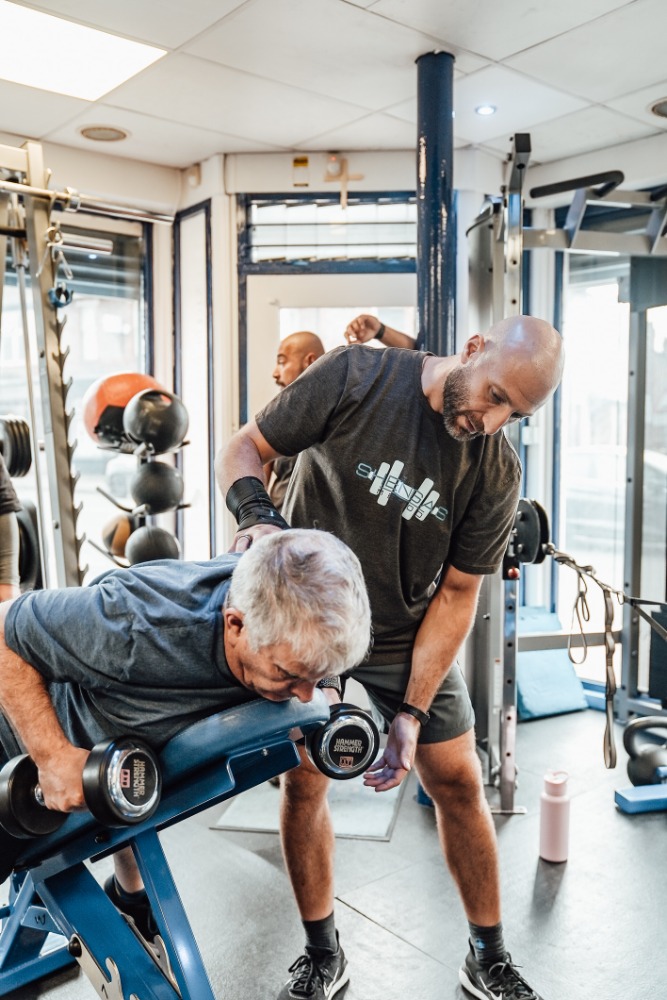
When people think about getting older, they often think primarily about lifespan.
How long am I going to live?
But there’s another question that’s arguably just as important:
What do I want to be physically capable of doing while I’m alive?
Can you climb stairs comfortably?
Carry your shopping?
Get yourself off the floor?
Travel?
Play with your grandchildren?
Continue gardening?
Play golf?
Walk around a city on holiday?
Move furniture?
Carry a suitcase?
Get in and out of a car easily?
Continue doing the things you enjoy without constantly needing help?
That’s where physical training becomes much bigger than aesthetics.
At Soma Fitness, our private personal training studio on Hale Road in Altrincham works with men and women throughout Altrincham, Hale, Bowdon, Hale Barns, Timperley, Sale and surrounding South Manchester.
A large part of good training as you get older isn’t simply about looking fitter.
It’s about maintaining and developing the physical capacity required to keep living your life on your own terms.
Healthy Ageing Isn’t About Avoiding Ageing
Nobody gets to stop the ageing process.
The goal shouldn’t be pretending you’re still 25.
But getting older doesn’t mean we should simply accept every decline in physical capacity as inevitable.
Ageing happens alongside changes in lifestyle.
People often:
Move less.
Stop playing sport.
Spend more time sitting.
Lose opportunities to lift heavy objects.
Reduce vigorous activity.
Gain weight.
Stop strength training.
Then decades pass.
Some of what people call:
“I’m just getting old.”
is actually a combination of ageing and reduced physical activity.
And while we can’t change our date of birth, we can influence how physically active and capable we remain.
Muscle Becomes Increasingly Valuable as You Age
Muscle isn’t just something bodybuilders care about.
Muscle allows you to produce force.
That means it helps you:
Stand up.
Walk.
Lift.
Carry.
Climb.
Balance.
Move objects.
Recover your position if you stumble.
Perform daily tasks.
As we get older, maintaining adequate muscle becomes increasingly relevant to physical function.
That’s one reason resistance training deserves such an important place in a long-term healthy ageing strategy.
Strength Is Your Physical Reserve
Think about strength as creating reserve capacity.
Imagine getting out of a chair requires a certain amount of force.
If that task only requires 20% of your maximum capacity, it feels relatively easy.
If the same task requires 80% of what you’re capable of producing, it becomes considerably more demanding.
This concept applies to everyday life.
Carrying shopping.
Climbing stairs.
Lifting luggage.
Getting off the floor.
The stronger you are relative to the task, the easier many everyday movements become.
That’s one reason we don’t simply want enough strength to survive today’s activities.
We want to build and maintain physical reserve for later life.
Don’t Wait Until You’re Weak to Start Strength Training
People often think strength training becomes relevant once they start feeling old.
I’d look at it differently.
The best time to build strength is before you desperately need it.
If you’re 45, 50 or 55 and physically capable now, that’s an opportunity.
Build muscle.
Build strength.
Build cardiovascular fitness.
Maintain movement.
Develop good habits.
Then you’re entering later decades from a stronger starting point.
We don’t want to begin thinking about physical independence only after it’s already been significantly reduced.
What Does “Functional Strength” Actually Mean?
The phrase gets used constantly.
Sometimes it becomes an excuse for making people perform bizarre exercises on unstable equipment.
Functional strength doesn’t need to be complicated.
If getting stronger helps you perform the functions that matter in your life, it’s functional.
A leg press can be functional.
A squat can be functional.
A row can be functional.
A deadlift variation can be functional.
A machine chest press can be functional.
A loaded carry can be functional.
The exercise doesn’t need to visually imitate daily life.
We train physical qualities in the gym so those qualities are available when we need them outside the gym.
Getting Out of a Chair Is a Strength Task
You might not think of standing up from a chair as exercise.
But mechanically, your muscles need to produce enough force to lift your body.
For a strong person, that’s trivial.
For somebody who has lost significant lower-body strength, it can become challenging.
That’s why lower-body strength is so important.
Exercises such as:
Squats.
Leg presses.
Split squats.
Step-ups.
Hip-extension exercises.
And other appropriate lower-body movements can help develop the musculature responsible for these fundamental actions.
Stairs Tell You a Lot About Physical Capacity
Stair climbing requires:
Lower-body strength.
Balance.
Coordination.
Cardiovascular capacity.
People often first notice declining fitness when stairs become increasingly uncomfortable.
That’s useful information.
If climbing one flight of stairs leaves you breathless or your legs feeling exhausted, there’s a physical capacity we can potentially improve.
We shouldn’t simply avoid stairs forever.
Where appropriate, we can train the qualities required to handle them better.
Getting Off the Floor Matters More Than People Think
Imagine you’re 75.
Could you comfortably lower yourself to the floor and stand back up?
This has practical importance.
Perhaps you’re:
Playing with grandchildren.
Gardening.
Picking something up.
Doing household work.
Or you’ve simply ended up on the floor unexpectedly.
Floor transfers require a mixture of:
Strength.
Mobility.
Coordination.
Balance.
Confidence.
This is another reason healthy ageing training should focus on maintaining broad physical capability rather than one isolated fitness metric.
Grip Strength Matters in Everyday Life
Think about how frequently you use your hands.
Carrying bags.
Opening jars.
Holding tools.
Carrying luggage.
Lifting objects.
Grip strength can be trained indirectly through:
Rows.
Deadlift variations.
Pulling exercises.
Loaded carries.
Dumbbells.
And other resistance exercises.
You don’t necessarily need a dedicated thirty-minute grip workout.
But maintaining the ability to hold and carry meaningful loads is useful.
Loaded Carries Can Be Excellent
Carrying exercises are beautifully simple.
Pick something up.
Carry it.
Depending on the variation, loaded carries can challenge:
Grip.
Trunk strength.
Posture.
Lower-body strength.
Work capacity.
They can also have a very obvious relationship with everyday activities.
Again, we don’t need to make training complicated.
Sometimes simple movements provide a lot of value.
Balance Becomes Increasingly Important
Balance isn’t just something you either have or don’t have.
It relies on multiple systems working together, including:
Strength.
Sensory information.
Vision.
Coordination.
The nervous system.
Maintaining physical activity and appropriate challenge can help preserve physical capabilities involved in balance.
That doesn’t mean everyone over 60 needs to stand on a wobble board.
Balance can also be challenged through normal strength exercises, single-leg movements, walking and other appropriately selected tasks.
Stronger Legs Can Help Create More Options
Think about stepping off a curb.
Catching yourself when you stumble.
Walking uphill.
Standing from a low chair.
Climbing stairs.
Many of these actions require lower-body force production.
Developing stronger legs doesn’t guarantee you’ll never fall.
Nothing does.
But strength gives the body greater physical capacity to work with.
That’s the theme throughout healthy ageing:
Create more capacity, not less.
Strength Training Isn’t Just for Young People
One of the most damaging misconceptions in fitness is that heavy resistance training is something people should gradually stop doing as they age.
The opposite argument is often stronger.
The ability to produce force becomes increasingly valuable as we age.
That doesn’t mean everyone needs to attempt maximal barbell lifts.
“Heavy” is relative.
For one client, challenging resistance might mean a 100kg deadlift.
For another, it might mean a 20kg goblet squat.
What matters is providing an appropriate stimulus for that individual.
You Can Still Get Stronger Later in Life
Age influences adaptation.
But it doesn’t remove it.
People can improve strength and muscle into later adulthood when training is appropriately structured.
So instead of thinking:
“I’m 60, I just need to maintain.”
the question can still be:
“What can I improve?”
Could you become stronger over the next year?
Improve your cardiovascular fitness?
Lose unnecessary body fat?
Learn resistance training?
Improve your balance?
Walk further?
Very often, the answer is yes.
Strength Training Over 60 Doesn’t Need to Be Gentle
It needs to be appropriate.
Those aren’t the same thing.
We don’t need to treat every older adult as fragile.
Somebody who has trained consistently for thirty years may tolerate substantially more than somebody aged 35 who has never exercised.
Chronological age is only one piece of information.
Training should also consider:
Experience.
Health.
Injury history.
Current strength.
Mobility.
Goals.
Recovery.
Confidence.
And medical considerations where relevant.
Machines Can Be Excellent
There sometimes seems to be a hierarchy in fitness:
Barbells are advanced.
Dumbbells are good.
Machines are somehow inferior.
That’s nonsense.
Machines can be extremely useful.
They provide stability.
They’re easy to load progressively.
They can allow muscles to be trained hard.
They’re often simple to learn.
For many clients, a combination of machines and free weights works extremely well.
The tool matters less than how appropriately we use it.
You Don’t Have to Deadlift From the Floor
Another misconception is that functional ageing requires everyone to perform the classic barbell squat, bench press and conventional deadlift.
Those exercises can be excellent.
They’re not compulsory.
Someone might use:
A leg press instead of a squat.
A dumbbell Romanian deadlift instead of pulling from the floor.
A machine chest press instead of a barbell bench press.
The objective is developing physical qualities.
We’re not testing whether you’re worthy of joining a powerlifting club.
Cardiovascular Fitness Matters Just as Much
Healthy ageing isn’t only about strength.
Your cardiovascular system matters enormously.
We want to maintain the capacity to:
Walk.
Climb.
Travel.
Move for extended periods.
Complete daily activity without excessive fatigue.
That means resistance training should usually sit alongside appropriate cardiovascular activity.
Depending on the person, that might include:
Walking.
Cycling.
Swimming.
Running.
Cross trainer.
Rowing.
Sport.
Or another activity you enjoy.
Walking Is Valuable – But It Doesn’t Replace Strength Training
Walking is one of the best habits most people can develop.
It’s accessible.
It’s practical.
It can be social.
It increases daily physical activity.
But walking and resistance training provide different stimuli.
Walking doesn’t challenge your muscles in the same way as progressive resistance training.
Likewise, lifting weights doesn’t completely replace cardiovascular exercise.
A comprehensive healthy ageing strategy usually benefits from both.
Don’t Underestimate Your Work Capacity
Sometimes people describe themselves as:
“Unfit.”
What they often mean is that their ability to sustain physical activity has declined.
Perhaps:
Gardening feels exhausting.
A long day sightseeing wipes them out.
A few flights of stairs feel difficult.
Building general cardiovascular fitness and muscular capacity can make everyday activity feel more manageable.
You aren’t only training for a gym performance.
You’re training so life demands a smaller percentage of what you’re physically capable of doing.
Power Matters as You Age Too
Strength is your ability to produce force.
Power involves producing force quickly.
Why might that matter?
Think about catching yourself after a trip.
Moving quickly up a step.
Reacting to something unexpectedly.
Life doesn’t always happen slowly.
That doesn’t mean every older adult needs aggressive jumping programmes.
But where appropriate, training the ability to move with intent and produce force relatively quickly can be useful.
Exercise selection should reflect the individual.
You Don’t Need to Train Like an Athlete
Healthy ageing doesn’t require:
Olympic lifting.
Sprinting.
Complex plyometrics.
Advanced gymnastics.
Unless you enjoy those things and they’re appropriate for you.
For most people, the fundamentals are more important.
Get stronger.
Maintain muscle.
Train your cardiovascular system.
Move regularly.
Eat appropriately.
Sleep.
Maintain a healthy body composition.
Keep doing those things.
Muscle Is Expensive to Lose and Valuable to Keep
People often spend decades primarily worrying about body weight.
“How much do I weigh?”
That’s understandable.
But as we get older, body composition becomes increasingly important.
Losing weight isn’t always automatically positive if a large amount of the loss comes from lean tissue.
During fat loss, resistance training and sufficient protein become particularly relevant because we want to preserve as much muscle as reasonably possible.
The goal isn’t simply becoming lighter.
Ideally, we want to improve health and body composition while maintaining physical capability.
Protein Becomes an Important Part of the Picture
Protein provides amino acids used throughout the body, including processes involved in maintaining and building muscle.
As we age, paying attention to protein intake becomes particularly worthwhile.
Useful foods might include:
Chicken.
Fish.
Eggs.
Lean meat.
Greek yoghurt.
Cottage cheese.
Milk.
Soy.
Tofu.
Beans and pulses.
Protein supplements where convenient.
You don’t need to eat like a competitive bodybuilder.
But chronically under-consuming protein isn’t ideal if maintaining muscle is a priority.
Don’t Crash Diet Into Older Age
Aggressive dieting can be particularly unhelpful if it results in:
Poor training.
Low energy.
Difficulty recovering.
And unnecessary loss of lean tissue.
If fat loss is appropriate, a moderate and sustainable approach is generally more sensible.
We can create an energy deficit while still prioritising:
Strength training.
Protein.
Recovery.
Physical activity.
And gradual progress.
What About Body Weight?
Excess body mass can make certain activities more physically demanding.
For example:
Walking uphill.
Climbing stairs.
Getting up from the floor.
Running.
Carrying your own body.
So for someone carrying substantial excess body fat, reducing weight may improve many aspects of physical function.
But we don’t need to choose between:
Lose weight
and
get stronger.
Those goals can often be worked on together.
Don’t Neglect Bone Health
Bone is living tissue.
Mechanical loading matters.
Resistance training can provide loading that helps support bone health alongside other lifestyle factors.
This becomes particularly important for women as they move through menopause and later life.
Again, exercise isn’t a cure for osteoporosis and doesn’t replace medical care.
But regular physical activity and appropriate resistance training can form part of a broader bone-health strategy.
Women Shouldn’t Be Afraid of Lifting Weights
Many women entering their 50s and 60s grew up during an era where exercise advice often revolved around:
Aerobics.
Light weights.
High repetitions.
And avoiding heavy resistance.
That view is outdated.
Women can benefit enormously from appropriately challenging resistance training.
You don’t need pink dumbbells.
You need a programme appropriate to your current capacity and goals.
Men Need to Take Ageing Seriously Too
Men can make the opposite mistake.
They remember what they lifted at 25.
They return to the gym at 50.
Then immediately try to prove they can still do it.
Your previous ability doesn’t determine today’s appropriate loading.
We want to build forward from your current capacity.
Not continuously compete against a younger version of yourself.
Training Should Support Your Hobbies
What do you want to continue doing?
Golf?
Skiing?
Hiking?
Cycling?
Gardening?
Travel?
Playing with grandchildren?
Your gym programme can support the physical qualities required for those activities.
That’s a much more meaningful way to think about exercise.
Instead of:
“I have to go to the gym.”
Think:
“I’m training so I can continue doing the things I enjoy.”
Healthy Ageing Is About Keeping Options Open
This may be the central idea of the entire article.
Physical fitness gives you options.
You can:
Choose the stairs.
Walk instead of taking transport.
Carry your own luggage.
Join friends on a hike.
Play sport.
Travel somewhere demanding.
Help with jobs around the house.
Get on the floor.
Get back up.
As physical capacity decreases, the number of available options can shrink.
Training is one way of fighting to keep those options open for as long as possible.
What If You’ve Never Exercised Before?
You don’t need twenty years of training history.
You start from where you are.
A beginner programme may initially involve:
Simple resistance exercises.
Walking.
Basic cardiovascular work.
Learning technique.
Building confidence.
Gradually increasing workload.
The first objective isn’t proving how hard you can train.
It’s establishing something you can repeatedly do.
What If You Haven’t Exercised for 20 Years?
The same principle applies.
Don’t try to replicate your old routine immediately.
Your previous training may help you relearn certain movements.
But your current programme should reflect:
Your current fitness.
Current body weight.
Current health.
Current schedule.
Current ability.
Build from today.
Not 1998.
Start With Consistency Before Chasing Perfection
The most sophisticated programme on earth achieves very little if you don’t follow it.
For somebody getting back into exercise, the first major win may simply be:
Two strength sessions every week.
Regular walking.
One or two cardiovascular sessions.
Better nutrition.
Doing that consistently for several months can completely change your starting point.
Then we progress.
How Often Should You Strength Train for Healthy Ageing?
There isn’t one perfect frequency for everyone.
But for many adults, two to three resistance-training sessions per week can provide an excellent framework.
Someone might initially begin with two.
Another person may enjoy three or four.
It depends on:
Training history.
Goals.
Programme structure.
Recovery.
Other activity.
And lifestyle.
The goal is enough training to create adaptation while still being able to recover and maintain consistency.
Full-Body Training Can Work Very Well
For someone training twice per week, full-body sessions can be extremely practical.
A session might include:
A lower-body movement.
A hip-dominant exercise.
An upper-body push.
An upper-body pull.
Accessory work.
Core training.
Perhaps some conditioning.
This allows us to train major muscle groups repeatedly without needing to live in the gym.
Progress Matters at Every Age
You still need progressive overload.
That may involve gradually increasing:
Resistance.
Repetitions.
Sets.
Movement quality.
Range of motion.
Exercise complexity.
Work capacity.
The goal is not random exercise.
The goal is adaptation.
And adaptation requires an appropriate progressive stimulus.
Recovery Matters Too
Training is only one part of the process.
Your ability to recover can be influenced by:
Sleep.
Nutrition.
Stress.
Training volume.
Medical conditions.
Medication.
Lifestyle.
Other physical activity.
Good programming considers the whole person.
We don’t simply add more exercise indefinitely.
Sleep Is Part of Healthy Ageing
Sleep supports many aspects of health and recovery.
If you’re trying to train regularly while consistently sleeping poorly, training can feel considerably harder.
You may also find:
Hunger changes.
Energy drops.
Motivation decreases.
Recovery suffers.
We don’t need to make sleep another source of anxiety.
But treating it as an important part of your health strategy makes sense.
Social Connection Matters Too
There’s another underrated benefit of exercise.
It gives people structure.
Routine.
Interaction.
A sense of progress.
Something to work towards.
For some clients, personal training becomes an important part of their week not only physically, but psychologically and socially.
Healthy ageing isn’t just about one muscle or one metric.
It’s about maintaining a life that feels active and meaningful.
Don’t Train From Fear
You shouldn’t spend the next thirty years exercising because you’re terrified of ageing.
Train because physical capability is valuable.
Train because strength feels good.
Train because walking up stairs without thinking about it is useful.
Train because travelling is easier when you’re fit.
Train because being able to carry your own shopping matters.
Train because you enjoy golf.
Or hiking.
Or playing with your grandchildren.
A positive reason to train is often much more sustainable than fear.
Previous Injuries Don’t Automatically Mean Stop
Perhaps you’ve had:
Back pain.
A knee injury.
Shoulder surgery.
Hip problems.
An old sporting injury.
That history needs to be considered.
But it doesn’t automatically mean exercise should disappear from your life.
Training can often be adjusted around the individual.
At Soma Fitness, members of our coaching team have additional qualifications in injury rehabilitation, helping us appropriately modify exercise around previous problems where suitable.
If symptoms require medical or physiotherapy assessment, we’ll recommend that rather than pretending personal training replaces healthcare.
Medication and Medical Conditions Need Context
If you’ve been diagnosed with a medical condition or take medication that may influence your response to exercise, that should be discussed before beginning a programme.
In some circumstances, medical clearance may be appropriate.
That’s not about creating fear around exercise.
It’s about making good professional decisions.
What Should You Be Able to Do at 70?
There’s no universal checklist.
Everyone’s circumstances are different.
But it’s worth asking yourself:
What would I like my physical life to look like?
Would you like to:
Travel independently?
Walk several kilometres?
Carry your suitcase?
Use stairs?
Continue playing golf?
Go hiking?
Play on the floor with grandchildren?
Maintain your home?
Drive comfortably?
Then your training today can start supporting the person you want to be later.
The Goal Isn’t Merely a Longer Life
It’s a life with capacity.
Years in which you’re able to:
Move.
Participate.
Travel.
Play.
Work if you choose.
Maintain hobbies.
Spend time with family.
And remain as independent as reasonably possible.
Training can’t guarantee any of those outcomes.
There are too many factors involved.
But developing and maintaining physical fitness gives you more capacity to work with.
And that is worth investing in.
Why Personal Training Can Help With Healthy Ageing
The principles aren’t complicated.
But implementing them consistently can be.
Questions arise:
Which exercises?
How much weight?
How many repetitions?
How often?
How hard?
What about my knee?
What about my blood pressure?
Should I do cardio too?
How do I progress?
Am I doing enough?
Am I doing too much?
Personal training helps organise those decisions into a structured process.
A Good Programme Should Change as You Change
Your programme at 50 doesn’t have to be your programme at 55.
You may become:
Stronger.
Fitter.
More experienced.
More confident.
Your goals may change.
Perhaps you begin simply wanting to improve health.
Then you discover you enjoy strength training.
Or decide to prepare for a hiking holiday.
Or return to golf.
Training should evolve with you.
Frequently Asked Questions About Healthy Ageing and Strength Training
Is strength training safe as you get older?
For many adults, appropriately designed resistance training is an excellent form of exercise. The programme should reflect your current ability, health, experience and any relevant medical considerations.
Can you build muscle after 60?
Yes. Older adults retain the ability to adapt to resistance training and can improve muscle and strength with appropriate training, nutrition and recovery.
How often should older adults lift weights?
Frequency depends on the individual, but two or more appropriately structured resistance sessions per week can be a practical approach for many people.
Is walking enough to stay strong as you age?
Walking is valuable physical activity but doesn’t provide the same resistance-training stimulus required to maximise muscular strength. Ideally, the two can complement one another.
Should people over 60 lift heavy weights?
“Heavy” is relative. Appropriately challenging resistance can be useful at older ages, but loads should reflect the individual’s experience, capacity and health.
Is strength training useful for balance?
Strength is one component involved in balance and physical function. Balance itself is multifactorial, so programmes may also include movement and balance challenges where appropriate.
Can personal training help if I have arthritis or previous injuries?
Training can often be modified, but the appropriate approach depends on the individual. Existing diagnoses, symptoms and clinical advice should be taken into account.
Am I too old to start exercising?
Age alone doesn’t make someone too old to become more physically active. The starting point and programme simply need to be appropriate for the individual.
Looking for Healthy Ageing Personal Training in Altrincham or Hale?
If you’re in your 40s, 50s, 60s or beyond, personal training doesn’t need to be about chasing the body you had at 25.
It can be about something far more valuable:
Building the physical capacity you want at 70.
At Soma Fitness, we provide private one-to-one personal training from our studio on Hale Road in Altrincham.
We work with men and women throughout:
Altrincham, Hale, Bowdon, Hale Barns, Timperley, Sale and surrounding South Manchester.
Our coaching can help you work towards improvements in:
Strength.
Muscle.
Fitness.
Body composition.
Confidence.
Physical function.
And sporting or recreational performance.
Your first step is a free consultation with one of our coaching team.
We’ll discuss:
Your goals.
Training experience.
Current activity.
Health and injury history.
Lifestyle.
Schedule.
And most importantly:
What do you want to remain physically capable of doing as you get older?
Then we can start building towards it.
Don’t wait until strength becomes something you wish you still had.
Build it while you can. Maintain it for as long as you can.
Contact Soma Fitness to arrange your free consultation.
Recent Comments