
Strength & Conditioning in Altrincham – Personal Training for Recreational Athletes
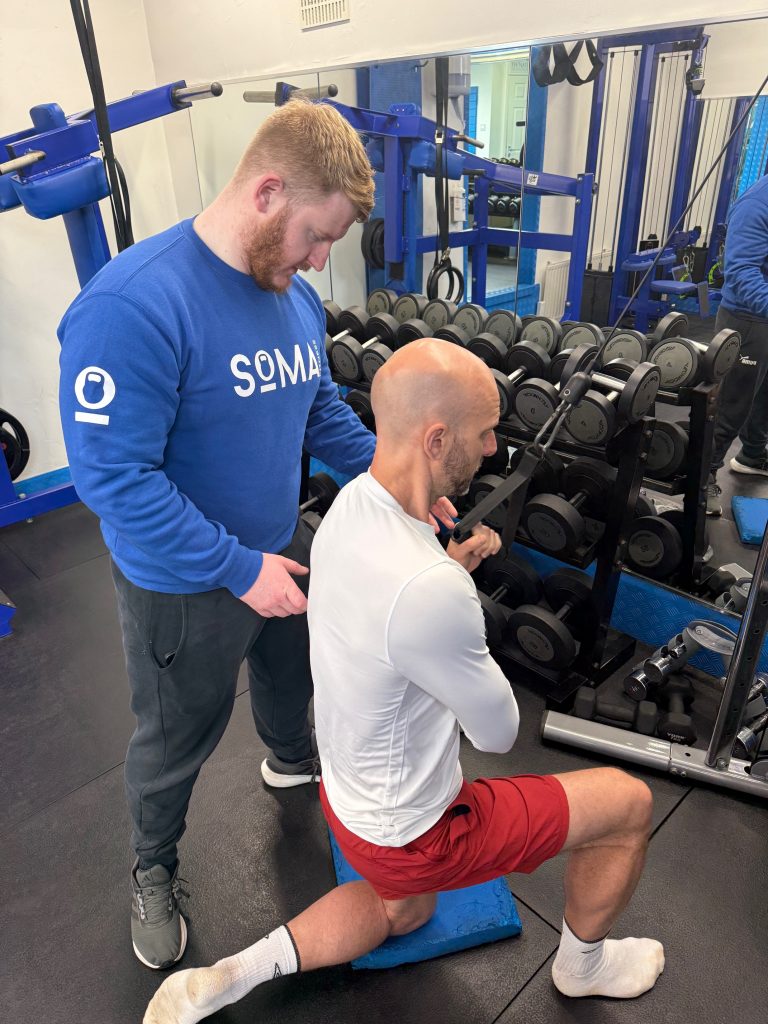
You don’t have to be a professional athlete to benefit from strength and conditioning. Whether you enjoy running, playing padel, golf, tennis, football or another recreational sport, developing your physical fitness outside your chosen activity can be a valuable part of your overall training.
Many recreational athletes spend considerable time practising their sport but give relatively little attention to their general strength, muscular development, power and physical conditioning. Others attend the gym regularly but follow programmes that have very little connection to what they’re trying to achieve outside it.
At Soma Fitness, our private personal training studio on Hale Road in Altrincham, we work with men and women who want their training to serve a purpose. For some, that means losing body fat or building muscle. For others, it means becoming physically stronger, fitter and better prepared for the sports and activities they enjoy.
Our approach to strength and conditioning is built around the individual, their sporting demands, training history and lifestyle.
What Is Strength and Conditioning?
Strength and conditioning is the structured development of physical qualities that contribute to exercise and sporting performance. Depending on the individual, this may involve muscular strength, power, speed, cardiovascular fitness, movement competency and the ability to tolerate training demands.
Unlike a general workout designed simply to burn calories or create fatigue, strength and conditioning starts with a specific question: What physical qualities does this person need to develop, and how should we train them?
For a recreational runner, that might mean developing lower-body strength while managing the demands of weekly mileage. For a padel player, the emphasis might include strength, power and the ability to accelerate and decelerate. For a golfer, we might consider general strength, rotational power and physical preparation.
The exercises will vary, but the principle remains the same: training should have a clear purpose.
You Don’t Need to Be an Elite Athlete
One of the biggest misconceptions surrounding strength and conditioning is that it’s exclusively for professional athletes.
In reality, recreational athletes can benefit from structured physical preparation too. You might be a 45-year-old business owner who plays padel twice per week, a 52-year-old preparing for a half marathon, or someone who enjoys golf and wants to develop greater physical strength.
You may have no interest in competing professionally. Your goal might simply be to feel stronger, improve your general fitness and continue enjoying your sport as you get older.
These are all valid reasons to follow a strength and conditioning programme.
At Soma Fitness, we don’t expect clients to arrive with an athletic background. We establish their current ability and build their programme accordingly.
Why Playing Your Sport Isn’t Always Enough
Sport provides a training stimulus, but the stimulus is specific to the demands of that activity. Running develops qualities associated with running, while golf and padel involve different movement patterns, skills and physical demands.
However, participating in a sport doesn’t necessarily develop every physical quality that could benefit the individual.
For example, a runner may have excellent cardiovascular fitness but relatively little experience with progressive resistance training. A golfer may practise regularly without following any structured strength programme. A recreational footballer may play once per week but perform very little physical training between matches.
Strength and conditioning allows us to develop selected physical qualities outside the sport itself.
The gym supports your sporting activity; it doesn’t replace the need to practise your sport.
Strength Is the Foundation
Muscular strength is an important physical quality because it influences your ability to produce force.
Developing strength may contribute to other qualities, including power and the ability to perform demanding physical tasks. It also provides a foundation for maintaining muscle mass and physical function as we age.
At Soma Fitness, strength training may include squats, leg presses, split squats, deadlift variations, rows, presses, pulldowns and other resistance exercises.
We don’t insist that every client performs the same movements. Exercise selection depends on training experience, individual anatomy, current ability, goals and the demands of their sport.
A recreational runner may benefit from a different distribution of exercises and training volume than someone whose main activity is golf.
The objective is to build strength in a way that complements the individual’s wider training.
Developing Power for Sport
Strength and power are related but distinct physical qualities. Strength describes the ability to produce force, while power involves producing force quickly.
Many sports require rapid force production. A golfer accelerating through a swing, a padel player changing direction or a tennis player moving towards a ball all perform movements involving relatively short periods of force application.
Depending on the individual, we may incorporate exercises such as medicine-ball throws, jumps and other ballistic movements.
These exercises are generally performed when the client is relatively fresh, with sufficient recovery between efforts to maintain movement quality.
Power training doesn’t need to be complicated. It needs to be appropriate, progressive and relevant to the objective.
Strength and Conditioning for Runners in Altrincham
Running is one of the recreational activities we can support through structured resistance training.
Many runners dedicate considerable time to improving their cardiovascular fitness but have limited experience developing muscular strength.
Resistance training can complement running by developing lower-body strength, force-producing capacity and other physical qualities. Research also suggests that appropriately programmed strength training can improve running economy in some runners.
However, the gym programme must account for the demands of running itself.
Someone preparing for a marathon may already be performing several running sessions each week, including long runs, intervals and easier aerobic work. Adding excessive resistance-training volume could create unnecessary fatigue and interfere with important running sessions.
At Soma Fitness, we can organise strength training around a runner’s existing schedule, taking account of mileage, race preparation and recovery.
For more detail, read our guides to strength training for runners in Altrincham and personal training for runners near Hale.
Strength and Conditioning for Padel Players
Padel is another activity where general physical preparation can be valuable.
Although played on a relatively small court, padel involves repeated acceleration, deceleration, lateral movement, reaching and rotational actions.
A strength and conditioning programme may therefore include lower-body strength, unilateral exercises, trunk training, power development and appropriate conditioning.
For example, split squats and step-ups can develop single-leg strength, while medicine-ball exercises may be used to develop rotational power. Other exercises can target the upper body and general muscular capacity.
However, it’s important to distinguish physical preparation from technical coaching. Strength training doesn’t automatically improve shot selection, court positioning or racket technique.
Those qualities are developed through padel practice and appropriate technical coaching.
Our role is to help develop physical qualities that complement the sport.
We’ve also published a dedicated guide to personal training and strength and conditioning for padel players in Hale and Altrincham.
Strength Training for Golfers
Golf is primarily a skill-based sport, but physical qualities can contribute to a player’s overall capacity.
Strength, power, mobility and coordination may all be relevant, depending on the golfer.
A strength programme might include lower-body exercises, upper-body pushing and pulling, trunk training and rotational power exercises.
That doesn’t mean every gym movement needs to imitate a golf swing. In fact, attempting to recreate the swing under resistance isn’t necessarily the most effective way to develop general strength or power.
The golf course and practice range are where you develop your technical skills. The gym provides an opportunity to develop physical qualities that can complement those skills.
For golfers interested in this approach, we have a separate article covering personal training for golfers in Hale and Altrincham.
Strength and Conditioning for Tennis, Football and Other Sports
The same principles apply to a wide range of recreational sports.
Tennis involves repeated movement, acceleration, braking and rotational actions. Football includes running, sprinting, changes of direction and physical contact. Martial arts and boxing place their own demands on strength, power, conditioning and recovery.
These sports aren’t identical, so their training programmes shouldn’t automatically be identical either.
A good strength and conditioning programme considers the activities you’re already performing and identifies which physical qualities may benefit from additional development.
At Soma Fitness, we can build resistance training around recreational sports participation while accounting for your experience, schedule and goals.
Managing Training Load and Recovery
One of the most important considerations for recreational athletes is managing the total amount of training they’re performing.
Imagine someone who plays padel three times per week, runs twice and then decides to add four demanding gym sessions.
Individually, each activity may be beneficial. Collectively, however, the overall workload may exceed what that person can currently recover from.
Training adaptation depends on the relationship between the stimulus and the body’s capacity to recover.
This is why we ask clients about their sport, work commitments, sleep, previous training and general activity before building their programme.
The objective isn’t to accumulate as much exercise as possible. It’s to perform enough appropriate training to support progress.
How Many Strength Sessions Does a Recreational Athlete Need?
There isn’t one ideal number of weekly sessions for every recreational athlete.
For many people, two structured resistance-training sessions per week can provide a useful foundation, particularly when combined with regular sport.
Others may benefit from three or more sessions, depending on their goals, experience and overall training demands.
A recreational runner completing five running sessions each week may need a different approach from a golfer who plays once per week.
At Soma Fitness, we look at the complete training schedule rather than prescribing the same weekly structure to everyone.
Strength and Conditioning After 40
A significant proportion of recreational athletes are adults in their 40s, 50s and beyond.
You may have played sport throughout your life, or perhaps you’ve recently started something new. Either way, resistance training can remain valuable as you get older.
Ageing can influence muscle mass, strength, recovery and other physical characteristics. However, adults can continue responding positively to appropriately programmed resistance training later in life.
You don’t need to stop challenging yourself because you’ve turned 40 or 50.
You do need to account for your current physical capacity, health, training history and recovery.
For some people, that means starting with fundamental strength exercises. For others, it may involve more advanced strength and power training.
The programme should reflect the individual rather than assumptions about their age.
What If You Have Previous Injuries?
Many recreational athletes have experienced injuries at some point.
Perhaps you’ve had a previous knee problem, shoulder injury, ankle sprain or period of lower-back pain.
A history of injury doesn’t automatically mean resistance training is inappropriate. However, it may influence exercise selection, training volume and progression.
Where appropriate, we can modify exercises, adjust loading and work within relevant clinical recommendations.
Members of the Soma Fitness coaching team hold additional qualifications relating to injury rehabilitation and corrective exercise. Nevertheless, personal training does not replace medical diagnosis or physiotherapy, and persistent or concerning symptoms should be assessed by an appropriate healthcare professional.
Strength and conditioning can help develop physical capacity, but no programme can guarantee injury prevention.
You Don’t Need Complicated Exercises
One of the problems with sports-performance training on social media is the assumption that exercises need to look unusual to be effective.
You might see people performing complicated combinations of balance drills, resistance bands, medicine balls and sport-specific movements.
Some of these exercises may have a purpose, but complexity doesn’t automatically make training more effective.
For many recreational athletes, the fundamentals remain extremely valuable: progressive resistance training, appropriate power development, cardiovascular fitness, consistent practice and recovery.
We want exercises that can be coached effectively, progressed over time and justified within the programme.
Personal Training for Busy Recreational Athletes
Many people who play sport recreationally also have demanding professional and family lives.
You might run a business, work long hours, travel regularly or have young children. Your available training time may be limited, even though you’re motivated to improve your fitness.
This is where individual coaching can be particularly useful.
Rather than spending your limited time deciding which exercises to perform, you arrive for a structured session designed around your goals.
Your coach manages exercise selection, technique, progression and the relationship between your gym training and sporting activity.
The aim is to make your available training time productive without expecting you to organise your entire life around the gym.
Private Strength and Conditioning at Soma Fitness
Soma Fitness is a private personal training studio on Hale Road in Altrincham, specialising in one-to-one coaching.
We aren’t an open-membership gym where clients simply attend and train independently.
Your session is organised around your individual programme, with your coach providing guidance throughout.
This environment can be particularly useful for people who are new to resistance training, prefer a quieter facility or want their training managed professionally.
Our coaching is suitable for men and women with different levels of experience, from complete beginners to recreational athletes who already train regularly.
Why Our Sessions Are 60 Minutes
All one-to-one personal training sessions at Soma Fitness are 60 minutes.
This provides time for appropriate preparation, meaningful strength work, rest periods, technical coaching and discussion.
For recreational athletes, the session may also include selected power exercises or other physical preparation depending on the programme.
We don’t believe every minute needs to involve continuous exercise. If you’re performing demanding strength or power work, appropriate recovery between sets is part of maintaining training quality.
The goal is a productive training session rather than simply finishing as exhausted as possible.
What Does Strength and Conditioning at Soma Fitness Involve?
Our coaching process begins with understanding your goals and existing activity.
1. Free consultation. We discuss your sport, current training, experience, lifestyle, previous injuries and what you want to achieve.
2. Establishing your starting point. We consider your current strength-training experience, movement competency and physical capacity.
3. Individual programme design. We select appropriate exercises and organise training around your sport and available schedule.
4. One-to-one coaching. Your coach teaches and supervises the exercises, helping you develop effective execution and appropriate training effort.
5. Progressive training. We track performance and adjust load, repetitions, volume and other variables as appropriate.
6. Recovery and workload management. Your sport, running, work and other physical activities are considered when reviewing the programme.
7. Progress reviews. We assess how your training is developing and make changes when necessary.
There isn’t a single strength and conditioning programme that every recreational athlete should follow. The value lies in making the programme appropriate for the person.
Strength and Conditioning in Hale, Altrincham and South Manchester
Our studio is based on Hale Road in Altrincham, conveniently located for clients from Hale, Bowdon, Hale Barns, Timperley, Sale and surrounding South Manchester.
Soma Fitness has been coaching clients locally since 2007, helping men and women improve strength, fitness, body composition and physical capability through structured personal training.
Whether you’re preparing for a marathon, playing padel socially, enjoying regular golf or participating in another sport, we can discuss how a strength and conditioning programme might complement your existing activity.
Frequently Asked Questions
What is the difference between personal training and strength and conditioning?
Personal training is a broad coaching service that may address strength, fitness, body composition and other goals. Strength and conditioning places particular emphasis on developing physical qualities relevant to exercise or sporting performance. At Soma Fitness, these approaches can overlap within an individualised one-to-one programme.
Do I need to be an athlete to benefit from strength and conditioning?
No. Recreational athletes and active adults can benefit from structured physical preparation. Your programme should reflect your experience, goals and current ability.
Can strength training help improve my sporting performance?
Strength training can develop physical qualities that contribute to sporting performance. However, improvements in gym performance don’t automatically translate into better sporting results. Technical practice, skill and sport-specific training remain important.
How often should I strength train if I already play sport?
It depends on your sporting schedule, training experience, goals and recovery. Many recreational athletes can benefit from one to three well-structured resistance-training sessions per week.
Can I combine running and strength training?
Yes. Strength training can be organised around running mileage, long runs, harder sessions and race preparation.
Do you provide strength training for padel players?
Yes. We can develop strength and conditioning programmes that account for the physical demands of padel, while recognising that technical padel coaching is a separate service.
Do you work with people over 40 or 50?
Yes. We coach adults across a range of ages and training backgrounds. Programmes are tailored to the individual’s current ability and goals.
Can strength and conditioning prevent sports injuries?
No training programme can guarantee injury prevention. Strength and conditioning can develop physical capacity, but injury risk is influenced by many factors.
What if I’ve never trained in a gym before?
That’s completely fine. We can teach you the exercises, equipment and training principles from the beginning.
How long are your sessions?
All Soma Fitness one-to-one personal training sessions are 60 minutes.
Where is Soma Fitness located?
We’re based on Hale Road in Altrincham, serving clients from Hale, Bowdon, Timperley, Sale and surrounding South Manchester.
Train for More Than the Gym
Your gym training doesn’t need to be an entirely separate activity from the things you enjoy.
If you run, play padel, golf, tennis, football or participate in another sport, your strength and conditioning programme can be designed with those activities in mind.
At Soma Fitness, we provide private one-to-one coaching that considers your sporting demands, current fitness, experience and lifestyle.
You don’t need to be a professional athlete. You don’t need to train every day. And you don’t need a complicated programme filled with unusual exercises.
You need a structured approach that develops the physical qualities relevant to your goals.
Looking for strength and conditioning in Altrincham?
Book a free consultation at Soma Fitness. Visit our private studio on Hale Road, meet one of our coaching team and discuss how we can build your training around the sports and activities you enjoy.
Train with purpose. Build physical capacity. Keep doing what you enjoy.
Recent Comments