
Personal Training for Men Over 50 in Altrincham – Get Stronger, Fitter and Back in Shape
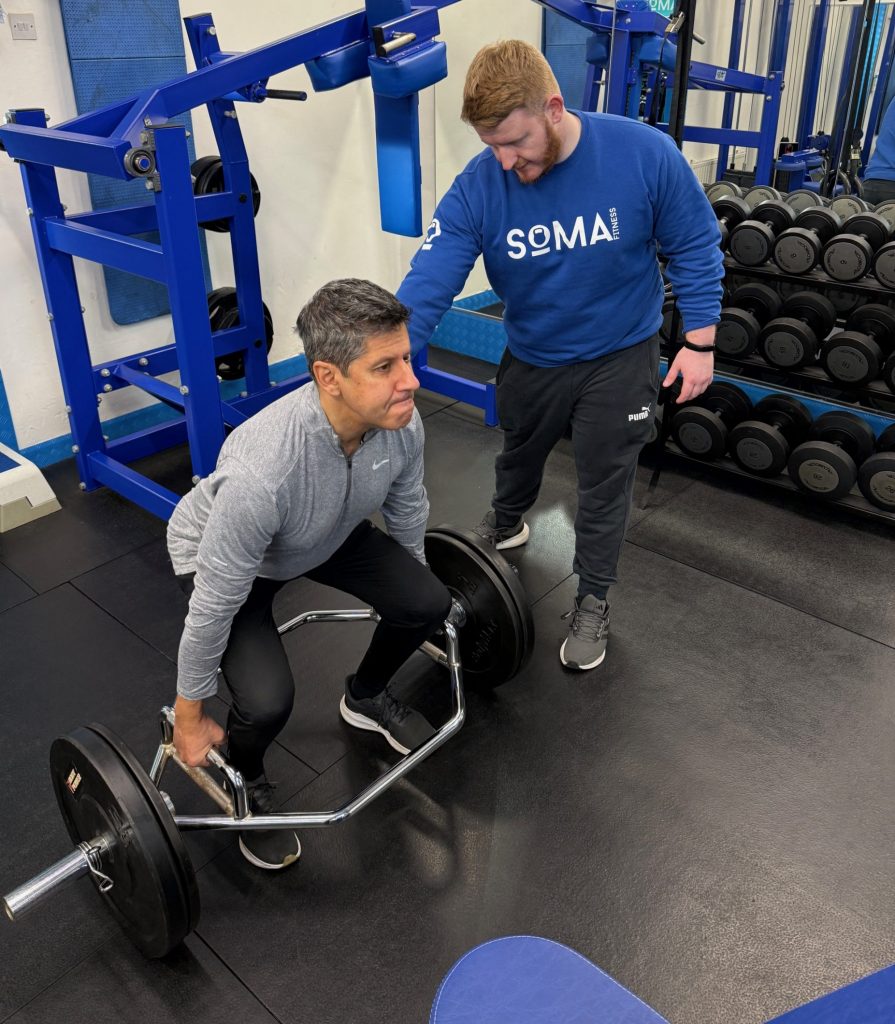
Turning 50 doesn’t suddenly make you old.
But it can make you realise you’ve neglected your fitness for longer than you intended.
Perhaps you were active in your:
20s.
30s.
Even your early 40s.
Then life became busier.
Work became more demanding.
You had a family.
Training became inconsistent.
You started sitting more.
Your weight gradually increased.
And somewhere along the way, you stopped feeling as physically capable as you used to.
For many men, reaching their 50s creates a moment where they think:
“I need to start taking care of myself properly again.”
If that’s where you are, you don’t need to train like a 25-year-old.
But you don’t need to accept becoming:
Weaker.
More unfit.
Less mobile.
And less physically capable
simply because you’re getting older.
At Soma Fitness, we provide private one-to-one personal training for men and women from our studio on Hale Road in Altrincham.
And many of the people we coach aren’t trying to become fitness models.
They simply want to become:
Stronger.
Fitter.
Leaner.
Healthier.
And more physically capable for the decades ahead.
What Actually Changes After 50?
Ageing is real.
Pretending otherwise isn’t useful.
As we get older, changes can occur in:
Muscle mass.
Strength.
Bone health.
Cardiovascular fitness.
Recovery.
And other aspects of physical function.
But there’s an important distinction:
Ageing happens.
Becoming inactive isn’t inevitable.
Those aren’t the same thing.
Some of What You Blame on Age May Be Inactivity
Imagine two versions of your life.
At 25, perhaps you:
Played football.
Walked everywhere.
Went to the gym.
Went out regularly.
Played sport.
And generally moved far more.
At 52, perhaps you:
Drive to work.
Sit for eight hours.
Drive home.
Eat dinner.
Sit on the sofa.
Then repeat it.
If your body composition and fitness change, age may be one factor.
But so is the fact that your lifestyle may now be completely different.
You Can Still Get Stronger After 50
This is one of the most important things to understand.
Being over 50 does not remove your ability to respond to resistance training.
You can still improve:
Strength.
Muscle.
Physical capacity.
Exercise skill.
And fitness.
Your programme simply needs to reflect:
Your starting point.
Training history.
Health.
Previous injuries.
Lifestyle.
And recovery.
You Don’t Need an “Old Man’s Workout”
Being 50 doesn’t mean your programme automatically becomes:
Resistance bands.
Tiny dumbbells.
Stretching.
And fifteen minutes on a recumbent bike.
If you’re capable of progressively performing:
Squats.
Presses.
Rows.
Hinges.
Split squats.
Machines.
Dumbbell exercises.
And other resistance movements…
they can all have a place.
The load and exercise selection should suit you.
But You Also Don’t Need to Train Like You’re 21
The opposite extreme isn’t useful either.
Perhaps you remember:
Bench pressing with your friends.
Heavy squats.
Playing rugby.
Training five days per week.
Or pushing every session as hard as possible.
That was decades ago.
Your programme today should be based on your current capacity.
Not what you could do in 1998.
Start From Where You Are Now
This is one of the biggest principles we use at Soma Fitness.
Maybe you haven’t trained for:
Five years.
Ten years.
Twenty years.
That’s okay.
We don’t begin by asking:
“What should a 50-year-old be able to lift?”
We establish what you can currently do.
Then we build from there.
Why Strength Training Becomes So Valuable
One of the physical qualities we particularly want to preserve as we age is muscular strength.
Strength supports your ability to:
Lift.
Carry.
Climb stairs.
Get up from the floor.
Play sport.
Perform physical tasks.
And remain independent.
You might not care about having an impressive squat.
But you’ll probably care about remaining physically capable.
Muscle Matters Too
Muscle isn’t only about appearance.
Skeletal muscle contributes to:
Movement.
Strength.
Physical function.
And metabolic health.
Preserving muscle becomes increasingly relevant as we age.
Resistance training provides a direct stimulus to muscle tissue.
Can You Build Muscle After 50?
Yes.
Your ability to build muscle doesn’t disappear when you turn 50.
The rate and magnitude of progress will vary between individuals.
But appropriately programmed resistance training combined with sufficient:
Protein.
Energy.
Recovery.
And consistency
can support muscle development later in life.
You Don’t Need to Become a Bodybuilder
When we talk about building muscle, some men imagine:
Extreme bodybuilding.
Massive calorie surpluses.
Six gym sessions per week.
That’s not what we’re talking about.
You might simply want to rebuild muscle in your:
Legs.
Back.
Chest.
Shoulders.
And arms
so that you look and feel stronger.
That’s a perfectly reasonable goal.
What About Losing Your Belly?
This is probably one of the most common goals among men who come to us.
Perhaps your weight has gradually increased.
Your trousers are tighter.
Your waist has grown.
And most of the weight seems to sit around your middle.
You might call it:
“Middle-aged spread.”
But fat loss still follows the same fundamental principle.
Losing Body Fat Requires an Energy Deficit
No special:
Over-50 diet.
Hormone-reset programme.
Detox.
Fat-burning workout.
Or supplement
can bypass energy balance.
For body mass to decrease over time, your energy intake needs to be appropriately lower than your energy expenditure.
Our job is to help make that practical.
You Don’t Need to Live on Salads
Fat loss doesn’t require:
Removing all carbohydrates.
Never eating out.
Never drinking alcohol.
Or eating chicken and broccoli from plastic containers six times per day.
For most clients, we’re looking for:
Better food choices.
Appropriate portions.
Adequate protein.
Sensible calorie intake.
And consistency.
Protein Becomes Particularly Relevant
Protein supports the maintenance and development of muscle tissue.
If you’re:
Over 50.
Resistance training.
And particularly if you’re losing weight…
adequate protein deserves attention.
We’ve published a separate Soma Fitness guide explaining how much protein you need per day.
Don’t Be Afraid of Carbohydrates
Carbohydrates can support training performance and contribute to muscle glycogen.
You don’t need unlimited carbohydrate.
But automatically removing:
Bread.
Rice.
Potatoes.
Fruit.
Pasta.
And every other carbohydrate source
isn’t necessary simply because you’re trying to become leaner.
What About Alcohol?
This is relevant for many men we coach.
You might enjoy:
A few beers.
Wine with dinner.
A drink at the weekend.
You don’t necessarily have to become completely abstinent to improve your body composition.
But alcohol contains calories and can also influence:
Sleep.
Appetite.
Food choices.
Recovery.
And next-day activity.
If progress matters, it needs to be accounted for.
Your Weekend Still Counts
Monday to Friday:
Perfect.
Then Friday evening arrives.
Takeaway.
Drinks.
Restaurant Saturday.
Big Sunday lunch.
Then:
“I’ll start again Monday.”
It’s entirely possible for a large weekend intake to offset the calorie deficit you created during the week.
That doesn’t mean never socialising.
It means looking at your nutrition across the whole week.
Cardiovascular Fitness Matters Too
Being strong but getting out of breath climbing a flight of stairs isn’t our definition of complete fitness.
We want to consider cardiovascular health and fitness too.
Depending on the individual, that might involve:
Walking.
Cycling.
Running.
Rowing.
Incline treadmill work.
Zone 2-style cardio.
Intervals.
Or recreational sport.
You Don’t Have to Become a Runner
If you hate running, that’s fine.
There are many ways to improve cardiovascular fitness.
You might prefer:
Cycling.
Walking uphill.
A cross trainer.
A rowing machine.
Or playing:
Padel.
Tennis.
Golf.
Football.
The method needs to be something you can realistically perform.
Walking Is One of the Simplest Places to Start
If you work at a desk and average:
3,000 steps per day,
we don’t necessarily need to immediately prescribe:
15,000.
We can establish your current activity and gradually increase it.
Walking is accessible.
Low cost.
Easy to recover from.
And easy to fit around everyday life.
Do You Need 10,000 Steps?
Not necessarily.
10,000 isn’t a magical threshold.
Your step target should be considered in context.
We’ve published a separate guide explaining how many steps per day you actually need.
What About HIIT After 50?
High-intensity interval training isn’t inherently prohibited because you’re over 50.
But it also isn’t compulsory.
The appropriate type and intensity of cardiovascular training depends on:
Your fitness.
Health.
Experience.
Goals.
And other training.
You don’t need to destroy yourself on an exercise bike to prove you’re fit.
Strength Training Should Be Progressive
Simply attending the gym isn’t enough.
If you want to become stronger, your programme should gradually progress.
That might involve:
More repetitions.
More load.
Improved execution.
Greater range of motion.
Additional productive training volume.
Or another appropriate progression.
We want measurable improvement over time.
Progressive Doesn’t Mean Reckless
Progression isn’t:
Adding weight every session regardless of technique.
Trying to beat a personal best every week.
Or training through significant pain.
Progress should be earned.
Sometimes the right decision is:
Increase the load.
Sometimes it’s:
Keep it the same.
Good programming knows the difference.
How Hard Should You Train After 50?
Being older doesn’t mean every set needs to feel easy.
To stimulate adaptation, resistance training needs to provide sufficient challenge.
But we also don’t need every exercise taken to:
Absolute failure.
Maximum exhaustion.
Or complete physical collapse.
Training effort should be programmed.
Soreness Isn’t the Goal
If you can’t walk downstairs for four days after your first leg session, that doesn’t prove the workout was effective.
It might simply prove that you did too much too soon.
Our aim is:
Stimulate → recover → adapt → progress.
Not:
Destroy → recover for a week → dread coming back.
What Exercises Should Men Over 50 Do?
There isn’t a universal list.
Depending on the individual, we might use:
Squats.
Leg presses.
Split squats.
Deadlift variations.
Rows.
Pulldowns.
Chest presses.
Shoulder presses.
Dumbbells.
Machines.
Cables.
Calf exercises.
Arm training.
And trunk work.
Exercise selection should reflect the person.
Machines Are Excellent Training Tools
You don’t have to perform everything with:
Barbells.
Machines can provide:
Stability.
Straightforward progression.
Consistent setup.
And effective resistance.
We use whatever tool makes sense.
Free Weights Are Useful Too
Likewise, you don’t suddenly become too old for:
Dumbbells.
Kettlebells.
Or barbells.
They can all be useful where appropriate.
The equipment isn’t inherently good or bad.
It’s about how we use it.
What About Mobility?
You don’t necessarily need a separate hour-long mobility programme.
Strength training through appropriate ranges of motion can itself expose your joints to movement.
Where specific mobility limitations affect:
Exercise selection.
Comfort.
Or function,
we can address them.
But we don’t automatically assume every 50-year-old is:
“Tight.”
What About Balance?
Balance becomes increasingly relevant as we age.
Depending on the individual, we can challenge stability through exercises such as:
Split squats.
Single-leg movements.
Step-ups.
Carries.
And other standing resistance exercises.
Again, progression should match ability.
What If Your Knees Hurt?
Many men reach 50 with some history of:
Knee pain.
Back pain.
Shoulder pain.
Or previous injuries.
That doesn’t automatically mean you can’t strength train.
But it does mean exercise selection may need to be individualised.
Pain Doesn’t Automatically Mean Stop Everything
Depending on the situation, we may be able to modify:
Load.
Range.
Exercise selection.
Volume.
Grip.
Tempo.
Or training frequency.
But personal trainers don’t diagnose injuries.
Persistent or concerning symptoms may require appropriate clinical assessment.
Previous Injuries Need Context
Maybe you’ve had:
A knee operation.
Shoulder surgery.
A slipped disc diagnosis.
An old football injury.
Or something else.
We want to know.
That doesn’t automatically mean you can never train that area again.
But it may influence how we start.
Members of the Soma Fitness coaching team also hold additional qualifications relating to injury rehabilitation and corrective exercise.
What If You’ve Never Lifted Weights Before?
That’s completely fine.
Many clients start resistance training later in life.
We don’t expect you to know:
What exercises to do.
How to set up machines.
How much weight to use.
How many repetitions.
Or how hard to push.
That’s what coaching is for.
You Don’t Need to Get Fit Before Hiring a Personal Trainer
This is something people genuinely worry about.
They think:
“I’ll get myself a bit fitter first, then I’ll contact a PT.”
But if you already knew exactly:
What to do.
How to programme it.
And how to stay consistent…
you probably wouldn’t need the help.
You can start from your current level.
What If You’re Embarrassed About Your Fitness?
This is another reason some people avoid gyms.
Maybe you feel:
Overweight.
Unfit.
Weak.
Self-conscious.
Or simply out of place.
Soma Fitness is a private personal training studio, not an open-membership commercial gym.
You’re there to be coached.
Not judged.
You Don’t Have to Train Around a Crowded Gym
There are no rows of people waiting for:
Benches.
Machines.
Or racks.
You’re not wandering around wondering what to do next.
Your session has structure.
Your coach is with you.
For many people returning to fitness later in life, that environment makes starting considerably easier.
What If You’re Already Fit?
Personal training isn’t only for beginners.
Perhaps you’re 52 and already:
Running.
Cycling.
Playing golf.
Playing padel.
Skiing.
Playing tennis.
Or training in the gym.
Your goal may be to improve your physical preparation for those activities.
Strength Training for Golf After 50
Golf is skill-dominant.
But strength and power can contribute to physical capacity.
We’ve already published a dedicated Soma Fitness article explaining strength training for golfers in Hale and Altrincham.
Your gym programme can be built around your golf rather than competing with it.
What About Padel?
Padel is becoming increasingly popular among the kind of clients we coach.
It involves:
Accelerating.
Braking.
Changing direction.
Reaching.
Rotating.
And repeated bouts of activity.
We’ve also published a dedicated guide to strength and conditioning for padel players in Hale and Altrincham.
Again:
The gym develops physical qualities.
The court develops your game.
What About Running?
You can absolutely combine strength training and running after 50.
Your programme simply needs to account for:
Mileage.
Hard running sessions.
Long runs.
Race preparation.
And recovery.
We’ve produced separate guidance on personal training and strength training for runners.
Training Should Support Your Life Outside the Gym
This is ultimately the point.
You might want to be stronger because you enjoy:
Golf.
Running.
Padel.
Skiing.
Cycling.
Walking.
Travelling.
Playing with your grandchildren.
Or simply feeling physically capable.
Your gym performance isn’t the final destination.
It’s a tool.
Being Stronger Makes Everyday Tasks Easier
Imagine carrying:
Shopping.
Suitcases.
Furniture.
Gardening equipment.
Or picking something heavy off the floor.
If those tasks represent a smaller percentage of your maximum physical capacity, they generally become easier.
That’s one reason strength has value beyond appearance.
Healthy Ageing Isn’t About Avoiding Challenge
Sometimes fitness advice for older adults becomes:
Be careful.
Slow down.
Don’t lift heavy things.
Don’t challenge yourself.
But adaptation requires challenge.
The goal isn’t to remove physical stress.
It’s to apply appropriate physical stress and allow your body to adapt.
Recovery Still Matters
As your training develops, we need to consider:
Sleep.
Nutrition.
Stress.
Work.
Other sports.
And total training volume.
If you’re:
Working 60 hours.
Playing padel three times.
Running twice.
And sleeping five hours…
that matters.
Your programme needs to exist within your life.
You Don’t Need Six Gym Sessions Per Week
For many men over 50, two or three well-structured resistance sessions each week can provide an excellent foundation.
More isn’t automatically better.
The programme needs to be:
Effective.
Recoverable.
And sustainable.
Consistency Beats Short Bursts of Motivation
This is where many people struggle.
January:
Five workouts per week.
Restrictive diet.
No alcohol.
10,000 steps.
Everything perfect.
February:
Nothing.
A better strategy is building something you can maintain throughout:
Busy weeks.
Holidays.
Work stress.
Family commitments.
And normal life.
Your Programme Needs to Survive Your Bad Weeks
Anyone can follow a fitness plan when life is perfect.
The question is:
What happens when work becomes chaotic?
Maybe your normal plan is:
Three sessions.
But this week you can manage:
Two.
Fine.
Two is considerably better than deciding the week has failed.
What About Testosterone?
Men over 50 are increasingly exposed to marketing around:
Testosterone.
“Low-T.”
Hormone optimisation.
And supplements claiming to restore youth.
Hormonal health can certainly be medically relevant.
But a personal trainer shouldn’t diagnose low testosterone from symptoms or social-media checklists.
If you have genuine concerns, speak to an appropriately qualified healthcare professional.
Our job is:
Training.
Nutrition guidance within scope.
Activity.
Recovery.
And coaching.
Supplements Aren’t the Foundation
You don’t need a cupboard containing:
Twenty supplements
before you start training.
Get the fundamentals right first:
Training.
Protein.
Overall nutrition.
Sleep.
Activity.
Consistency.
Some supplements may have evidence supporting particular uses, but they’re additions—not substitutes.
Creatine Can Be Useful
Creatine monohydrate is one of the better-researched sports supplements and may support improvements in high-intensity exercise performance and adaptations to resistance training.
But it’s optional.
You can make excellent progress without it.
How Quickly Can You Get Results?
That depends on:
Your starting point.
Goal.
Training frequency.
Nutrition.
Sleep.
Genetics.
Consistency.
And what we mean by “results.”
You may notice improvements in:
Exercise confidence.
Strength.
And fitness
relatively early.
Changes in body composition usually require more time and consistent behaviour.
Don’t Judge Everything by the Scales
If your goals include:
Losing fat.
Building muscle.
And becoming stronger,
scale weight is only one measurement.
We might also consider:
Waist measurements.
Progress photographs.
Training performance.
Clothing fit.
Fitness.
And how you feel physically.
What Does Personal Training for Men Over 50 at Soma Fitness Look Like?
There’s no generic “over-50 programme.”
We start with the person.
1. Free consultation
We discuss:
Your goals.
Training history.
Current activity.
Work.
Lifestyle.
Previous injuries.
Sports.
And schedule.
2. Establish your starting point
We don’t compare you with another 50-year-old.
We assess where you are.
3. Build your programme
Based on:
Your goal.
Experience.
Availability.
And physical capacity.
4. Coach your exercises
We teach:
Setup.
Technique.
Execution.
And appropriate effort.
5. Progress your training
Your programme develops as you do.
6. Consider cardiovascular fitness
Strength isn’t the only physical quality that matters.
7. Address activity and nutrition
Particularly where fat loss or body composition is a goal.
8. Track progress
We want evidence that the programme is working.
9. Adjust
Because real people don’t progress perfectly every week.
Our Personal Training Sessions Are 60 Minutes
Every Soma Fitness one-to-one personal training session is 60 minutes.
That gives us time for:
Preparation.
Meaningful resistance training.
Appropriate rest.
Technique coaching.
Cardiovascular work where appropriate.
And communication with your coach.
We don’t believe every second needs to involve frantic movement.
If you’re performing demanding strength work, rest is part of the programme.
Private One-to-One Personal Training
Soma Fitness isn’t an open-membership gym.
We specialise in private one-to-one personal training.
For someone returning to fitness after years away, that can remove a lot of uncertainty.
You don’t need to worry about:
What exercises to do.
Whether you’re doing them correctly.
How much weight to use.
When to progress.
Or how to organise the programme.
That’s what we’re there for.
Personal Trainer for Men Over 50 in Altrincham
Soma Fitness is located on Hale Road in Altrincham and works with clients from:
Altrincham.
Hale.
Bowdon.
Hale Barns.
Timperley.
Sale.
And surrounding South Manchester.
We’ve been coaching clients locally since 2007.
Whether you’re:
Or beyond…
you don’t need to accept becoming weaker and less capable every year.
You can train.
Frequently Asked Questions
Is 50 too old to start strength training?
No. Adults can begin resistance training later in life. Your starting point and programme should reflect your health, experience and current physical capacity.
Can I build muscle after 50?
Yes. People can continue developing muscle later in life through appropriately programmed resistance training alongside adequate nutrition and recovery.
How many times per week should a man over 50 lift weights?
There isn’t one compulsory frequency. For many people, two or three well-structured resistance sessions per week can provide a strong foundation.
Can I lose belly fat after 50?
Body-fat loss remains possible after 50. You cannot selectively choose where fat is lost from, and an appropriate energy deficit is still required.
Do I need to lift heavy weights?
“Heavy” is relative. Resistance needs to provide sufficient challenge to stimulate adaptation, but you don’t need to continually perform maximal lifts.
Should men over 50 do cardio?
Cardiovascular fitness remains important. The appropriate amount and type of cardio depends on your goals, health, fitness and other activity.
Can I run after 50?
Many people continue running well beyond 50. Your running and strength programmes should reflect your individual health, training history and capacity.
Can I play padel and strength train?
Yes. Your gym programme can be organised around your padel schedule and other sport.
What if I have an old knee, back or shoulder injury?
An old injury doesn’t automatically prevent strength training. Exercise selection may need modifying, and persistent or concerning symptoms may require assessment by an appropriate healthcare professional.
Do I need to get fit before starting personal training?
No. Personal training can begin from your current fitness and experience level.
Is Soma Fitness a public gym?
No. Soma Fitness is a private personal training studio focused on one-to-one coaching.
How long are your sessions?
All Soma Fitness one-to-one personal training sessions are 60 minutes.
Where is Soma Fitness?
We’re based on Hale Road in Altrincham, serving clients throughout Altrincham, Hale and surrounding South Manchester.
Your 50s Don’t Have to Be the Decade You Start Slowing Down
You can’t stop ageing.
And we’re not going to sell you a fantasy that exercise somehow makes you 25 again.
But you can influence how physically capable you are as you get older.
You can become:
Stronger.
Fitter.
Leaner.
More active.
And more confident in what your body can do.
You don’t need to make fitness your entire life.
You need a programme you can consistently follow.
At Soma Fitness, we provide private one-to-one personal training from our studio on Hale Road in Altrincham.
If you’re over 50 and thinking:
“It’s time I got myself back into shape.”
your first step is a free consultation.
Come into the studio.
Meet one of our coaching team.
Tell us where you are now.
Tell us where you’d like to be.
And we’ll explain how we’d approach getting you there.
You’re not training to become younger.
You’re training to remain capable as you get older.
Contact Soma Fitness today to arrange your free consultation.
Recent Comments