
Strength Training for Beginners in Hale – How to Start Properly and Build Lasting Results
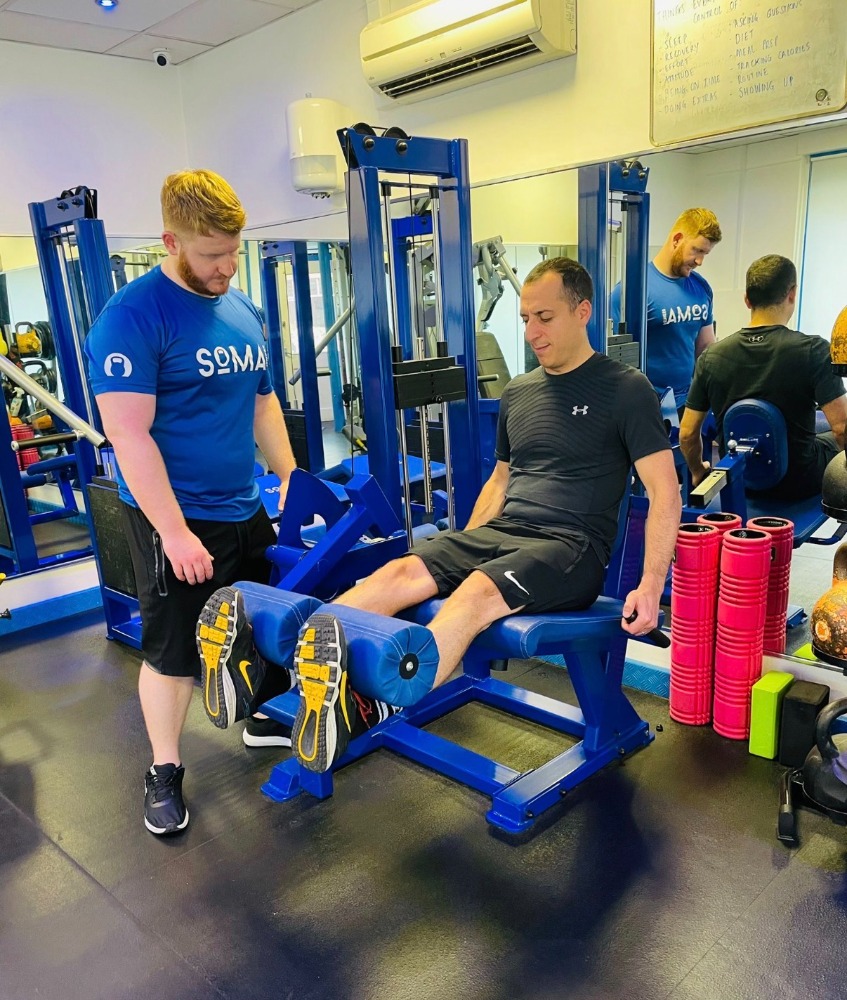
Walking into a gym for the first time can be intimidating.
Rows of unfamiliar machines.
People lifting heavy weights.
Exercises you’ve never seen before.
Terminology you don’t understand.
And the uncomfortable feeling that everyone else knows exactly what they’re doing.
The reality?
Every experienced gym-goer was once a complete beginner.
You don’t need to be strong before you start strength training.
You don’t need to know how to squat.
You don’t need to understand sets, repetitions or progressive overload.
And you certainly don’t need to “get fit” before hiring a personal trainer.
At Soma Fitness, we’ve spent almost twenty years helping men and women across Hale, Altrincham and the surrounding areas learn how to train effectively.
If you’re interested in strength training for beginners in Hale, here’s what you actually need to know.
What Is Strength Training?
Strength training—also called resistance training is exercise where your muscles work against resistance.
That resistance could come from:
- Dumbbells
- Barbells
- Weight machines
- Cables
- Resistance bands
- Your own bodyweight
The basic principle is straightforward.
You challenge your muscles.
Your body adapts.
Over time, you gradually increase the challenge.
That’s how you become stronger.
You Don’t Need to Lift Heavy Weights on Day One
This is one of the biggest misconceptions beginners have.
They assume strength training means immediately putting a heavy barbell on their back.
It doesn’t.
The appropriate resistance is relative to you.
For one person, a bodyweight squat may provide enough challenge.
For another, it might be a loaded squat.
The objective isn’t to lift the heaviest weight in the gym.
It’s to select an appropriate resistance that challenges you while allowing you to maintain good technique.
Then we progress from there.
Technique Comes First
Beginners often focus on how much weight they’re lifting.
Initially, we’re much more interested in how you’re moving it.
Before aggressively increasing resistance, you should learn how to perform fundamental movement patterns competently.
These can include:
- Squatting
- Hip hinging
- Pushing
- Pulling
- Lunging
- Bracing
- Carrying
You don’t need to master dozens of complicated exercises.
Build competency in the fundamentals first.
What Are Sets and Repetitions?
Fitness terminology can make training sound far more complicated than it actually is.
A repetition, or rep, is one complete performance of an exercise.
If you perform ten squats, you’ve completed ten repetitions.
A set is a group of repetitions.
So if your program says:
3 × 10
that generally means three sets of ten repetitions.
Simple.
You don’t need a degree in exercise science to start training.
What Is Progressive Overload?
Once you’ve learned the exercises, we need to give your body a reason to continue adapting.
This is where progressive overload becomes important.
Imagine performing the same exercise:
With the same weight.
For the same repetitions.
At the same effort.
For the next five years.
Eventually, your body has very little reason to continue getting stronger.
Progressive overload means gradually increasing the training stimulus.
That could involve:
- Increasing weight
- Performing additional repetitions
- Improving technique
- Increasing range of motion
- Adding appropriate training volume
Progress doesn’t need to happen every workout.
We’re looking for improvement over months and years.
How Hard Should Beginners Train?
This is where beginners often go wrong in both directions.
Some barely challenge themselves.
Others try to destroy themselves during every workout.
Neither is particularly intelligent.
Strength training needs to be sufficiently challenging to create adaptation.
But beginners don’t need to train every exercise to absolute muscular failure.
Initially, learning technique, developing confidence and building consistency are priorities.
As your experience improves, training intensity can gradually increase.
Muscle Soreness Doesn’t Mean a Workout Was Better
Beginners often assume:
“I’m really sore, so yesterday must have been a great workout.”
Not necessarily.
Muscle soreness can occur when you introduce unfamiliar exercises or training volumes.
But soreness isn’t a reliable measurement of training quality.
A successful training program should be judged by whether you’re improving over time.
Are you getting stronger?
Is your technique improving?
Can you perform more repetitions?
Are you moving better?
Are you becoming more confident?
Those things matter far more than whether you struggle to walk downstairs the following morning.
How Often Should a Beginner Strength Train?
You don’t need to train every day.
For many beginners, two to three resistance training sessions per week can provide an excellent starting point.
This gives you enough exposure to practice the movements and create a training stimulus while still allowing plenty of recovery.
More isn’t automatically better.
Particularly when you’re starting.
Consistency beats volume you can’t sustain.
Full-Body Training Works Extremely Well for Beginners
Beginners often assume they need complicated bodybuilding splits.
Chest Monday.
Back Tuesday.
Legs Wednesday.
Shoulders Thursday.
Arms Friday.
For many beginners, that level of complexity is completely unnecessary.
A well-designed full-body program performed two or three times per week can work extremely well.
You might include exercises targeting:
- Legs
- Hips
- Chest
- Back
- Shoulders
- Arms
- Core
The exact program should depend on your goals, ability and available equipment.
Strength Training Isn’t Just for Young People
One of the most damaging misconceptions is that weights are something you do when you’re young.
Resistance training arguably becomes more valuable as we age.
Maintaining strength and muscle supports:
- Physical function
- Independence
- Balance
- Bone health
- Healthy ageing
- Everyday movement
Whether you’re starting at 25, 45 or 65, building strength is an investment in your future physical capacity.
Women Should Strength Train Too
Strength training isn’t just for men.
Women can gain enormous benefits from resistance training.
These include improvements in:
- Strength
- Muscle
- Bone health
- Physical function
- Confidence
- Body composition
These factors become particularly relevant as women approach peri-menopause and menopause.
And no, lifting weights doesn’t automatically make women “bulky.”
Building large amounts of muscle takes considerable time and dedicated training.
Can Strength Training Help With Fat Loss?
Absolutely, but it’s important to understand how.
Resistance training doesn’t magically melt body fat.
Fat loss requires an appropriate calorie deficit.
The benefit of strength training during fat loss is that it provides a stimulus to maintain muscle while body weight decreases.
That’s important because our objective shouldn’t simply be:
Lose weight.
It should be:
Improve body composition.
We want to reduce excess body fat while maintaining as much lean tissue as possible.
Do Beginners Need Cardio?
Cardiovascular training and strength training aren’t competitors.
Both have value.
Resistance training develops strength and muscle.
Cardiovascular exercise develops cardiovascular fitness.
Walking is also an excellent starting point for many beginners.
A balanced program might include:
- Two or three strength sessions
- Regular walking
- One or two appropriate cardiovascular sessions
The exact balance depends on your current fitness and goals.
Nutrition Doesn’t Need to Become Complicated
Starting strength training doesn’t mean you suddenly need six meals per day, dozens of supplements and a bodybuilding diet.
Focus on the basics.
Eat Enough Protein
Protein supports muscle repair and adaptation.
Eat Fruit and Vegetables
These provide fiber and valuable micronutrients.
Include Appropriate Carbohydrates
Carbohydrates can help fuel training.
Stay Hydrated
Simple, but frequently overlooked.
Manage Calories Around Your Goal
If you want to lose body fat, you need an appropriate calorie deficit.
If you’re primarily focused on muscle gain, your nutritional requirements will be different.
The basics executed consistently outperform complicated strategies executed badly.
Do Beginners Need Supplements?
Probably fewer than social media would have you believe.
Supplements are exactly that:
Supplementary.
They don’t compensate for poor nutrition, inconsistent training or inadequate sleep.
Build the foundations first.
Training.
Nutrition.
Sleep.
Daily activity.
Consistency.
Then consider whether particular supplements have a genuine purpose.
What If You Have an Old Injury?
This is one reason many beginners hesitate to start.
Perhaps you’ve had:
- Back pain
- Knee problems
- Shoulder issues
- Previous surgery
- An old sporting injury
An injury history doesn’t automatically mean you can’t strength train.
It may mean exercises need to be selected or modified appropriately.
Our coaching team at Soma Fitness has additional qualifications in injury rehabilitation, allowing us to adapt training where appropriate.
If symptoms require assessment from a doctor, physiotherapist or another healthcare professional, we’ll recommend that rather than trying to train through something that requires clinical attention.
Why Beginners Often Benefit From Personal Training
There is more free fitness information available today than ever before.
That’s partly the problem.
One video tells you squats are essential.
Another says squats are dangerous.
Someone says you need to train six times per week.
Someone else says twice is enough.
One influencer says carbohydrates are essential.
Another tells you to eliminate them.
For a beginner, it’s overwhelming.
A good Personal Trainer in Hale removes the noise.
Your coach determines:
- What exercises you need
- How many sets to perform
- How many repetitions
- How hard to train
- When to increase weight
- When to change exercises
- How to adapt around injuries
Instead of trying to become your own exercise scientist, you can focus on doing the work.
Confidence Comes From Competence
Many people aren’t actually afraid of gyms.
They’re afraid of looking like they don’t know what they’re doing.
There’s a simple solution.
Learn what you’re doing.
Once you know how to set up the equipment, perform the exercises and structure your workout, the gym becomes considerably less intimidating.
That’s one of the biggest benefits we see with beginners.
Their body changes.
But so does their confidence.
Why Choose Private Personal Training?
A busy commercial gym can be intimidating when you’re starting.
At Soma Fitness, our facility is dedicated to coached personal training.
There are no general gym memberships.
You aren’t wandering around trying to find an available machine.
Your coach has your program ready.
You arrive.
You train.
You learn.
You progress.
For many beginners, that environment makes taking the first step considerably easier.
Strength Training in Hale and Altrincham
Soma Fitness is based on Hale Road in Altrincham, serving clients throughout:
- Hale
- Altrincham
- Bowdon
- Hale Barns
- Timperley
- Sale
- Surrounding South Manchester areas
We’ve been coaching clients for almost twenty years.
Some arrive with years of training experience.
Many arrive with none.
Your starting point doesn’t matter.
What matters is what you do next.
Frequently Asked Questions About Strength Training for Beginners
Am I too unfit to start strength training?
No. Training should be adapted to your current ability. You don’t need to become fit before you start exercising.
What age should I start strength training?
Resistance training can be appropriate across a wide range of ages when appropriately programmed and supervised.
How many times per week should beginners lift weights?
For many beginners, two to three sessions per week is an excellent starting point.
Should beginners use machines or free weights?
Both can be useful. Exercise selection should depend on your ability, goals and individual circumstances rather than arbitrary rules about one being superior.
How long before I see results?
Strength improvements can occur relatively quickly when someone first starts training, while visible body-composition changes generally require longer-term consistency with both training and nutrition.
Do I need to lose weight before starting?
No. Resistance training can form part of a fat-loss program from the beginning.
Can I start if I’m over 40?
Absolutely. Maintaining and developing strength becomes increasingly important as we age.
Looking for Strength Training for Beginners in Hale?
If you’re looking for strength training for beginners in Hale, a Personal Trainer in Hale, or private personal training near Altrincham, we’d love to help.
You don’t need to know how to use a gym.
You don’t need to already be strong.
And you don’t need to be fit enough to start.
That’s what coaching is for.
At Soma Fitness, we’ll assess your starting point and build a personalised program around your ability, goals and lifestyle.
Then we’ll teach you how to train properly and progressively build from there.
Book a free consultation with the Soma Fitness coaching team and take the first step towards becoming stronger, fitter and more confident.
Recent Comments