
Why You’re Not Seeing Results in the Gym – And What to Do About It
You’ve been going to the gym.
You’re putting the effort in.
You’re training several times per week.
But when you look back over the last six months, you’re forced to ask yourself:
What has actually changed?
You’re not considerably stronger.
You haven’t built much muscle.
Your body fat hasn’t really changed.
And you’re starting to wonder whether you’re simply wasting your time.
This is something we see regularly at Soma Fitness.
People often come to us after spending months or sometimes years training independently without making the progress they expected.
The problem usually isn’t effort.
It’s structure.
At Soma Fitness, we’ve spent almost twenty years helping men and women across Hale, Altrincham and the surrounding areas train with greater purpose.
So if you’re not seeing results in the gym, here are some of the first things we’d look at.
1. You’re Exercising, But You’re Not Really Training
There’s an important distinction between exercise and training.
Exercise is physical activity.
Training is physical activity organised towards a specific outcome.
If you arrive at the gym and decide what you’re doing based on whichever machine happens to be free, you’re exercising.
If you follow a structured program designed around a specific goal and progressively improve your performance over time, you’re training.
There’s nothing wrong with exercise.
But if you want a specific result, you need a specific process.
Want to build muscle?
Train for muscle growth.
Want to become stronger?
Train for strength.
Want to improve your cardiovascular fitness?
Train your cardiovascular system.
Your program should reflect the adaptation you’re trying to create.
2. You’re Changing Your Program Too Often
Social media hasn’t helped with this one.
Every week there’s a new exercise.
A new workout.
A new training method.
A new “best” way to build muscle.
So people constantly change their program.
Monday they see a new chest exercise on Instagram.
Wednesday they watch a YouTube video and completely change their back workout.
By Friday, they’re following someone else’s leg routine.
The result?
They never perform anything consistently enough to determine whether it’s actually working.
Variety isn’t the same as progression.
A good program doesn’t need to entertain you with completely new exercises every week.
It needs to provide enough consistency for you to improve.
3. You’re Not Applying Progressive Overload
This is one of the biggest reasons gym-goers stop progressing.
Your body adapts to the demands placed upon it.
If you continually provide the same stimulus, eventually there’s very little reason for further adaptation.
That’s why training needs to progress.
Progressive overload could involve:
- Increasing load
- Performing more repetitions
- Improving technique
- Increasing range of motion
- Adding appropriate training volume
- Improving control of the exercise
This doesn’t mean you need to add weight every workout.
Progress isn’t perfectly linear.
But if you’re lifting exactly the same weights for exactly the same repetitions that you were twelve months ago, we need to ask why.
4. You’re Not Tracking Your Training
Ask yourself:
What did you bench press six weeks ago?
How many repetitions?
How many sets?
What about your leg press?
Romanian deadlift?
Lat pulldown?
If your answer is:
“I can’t remember.”
Then how do you know whether you’re progressing?
You don’t.
This is why we track training.
Your training log provides objective information.
It tells us what’s improving.
What’s stagnating.
And where adjustments may be required.
You wouldn’t run a business without looking at the numbers.
Don’t expect your training to progress if you’re ignoring them there too.
5. You’re Training Too Easily
This is particularly common among people who’ve trained for several years.
They’re consistent.
Their technique looks good.
But the sets simply aren’t particularly challenging.
To build muscle and strength, your muscles need an appropriate stimulus.
That doesn’t mean every single set needs to be taken to complete muscular failure.
But if you finish every set knowing you could comfortably perform another eight repetitions, the training stimulus may simply be insufficient.
Your working sets should actually feel like working sets.
6. Or You’re Training Too Hard
The opposite problem also exists.
Some people treat every session like a war.
Every exercise to failure.
Forced repetitions.
Drop sets.
More exercises.
More sets.
More intensity.
Then they wonder why they’re exhausted and their performance stops progressing.
More isn’t automatically better.
Training needs to create enough stimulus to drive adaptation while still allowing you to recover.
The objective isn’t to prove how hard you can suffer.
The objective is to improve.
7. Your Technique Is Limiting the Exercise
Technique doesn’t need to look identical for every person.
We’re all built slightly differently.
But exercises should still be performed in a way that effectively loads the muscles we’re trying to train.
Poor execution can reduce the quality of the stimulus and make progression more difficult.
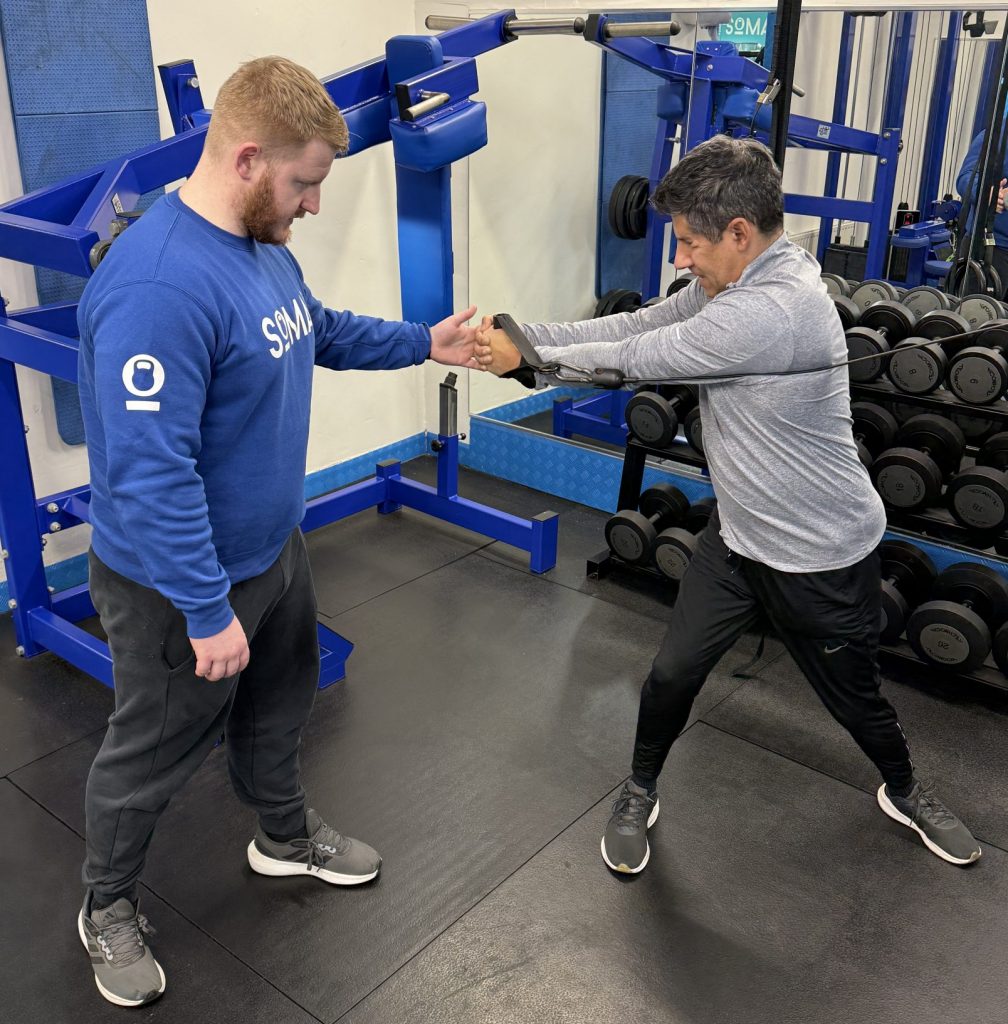
This is one area where working with a Personal Trainer in Hale can be particularly useful.
Small changes to:
- Position
- Range of motion
- Tempo
- Exercise setup
- Stability
can significantly change how an exercise feels and performs.
8. You’re Doing Too Much Junk Volume
More sets don’t automatically equal more muscle.
There’s a point where additional training produces diminishing returns while increasing fatigue.
We often see people performing:
Five chest exercises.
Five sets each.
Twenty-five sets in a single workout.
Then repeating something similar several days later.
That’s not automatically better than a smaller amount of high-quality training.
Your program should contain enough volume to stimulate progress, not as much volume as you can physically survive.
9. Your Nutrition Doesn’t Match Your Goal
You can’t separate training from nutrition.
If you’re trying to lose body fat but consistently consuming more calories than you expend, fat loss isn’t going to happen.
If you’re trying to maximise muscle gain while chronically under-eating, progress may also be limited.
Your nutrition needs to support the objective.
For fat loss, that usually means establishing an appropriate calorie deficit while maintaining sufficient protein and resistance training.
For muscle building, energy availability, protein intake and overall dietary quality become important considerations.
Your gym program can be excellent.
But it can’t completely compensate for nutrition that contradicts your goal.
10. You’re Not Eating Enough Protein
Protein provides the amino acids required for building and maintaining muscle tissue.
For someone regularly resistance training, protein intake deserves attention.
Good sources include:
- Chicken
- Turkey
- Lean meat
- Fish
- Eggs
- Greek yogurt
- Cottage cheese
- Dairy
- Tofu and soy foods
- Beans and pulses
- Protein supplements where useful
You don’t need to become obsessive.
But consistently eating very little protein isn’t going to support your training particularly well.
11. You’re Judging Progress Only by the Scales
The scales are useful.
But they’re one measurement.
Imagine you’ve lost some body fat while gaining a small amount of muscle.
Your body may look different.
Your waist may be smaller.
Your clothes may fit better.
Your strength may have increased.
Yet your body weight might not have changed dramatically.
That’s why we can use several markers of progress:
- Body weight
- Waist measurements
- Progress photographs
- Strength
- Training performance
- Clothing fit
- General fitness
One number doesn’t tell the entire story.
12. Your Expectations Are Unrealistic
This is a big one.
Social media has completely distorted people’s expectations.
Twelve-week transformations.
Thirty-day challenges.
Before-and-after photographs.
People begin believing their body should completely transform every few months.
Real progress is usually slower.
Especially once you’re no longer a complete beginner.
Building meaningful amounts of muscle takes time.
Losing substantial amounts of body fat takes time.
Building strength takes time.
That’s not a flaw in the process.
That’s the process.
13. You’re Not Giving the Program Long Enough
People frequently change strategy just before it has a chance to work.
They diet for two weeks.
Change calories.
Train for three weeks.
Change the program.
Try a supplement.
Change again.
There’s constant activity but very little consistency.
Good coaching sometimes means telling someone:
Don’t change anything yet.
Collect more data.
Allow the program to work.
Then make decisions based on evidence rather than emotion.
14. Your Recovery Is Poor
Your body doesn’t adapt while you’re performing the set.
The training provides the stimulus.
Adaptation occurs afterwards.
If you’re consistently:
- Sleeping poorly
- Highly stressed
- Under-eating
- Training excessively
- Drinking heavily
- Never taking recovery seriously
then your ability to perform and recover may suffer.
You don’t need a perfect recovery routine.
But you can’t continually ask more from your body while giving it nothing back.
15. You’re Sitting Down for the Other 23 Hours
A gym session is fantastic.
But it doesn’t make the rest of your lifestyle irrelevant.
Many of the professionals we coach across Hale and Altrincham have sedentary jobs.
They train for an hour.
Then spend most of the remaining day sitting.
At a desk.
In the car.
In meetings.
On the sofa.
Daily movement still matters.
Walking and general physical activity contribute to energy expenditure, cardiovascular health and overall physical activity.
Don’t judge your lifestyle solely by whether you went to the gym that morning.
16. You Don’t Have a Clear Goal
“I just want to get fitter.”
That’s fine as a starting point.
But eventually we need to define what success looks like.
Do you want to:
Lose 10kg?
Increase muscle mass?
Improve your squat?
Become stronger?
Improve cardiovascular fitness?
Train pain-free?
Prepare for an event?
Your goal determines what we measure.
And what we measure helps determine how we train.
17. You Keep Starting Again
This may be the biggest issue of all.
January.
You start.
February gets busy.
You stop.
April arrives.
You start again.
Summer holiday.
Stop.
September.
Start.
Christmas.
Stop.
Then January arrives again.
You’ve spent the entire year repeatedly completing the first four weeks of training.
The people who make the greatest transformations aren’t necessarily the people with perfect program.
They’re often the people who simply stop quitting.
Consistency Beats the Perfect Program
Exercise science matters.
Programming matters.
Nutrition matters.
Technique matters.
But none of them matter if you can’t maintain the process.
A very good program followed consistently for two years will outperform an apparently perfect program followed inconsistently for six weeks.
That’s why at Soma Fitness we don’t simply ask:
“What’s theoretically optimal?”
We also ask:
“What can this person realistically sustain?”
That’s where long-term results come from.
Why Personal Training Can Break the Plateau
Sometimes you need another pair of eyes.
A good coach can look objectively at:
- Your program
- Exercise selection
- Technique
- Training intensity
- Progression
- Nutrition
- Recovery
- Lifestyle
- Adherence
and identify where the bottleneck actually is.
That’s significantly more useful than randomly adding another workout or cutting another 500 calories.
Good coaching isn’t about making everything more complicated.
Often, it’s about identifying the few things that actually need fixing.
Why Choose Soma Fitness?
Soma Fitness is a private personal training studio based on Hale Road in Altrincham, working with men and women throughout:
- Hale
- Altrincham
- Bowdon
- Hale Barns
- Timperley
- Sale
- Surrounding South Manchester areas
We’ve been helping clients improve their health, strength and body composition for almost twenty years.
Our coaching can incorporate:
- Personalised strength training
- Muscle building
- Fat loss
- Nutrition guidance
- Lifestyle coaching
- Progress tracking
- Accountability
- Injury-aware programming
Our coaches also have additional qualifications in injury rehabilitation, helping us adapt training appropriately around previous injuries and individual limitations.
Frequently Asked Questions
How long should it take to see gym results?
It depends on your starting point and goal. Beginners may notice strength improvements relatively quickly, while significant changes in muscle mass or body composition generally require sustained training and nutrition over a longer period.
Why am I getting stronger but not looking different?
Strength can improve through several adaptations and doesn’t always immediately produce dramatic visible changes. Muscle growth and fat loss also depend on nutrition, training history and sufficient time.
Why am I training but not losing weight?
If body weight isn’t decreasing over a meaningful period, your average energy intake may not be creating a sufficient calorie deficit. However, short-term weight fluctuations can also mask fat loss, so trends should be assessed rather than individual weigh-ins.
Should I change my workout if I’ve stopped progressing?
Potentially, but not automatically. First assess your training performance, progression, effort, recovery, nutrition and adherence. Sometimes the programme needs adjusting; sometimes it simply needs executing better.
Do I need to train to failure?
Not every set needs to reach complete muscular failure. However, resistance training generally needs to be sufficiently challenging to create an appropriate stimulus.
Is two or three gym sessions per week enough?
For many people, absolutely. A well-designed program performed consistently two or three times per week can produce excellent results.
Would a personal trainer help if I already know how to train?
Potentially. Experienced trainees can still benefit from objective programming, technique feedback, progression management and accountability.
Training Hard But Still Not Seeing Results?
If you’re putting the effort into the gym but aren’t getting the return you expected, don’t automatically assume you need to do more.
You may need to do things better.
At Soma Fitness, we help men and women across Hale and Altrincham turn random exercise into structured training.
We’ll look at where you are now.
What you’ve been doing.
What’s working.
What’s not.
And what needs to change.
If you’re looking for a Personal Trainer in Hale, PT in Hale, or personal coaching in the Altrincham area, book a free consultation at Soma Fitness.
We’ll sit down, discuss your goals and determine how we can help you start making measurable progress again.
Train with purpose. Measure what matters. And give the process enough time to work.
Recent Comments