
Is Personal Training Worth It? A Guide for Hale & Altrincham
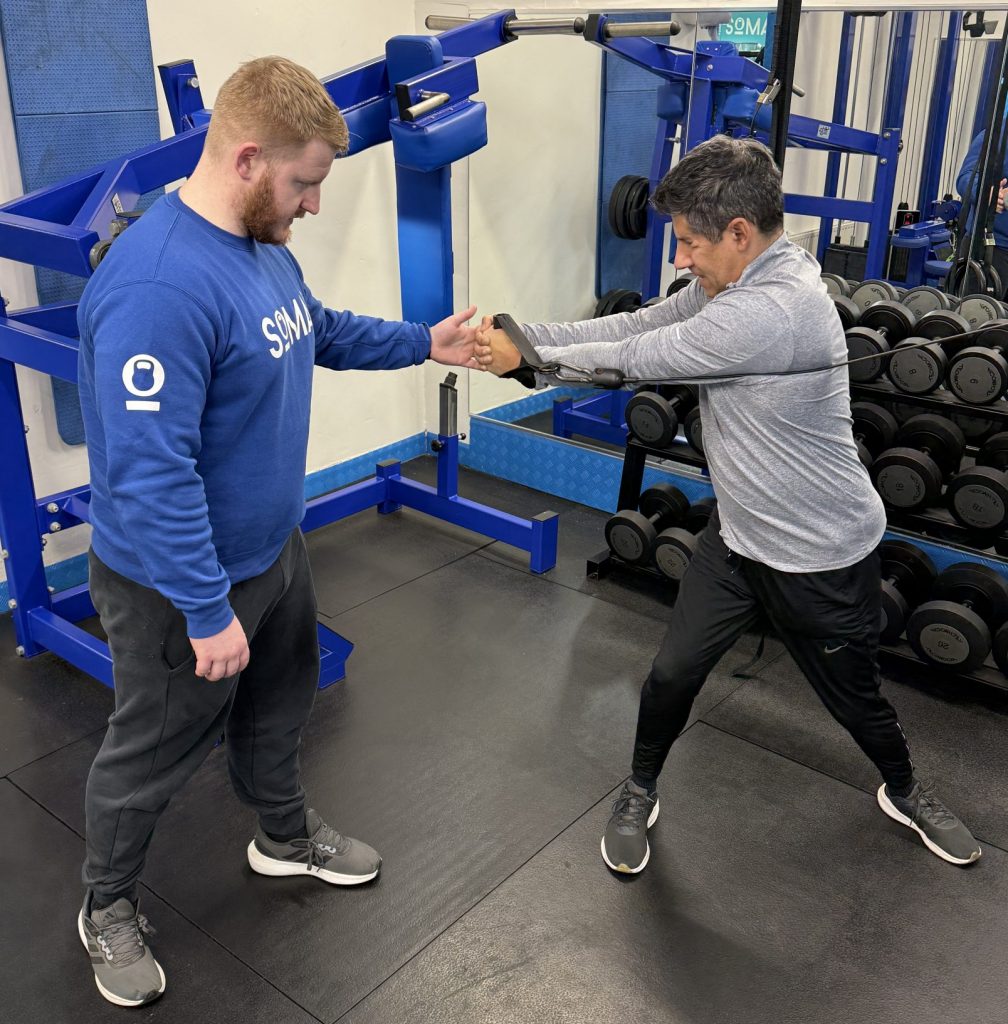
If you’re considering hiring a personal trainer, there’s a good chance you’ve asked yourself:
Is personal training actually worth the money?
After all, you can join a gym yourself.
You can find thousands of workouts online.
You can watch exercise videos on YouTube.
You can track calories through an app.
So why pay someone to stand next to you while you exercise?
It’s a fair question.
And the answer isn’t:
Everyone needs a personal trainer.
They don’t.
At Soma Fitness, we’ve spent almost twenty years coaching men and women across Altrincham, Hale and the surrounding areas, and there are absolutely people capable of achieving excellent results independently.
But there are also situations where professional coaching can dramatically improve the quality, structure and consistency of your training.
The question isn’t simply:
“Is personal training worth it?”
A better question is:
“Would personal training solve the problems currently stopping me from achieving my goals?”
Let’s look at that properly.
What Are You Actually Paying a Personal Trainer For?
This is the first misconception.
You’re not simply paying somebody to count:
“Eight… nine… ten.”
If that’s all your trainer does, I’d question the value too.
Good personal training should involve far more than supervising a workout.
You’re paying for:
- Assessment
- Program design
- Exercise selection
- Technique coaching
- Progression
- Training management
- Accountability
- Education
- Feedback
- Progress monitoring
- Appropriate program adjustments
Depending on the coaching service, it may also include nutrition and lifestyle guidance.
The workout is only one part of the process.
Personal Training Removes Guesswork
Walk into most commercial gyms and you’ll see plenty of people working hard.
The problem isn’t necessarily effort.
It’s direction.
They do some chest.
Then some arms.
Maybe a few machines.
Ten minutes on the treadmill.
Next session, they do something completely different.
They’re exercising.
But there’s no clear progression.
A well-designed personal training program answers several questions:
What are we trying to achieve?
Which exercises are appropriate?
How much training do we need?
How hard should you train?
How will we measure progress?
When should the program change?
Once those questions are answered, training becomes considerably more purposeful.
A Personal Trainer Gives You Structure
One of the biggest advantages of coaching is structure.
Your training isn’t dependent on how motivated you feel that day.
Your session is booked.
Your program is prepared.
Your coach is waiting.
You arrive.
You train.
For busy professionals in Hale and Altrincham, this can be incredibly valuable.
Fitness becomes an appointment rather than something you hope to squeeze in if the day goes perfectly.
Accountability Is More Powerful Than People Realise
Most people already know that exercise is good for them.
They know vegetables are healthy.
They know drinking ten pints every weekend probably isn’t helping.
Knowledge isn’t always the problem.
Execution is.
You might genuinely intend to train three times this week.
Then Monday becomes busy.
Tuesday’s meeting runs late.
Wednesday you’re tired.
Thursday you’ll definitely train.
Thursday disappears.
Then it’s Friday.
Accountability closes the gap between intention and action.
Personal Training Can Save You Time
People often look at the time spent with a trainer and think:
“I could just train myself.”
You could.
But how much time have you already spent:
Following ineffective program?
Changing exercises?
Watching conflicting fitness videos?
Starting diets you couldn’t maintain?
Training without progressing?
If a coach helps you avoid years of trial and error, that’s worth considering when assessing the cost.
For a busy person, efficiency has value.
Technique Coaching Matters
You can learn exercises online.
But a video can’t necessarily see what you’re doing.
You might think your squat looks fine.
A coach can see:
Your position.
Your control.
Your range of motion.
How you’re distributing load.
Whether the exercise is appropriate for you.
Small technical adjustments can significantly improve how an exercise performs.
This becomes particularly valuable as the loads you’re using increase.
You Learn How Hard to Train
This is one of the most underestimated parts of resistance training.
Beginners often don’t know how hard a working set should feel.
Some train far too easily.
Others try to take absolutely everything to failure.
Neither extreme is necessary.
A coach can help you understand:
- Appropriate effort
- Load selection
- Repetition ranges
- Rest periods
- Progression
- Fatigue management
Over time, you develop a better understanding of your own capabilities.
A Good Trainer Tracks Progress
If your program is working, we should be able to identify some form of improvement.
Depending on your goal, we might monitor:
- Strength
- Repetitions
- Training loads
- Body weight
- Waist measurements
- Progress photographs
- Cardiovascular fitness
- Movement quality
- Adherence
Without tracking anything, you’re largely relying on memory and feeling.
Data doesn’t need to become obsessive.
But it gives us something objective to work with.
Personal Training Can Help With Fat Loss
If your goal is fat loss, your trainer shouldn’t simply try to make you sweat as much as possible.
Fat loss isn’t determined by how exhausted you feel after your session.
Nutrition matters.
Daily activity matters.
Resistance training matters.
Sleep and lifestyle can affect adherence.
A good coach helps organise those variables into a manageable strategy.
The aim isn’t simply to make the scales lighter.
We want to improve body composition while maintaining as much muscle and strength as possible.
Personal Training Can Help You Build Muscle
Muscle building requires more than simply lifting weights.
You need sufficient:
- Training stimulus
- Progressive overload
- Exercise volume
- Effort
- Nutrition
- Protein
- Recovery
One of the biggest reasons people stop progressing is that their training never actually progresses.
They’re doing the same weights for the same repetitions year after year.
Good coaching identifies where progression should occur and when changes are necessary.
Personal Training Becomes Increasingly Valuable After 40
Your 40s and 50s aren’t the time to stop challenging your body.
They’re arguably when resistance training becomes increasingly valuable.
Maintaining muscle and strength supports your ability to remain physically capable as you age.
For many clients, the goal changes.
At 25, perhaps you wanted bigger arms.
At 45, you might still want bigger arms.
Nothing wrong with that.
But now you may also care about:
Strength.
Mobility.
Body composition.
Bone health.
Cardiovascular fitness.
Being able to play with your children.
Remaining physically capable into your 60s and 70s.
Training becomes an investment in your future.
Personal Training for Women During Menopause
For women approaching or going through menopause, resistance training can become particularly important.
Changes associated with the menopausal transition can affect areas including muscle and bone health and body-fat distribution.
A well-structured program can support:
- Strength
- Muscle maintenance
- Bone health
- Physical function
- Body composition
Training doesn’t need to become gentle simply because you’re getting older.
It needs to become appropriate.
What If You Have Previous Injuries?
This is another situation where professional coaching can provide significant value.
Perhaps you’ve experienced:
- Lower back problems
- Knee pain
- Shoulder injuries
- Previous surgery
- Old sporting injuries
You may be nervous about returning to exercise.
The answer isn’t always to avoid resistance training.
Often, training simply needs to be appropriately modified.
At Soma Fitness, our coaching team has additional qualifications in injury rehabilitation, helping us adapt exercise selection and progression around individual circumstances where appropriate.
Personal trainers don’t replace physiotherapists or doctors, and where clinical assessment is required, we’ll recommend it.
Good coaching includes understanding the boundaries of your professional role.
What If You’re a Complete Beginner?
This is arguably one of the situations where personal training provides the most immediate value.
When you’ve never trained before, everything is unfamiliar.
What exercises should you do?
How do you use the equipment?
How many sets?
How many repetitions?
What weight?
How often?
How hard?
A trainer removes those decisions.
Your job becomes much simpler:
Turn up and learn.
Over time, your confidence increases because your competence increases.
Do Experienced Gym-Goers Benefit From Personal Training?
Absolutely.
But for different reasons.
An experienced trainee might not need someone to explain what a dumbbell is.
They may benefit from:
- More advanced programming
- Technique refinement
- Objective feedback
- Plateau management
- Exercise selection
- Fatigue management
- Accountability
Sometimes experience creates blind spots.
Another pair of knowledgeable eyes can identify things you’ve stopped noticing.
Is Personal Training Worth It If You’re Busy?
Potentially, this is where it offers the most value.
If you’ve got unlimited free time, wasting an hour occasionally isn’t particularly costly.
But if you’re running a business, managing a career and raising a family, your time matters.
You don’t want to spend ninety minutes wandering around a gym trying to decide what to do.
You want to arrive.
Train effectively.
Leave.
At Soma Fitness, our private facility is dedicated to coached personal training.
There are no general gym memberships.
Your programme is ready.
Your coach is there.
The session has a purpose.
When Personal Training Might NOT Be Worth It
Let’s be fair.
Personal training isn’t automatically worth it for everybody.
You may not need regular PT if:
- You’re highly experienced
- You already program effectively
- Your technique is strong
- You’re consistently progressing
- You’re accountable without external support
- You genuinely enjoy training independently
In that situation, occasional coaching or program reviews may be enough.
And that’s fine.
A good trainer shouldn’t try to convince you that you’re incapable of exercising without them.
Personal Training Isn’t Worth It If the Trainer Is Poor
This is important.
Simply hiring a PT doesn’t guarantee results.
Poor personal training is poor value at almost any price.
Warning signs include:
- Random workouts every session
- No program
- No progress tracking
- No goal assessment
- Constantly changing exercises
- No explanation behind training decisions
- Unrealistic promises
- Selling unnecessary supplements
- Treating every client identically
Being enthusiastic isn’t enough.
Coaching needs a process.
Don’t Judge a Trainer by Instagram Followers
Social media has made this particularly confusing.
A great content creator isn’t automatically a great coach.
And an excellent coach might have 800 Instagram followers.
Look at:
- Qualifications
- Experience
- Client results
- Coaching philosophy
- Communication
- Professionalism
- Program structure
The trainer needs to be good at coaching people, not simply good at filming themselves.
Is Online Coaching Better Value?
For some people, yes.
If you’re already confident training independently, online coaching can provide programming, accountability and guidance without paying for face-to-face training time.
That can make it a more affordable option.
But if you’re a beginner who needs hands-on exercise coaching, face-to-face personal training may initially provide more value.
Neither is universally superior.
They’re different services.
How Often Do You Need Personal Training?
You don’t necessarily need five sessions per week.
For many people:
Once Per Week
Can work extremely well if you’re completing additional independent training.
Twice Per Week
Provides an excellent balance of coaching, training and accountability for many busy professionals.
Three Times Per Week
Can work particularly well for people wanting more supervised training or who don’t want to train independently.
The appropriate frequency depends on:
Your goal.
Experience.
Schedule.
Budget.
Recovery.
And what you’re prepared to do outside your sessions.
The Cheapest Option Isn’t Always the Best Value
This applies to most professional services.
You wouldn’t necessarily choose:
The cheapest accountant.
The cheapest solicitor.
The cheapest builder.
You’d consider the outcome and quality of service.
Fitness should be viewed similarly.
That doesn’t mean expensive automatically equals good.
It doesn’t.
But price shouldn’t be assessed without considering value.
What Is Getting Results Worth?
There’s another side to this question.
Imagine spending another five years:
Starting and stopping diets.
Paying for gym memberships you barely use.
Losing weight and regaining it.
Feeling uncomfortable in the gym.
Watching your strength gradually decline.
Personal training has a financial cost.
But remaining stuck has a cost too.
Time.
Frustration.
Lost confidence.
And potentially years where you could have been becoming stronger and healthier.
What Should You Look for in a Personal Trainer?
Before committing, ask:
Do they understand my goal?
Have they worked with people like me?
Is the program personalised?
Do they track progression?
Can they explain why I’m doing each exercise?
Do I trust them?
Is the environment somewhere I’ll actually enjoy training?
Can I realistically sustain the cost and frequency?
You don’t need the most famous trainer.
You need the right coach for you.
Why Choose Soma Fitness?
Soma Fitness is a private personal training studio based on Hale Road in Altrincham, serving men and women throughout:
- Altrincham
- Hale
- Bowdon
- Hale Barns
- Timperley
- Sale
- Surrounding South Manchester areas
We’ve spent almost twenty years helping clients improve their:
- Strength
- Fitness
- Muscle
- Body composition
- Confidence
- Long-term physical health
Our coaching team also has additional qualifications in injury rehabilitation, allowing us to appropriately adapt training around previous injuries and individual needs.
Most importantly:
We coach the individual in front of us.
Not a generic template.
Frequently Asked Questions
Is having a personal trainer actually worth it?
It can be if professional coaching helps solve problems you’re struggling to solve independently, such as programming, technique, progression, accountability or consistency.
Is personal training worth it for beginners?
Beginners can gain considerable value from learning exercise technique correctly, understanding how to train and developing confidence in a structured environment.
Is personal training worth it for weight loss?
It can be, particularly when coaching considers resistance training, nutrition, activity and lifestyle rather than simply trying to burn calories during workouts.
Is one PT session per week worth it?
Yes, particularly if you’re willing to perform additional independent training. One weekly session can provide coaching, progression and accountability.
Is twice-weekly personal training enough?
For many people, absolutely. Two structured resistance sessions per week can provide an excellent foundation when combined with appropriate activity and nutrition.
Is personal training worth it after 40?
It can be particularly valuable if you want to develop or maintain strength, muscle, physical function and confidence as you age.
Do I need a personal trainer forever?
No. Good coaching should educate you and improve your independence. Some people eventually train alone, while others continue because they value the accountability and coaching.
Is Personal Training Worth It for You?
Here’s the simplest way to answer the question.
If you’re:
Training consistently.
Progressing.
Happy with your results.
Confident with your technique.
And know exactly what you’re doing…
You may not need a personal trainer.
But if you’ve spent the last few years:
Starting and stopping.
Guessing what exercises to perform.
Not progressing.
Struggling with your weight.
Feeling intimidated by gyms.
Or repeatedly promising yourself you’ll start again on Monday…
Professional coaching could be one of the smartest ways to break that cycle.
Looking for a Personal Trainer in Altrincham or Hale?
If you’re wondering whether personal training is worth it, you don’t need to make the decision from a website.
Come and meet us.
At Soma Fitness, we offer a free consultation where we’ll sit down and discuss:
Your goals.
Your current situation.
Your training history.
Your lifestyle.
Your availability.
And any injuries or limitations we need to consider.
We’ll explain how we’d approach your training and whether we think our coaching is appropriate for you.
Then you can decide.
If you’re looking for a Personal Trainer in Altrincham, Personal Trainer in Hale, or private one-to-one coaching in the surrounding area, we’d be happy to meet you.
Book your free consultation with the Soma Fitness coaching team and find out whether personal training is the right investment for you.
Recent Comments