
Personal Trainer for Muscle Building in Altrincham – Why Your Gym Progress Has Stalled
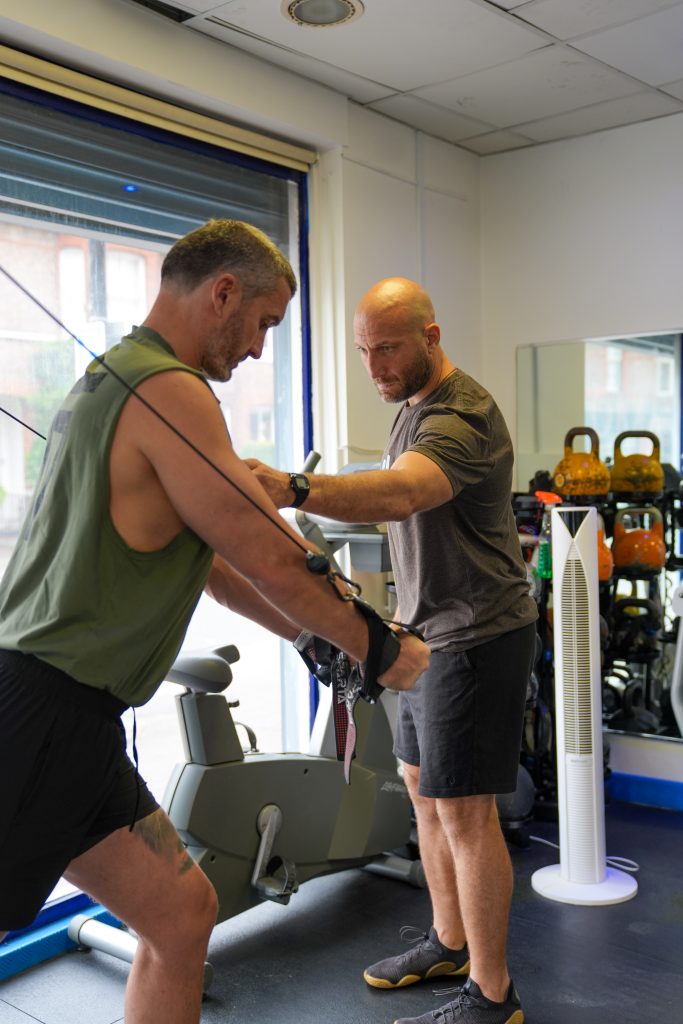
You train three or four times per week.
You rarely miss a session.
You’ve been doing it for months.
Maybe years.
But when you look back at your training, something doesn’t add up.
You’re using roughly the same weights.
Your physique hasn’t changed much.
You don’t feel significantly stronger.
And despite putting plenty of effort into the gym, you’re beginning to wonder:
Why am I not progressing?
This is a very different problem from not exercising.
You’re already doing the work.
The issue is whether that work is organised effectively enough to produce the adaptation you’re looking for.
At Soma Fitness, our private personal training studio on Hale Road in Altrincham works with men and women throughout Altrincham, Hale, Bowdon, Hale Barns, Timperley, Sale and surrounding South Manchester.
If your goal is building muscle and strength, simply going to the gym isn’t enough.
Your training needs direction.
Let’s look at where progress commonly breaks down.
Going to the Gym Isn’t the Same as Training
There is a difference between:
Exercising
and:
Training.
Exercise can simply mean being physically active.
You turn up.
Do some exercises.
Work hard.
Sweat.
Go home.
Training has a longer-term objective.
You’re trying to improve something.
That requires us to think beyond today’s workout.
A Training Programme Needs Direction
If your goal is building muscle, we need to know:
Which muscles are we trying to develop?
How frequently are we training them?
Which exercises are we using?
How many hard sets are being performed?
How close are those sets to muscular failure?
Are exercises progressing?
Are you recovering between sessions?
Are you eating appropriately?
And what does the programme look like next month?
Without that structure, it’s easy to spend years exercising without making the progress you expected.
One of the Biggest Problems: Random Workouts
Monday:
Chest.
Tuesday:
Something you saw on Instagram.
Thursday:
A completely different workout.
Saturday:
Whatever machines are free.
Next week:
New programme.
Three weeks later:
Another programme.
Constant variety can make training entertaining.
But it makes progression much harder to measure.
If exercises continually change, how do you know whether you’re actually getting better at them?
You Don’t Need a New Workout Every Week
Muscle doesn’t become bored.
You don’t need to constantly “confuse” it.
In many cases, keeping useful exercises in your programme for long enough allows you to:
Improve technique.
Build skill.
Track performance.
Add repetitions.
Add load.
And determine whether you’re progressing.
Variation can absolutely have a place.
But variation should have a reason.
Progressive Overload Matters
You’ve probably heard the term:
Progressive overload.
At its simplest, it means the training stimulus needs to progress appropriately over time.
That doesn’t mean adding weight to the bar every single session forever.
Progress could involve:
More repetitions.
More load.
More productive sets.
Improved technique.
Greater range of motion.
Better control.
Or progressing to a more demanding exercise where appropriate.
The important point is that your training shouldn’t remain completely unchanged indefinitely.
Are You Actually Tracking Your Training?
Ask yourself:
What weight did you use on your chest press three weeks ago?
How many repetitions?
How many sets?
What did you achieve last week?
If the answer is:
“I’m not sure.”
then progression becomes difficult.
You don’t need an enormous spreadsheet.
But some record of your training is extremely useful.
Your Logbook Tells a Story
Imagine six months ago you performed:
Dumbbell press – 24kg × 8
and now you’re performing:
Dumbbell press – 32kg × 10
with comparable technique and range of motion.
Something has improved.
Likewise, if six months have passed and every exercise is virtually identical, we need to understand why.
Training records give us information.
But Adding Weight Isn’t Everything
There’s another extreme.
Some people become so obsessed with adding load that exercise quality deteriorates.
Last month:
80kg × 8 with controlled technique.
This month:
100kg × 6 with:
Half the range.
Momentum.
Assistance.
And completely different execution.
The number increased.
But did the target muscle actually receive a better stimulus?
Not necessarily.
Exercise Execution Matters
For hypertrophy, we’re generally trying to create meaningful tension through the target musculature.
That means exercise execution deserves attention.
Depending on the movement, we may consider:
Stability.
Range of motion.
Control.
Joint position.
Exercise setup.
Tempo.
And whether the target muscle is actually being challenged effectively.
This doesn’t mean every repetition needs to look artificially slow.
It means execution should support the goal.
Are You Training Hard Enough?
This is another major reason progress stalls.
Some people finish every set because:
“I’ve reached ten reps.”
But perhaps they could have performed another:
Five.
Six.
Or seven repetitions.
If every working set is extremely easy, the stimulus for muscle growth may be limited.
Hypertrophy training generally requires us to perform sufficiently challenging sets.
Do You Need to Train to Failure?
Not necessarily on every set.
You don’t need every exercise to end with:
The weight pinned against you.
Technique collapsing.
And somebody screaming:
“ONE MORE!”
But you should develop an understanding of how close you are to the point where another good repetition would be difficult or impossible.
That’s a skill.
Learning Effort Takes Time
Beginners often underestimate how many repetitions they have left.
They perform ten.
Rack the weight.
And say:
“That was hard.”
But if required, they might have completed another eight repetitions.
As you become more experienced, you get better at judging:
How difficult a set actually was.
How many repetitions were probably available.
And when to stop.
A coach can help calibrate that.
But You Can Also Train Too Hard
The opposite problem exists.
Every exercise.
Every set.
Absolute failure.
Forced repetitions.
Drop sets.
Rest-pause.
More exercises.
More sets.
More fatigue.
Hard training is important.
But fatigue has a cost.
We need enough training to stimulate adaptation without creating so much fatigue that recovery and subsequent performance suffer unnecessarily.
More Volume Isn’t Automatically Better
People often assume:
If ten sets work…
Twenty must work better.
And thirty must be even better.
Training doesn’t work quite like that.
There is a point where additional volume produces diminishing returns and potentially excessive fatigue.
Your appropriate training volume depends on:
Training experience.
Exercise selection.
Effort.
Frequency.
Recovery.
And individual response.
Quality Sets Matter
Instead of asking:
“How many exercises should I do?”
a better question might be:
“How much productive training do I need?”
Five exercises performed with:
Good execution.
Appropriate effort.
Progression.
And sufficient recovery
may produce considerably more than twelve exercises performed without direction.
Exercise Selection Matters
There is no single compulsory exercise for building muscle.
You don’t have to:
Barbell back squat.
Conventional deadlift.
Flat barbell bench press.
Or perform any other particular lift.
Those exercises can be excellent.
But they’re tools.
The best exercise depends on:
The target muscle.
Your structure.
Training history.
Equipment.
Comfort.
Joint tolerance.
And the rest of the programme.
Different People May Need Different Exercises
Two clients may both want larger quadriceps.
One might respond extremely well to:
Back squats.
Another might perform better with:
Hack squats.
Leg presses.
Split squats.
Leg extensions.
Or a combination.
We don’t need to force every client into identical programmes.
Stability Can Be Useful for Hypertrophy
Sometimes people assume an exercise is better because it requires more balance.
Not necessarily.
If muscle growth is the objective, additional stability can sometimes allow you to direct more effort towards the target musculature.
That’s one reason machines can be extremely useful.
Machines aren’t:
“Cheating.”
They’re simply another resistance-training tool.
Free Weights Are Useful Too
Likewise, this doesn’t mean machines are always superior.
Dumbbells and barbells offer:
Flexibility.
Large exercise selection.
Coordination demands.
And excellent opportunities for progression.
A well-designed programme can use both.
We select exercises because they serve a purpose.
Not because one category is fashionable.
Are You Training Muscles Frequently Enough?
Training frequency is another variable.
You don’t necessarily need to train each muscle every day.
Nor is there one universally perfect split.
You could successfully use:
Full-body training.
Upper/lower.
Push/pull/legs.
Or other structures.
The question is whether your weekly programme distributes your training effectively and fits your schedule.
Your Programme Has to Fit Your Life
A theoretically perfect six-day bodybuilding programme isn’t very useful if you can realistically train three days per week.
The programme should account for:
Work.
Family.
Sport.
Sleep.
Recovery.
And available training days.
A programme you can consistently execute beats an elaborate programme you continually miss.
Three Good Sessions Can Achieve a Lot
For many recreational trainees, three well-structured resistance-training sessions each week can provide plenty of opportunity to progress.
Others may train:
Two.
Four.
Five.
Or more times.
Frequency is a tool.
It isn’t a badge of commitment.
Recovery Is Part of Training
Muscle isn’t built simply because you lifted weights.
Training creates a stimulus.
Adaptation then requires recovery.
That means we need to consider:
Sleep.
Nutrition.
Training frequency.
Total volume.
Stress.
And other physical activity.
If you’re training hard while:
Sleeping five hours.
Eating inadequately.
Playing sport five times per week.
And working extremely long hours…
your programme may need to account for that.
Sleep Matters for Muscle Building
You don’t need perfect sleep every night.
Real life doesn’t work that way.
But consistently poor sleep can make:
Training performance.
Recovery.
Appetite regulation.
And adherence
more difficult.
If muscle building matters to you, recovery shouldn’t be treated as an afterthought.
Nutrition Matters Too
You cannot separate muscle-building training from nutrition entirely.
You need enough:
Energy.
Protein.
Micronutrients.
And overall food.
If you’re trying to build as much muscle as possible while chronically under-eating, you’re making the process harder.
Do You Need a Huge Calorie Surplus?
No.
The traditional:
“Bulk as hard as possible and cut later”
approach can result in unnecessary body-fat gain.
For many recreational lifters looking to gain muscle, a more controlled approach makes sense.
The appropriate calorie intake depends on:
Current body composition.
Training status.
Goal.
Rate of progress.
And individual circumstances.
Protein Is Important
Protein provides the amino acids required to support muscle protein synthesis and repair.
Your exact requirements depend on context.
But if you’re serious about building muscle, consuming adequate protein across your diet is sensible.
Good protein sources can include:
Lean meats.
Fish.
Eggs.
Dairy.
Legumes.
Soy.
And appropriate supplements where useful.
Protein powder can be convenient.
It isn’t compulsory.
Carbohydrates Aren’t the Enemy
If you’re training hard, carbohydrates can be extremely useful.
They provide a readily available source of energy and contribute to muscle glycogen.
That can support resistance-training performance.
If your goal is building muscle, automatically eliminating carbohydrates because somebody online called them “bad” probably isn’t necessary.
Dietary Fat Matters Too
Fat also has important roles within the diet.
Again, we don’t need to turn this into:
Protein good.
Carbohydrates bad.
Fat good.
Or any other simplistic nutritional argument.
Your diet needs an appropriate balance for:
Your goal.
Health.
Preferences.
Training.
And adherence.
Supplements Come After the Fundamentals
People often want to know:
Which pre-workout?
Which amino acids?
Which testosterone booster?
Which muscle-building supplement?
Before asking:
Am I training properly?
Am I progressing?
Am I eating enough protein?
Am I sleeping?
Am I consistent?
Get those right first.
What About Creatine?
Creatine monohydrate is one of the better-supported sports supplements for improving high-intensity exercise performance and supporting training adaptations.
It can be useful.
It isn’t mandatory.
And it certainly won’t compensate for a poor training programme.
Why Your Strength May Have Stalled
If you’ve been lifting the same weights for months, possible explanations include:
Your programme isn’t progressing.
You’re not training hard enough.
You’re training too hard.
Your technique changes whenever load increases.
Your training volume isn’t appropriate.
Your exercise selection isn’t suitable.
You’re not recovering.
You’re under-eating.
You’re constantly changing programmes.
Or you’ve simply reached a level where progress is naturally slower.
That’s why context matters.
Beginners Progress Differently From Experienced Lifters
A beginner may progress rapidly.
They are:
Learning movements.
Developing coordination.
Increasing neural efficiency.
And adapting to a completely new stimulus.
Someone with ten years of structured resistance training shouldn’t expect the same rate of progress.
The more advanced you become, the more valuable small improvements become.
Muscle Building Takes Time
This isn’t particularly exciting marketing.
But it’s true.
Meaningful muscle development requires:
Months.
Years.
Consistency.
And patience.
You can improve relatively quickly as a beginner.
But dramatic natural muscular development doesn’t happen in four weeks.
That’s why the programme needs to be something you can sustain.
What If You’re Over 40?
Being over 40 doesn’t mean muscle building suddenly becomes impossible.
Men and women can continue responding positively to resistance training as they age.
Your programme may need to account for:
Training history.
Recovery.
Joint tolerance.
Injury history.
Lifestyle.
And current physical capacity.
But the fundamentals remain remarkably familiar:
Train appropriately.
Progress.
Eat well.
Recover.
Repeat.
Stop Comparing Yourself With Your 25-Year-Old Self
If you’re now:
Running a business.
Raising children.
Sleeping less.
And carrying twenty years of additional life responsibilities…
your training doesn’t need to resemble what you did at university.
We build the programme around your current life.
Not nostalgia.
What If You Have Previous Injuries?
Previous injuries may influence exercise selection.
Perhaps:
Your shoulder dislikes one pressing variation.
Your knee tolerates one squat better than another.
Your wrist requires a different grip.
That doesn’t automatically mean you cannot train the muscle.
Sometimes we simply need a different exercise.
Members of the Soma Fitness coaching team have additional qualifications in injury rehabilitation and corrective exercise, which can help us adapt training where appropriate.
Pain Isn’t Something We Ignore
There is also a difference between:
Muscular effort.
Normal training discomfort.
And pain that requires further investigation.
Personal trainers don’t replace:
Doctors.
Physiotherapists.
Or other healthcare professionals.
If something needs clinical assessment, it should be assessed.
Good coaching includes understanding the limits of your scope.
Why Personal Training Can Help an Experienced Gym-Goer
Personal training isn’t only for beginners.
In fact, somebody who has trained independently for several years can sometimes benefit enormously from an outside perspective.
You may need:
Programme review.
Technique feedback.
Better exercise selection.
More objective progression.
Accountability.
Or somebody to challenge assumptions you’ve carried for years.
You Can’t Always See Your Own Technique
An exercise may feel normal because you’ve performed it the same way for five years.
That doesn’t necessarily mean it’s optimal for your goal.
A coach can observe:
Setup.
Joint position.
Range.
Control.
Compensations.
And whether the exercise is doing what you intend it to do.
Sometimes a small adjustment changes the exercise considerably.
Programming Removes Guesswork
Imagine arriving at the gym knowing:
Exactly what exercises you’re doing.
The target repetitions.
Your previous performance.
What you’re trying to beat.
And why each exercise is in the programme.
That’s very different from walking in and thinking:
“What should I train today?”
Structure removes unnecessary decisions.
At Soma Fitness, We Track Training
Our coaching isn’t based around inventing a new workout every session.
We want to know:
What you did.
How you performed.
What needs progressing.
What needs adjusting.
And where the programme is heading.
The objective is long-term progression.
Our Sessions Are 60 Minutes
All Soma Fitness one-to-one personal training sessions are 60 minutes.
That gives us enough time for:
Preparation.
Primary exercises.
Accessory work.
Appropriate rest periods.
Technique coaching.
Progression.
And communication with your coach.
We’re not trying to squeeze the maximum number of exercises into an hour.
We’re trying to make the work productive.
You Don’t Need to Leave Exhausted
This is worth repeating.
A good muscle-building session doesn’t need to leave you unable to walk.
Soreness isn’t the goal.
Sweat isn’t the goal.
Exhaustion isn’t the goal.
Adaptation is the goal.
Sometimes excellent training feels brutally hard.
Sometimes it doesn’t.
Judge the programme by progression over time.
How Do We Know If Your Programme Is Working?
We can look at:
Training performance.
Repetitions.
Loads.
Exercise execution.
Body weight.
Measurements.
Progress photographs.
And your overall recovery.
No single metric tells us everything.
Together, they give us a much clearer picture.
What Does Muscle Building Coaching at Soma Fitness Look Like?
Your programme will be individual.
But broadly, the process can include:
1. Consultation
Understand your goal, history and current training.
2. Programme assessment
Identify what’s working and what isn’t.
3. Exercise selection
Choose movements appropriate for you and the target musculature.
4. Establish training volume and frequency
Enough work to stimulate progress without simply accumulating fatigue.
5. Monitor training intensity
Make sure working sets are genuinely productive.
6. Track performance
Record loads, repetitions and progression.
7. Support nutrition
Ensure your food intake supports the goal.
8. Manage recovery
Consider sleep, stress and other activity.
9. Review and adjust
Make changes when the evidence suggests they’re needed.
That’s very different from simply receiving another workout.
Personal Trainer for Muscle Building Near Altrincham
Soma Fitness is a private one-to-one personal training studio based on Hale Road in Altrincham.
We’re conveniently located for clients throughout:
Altrincham.
Hale.
Bowdon.
Hale Barns.
Timperley.
Sale.
And surrounding South Manchester.
If you’re already training but frustrated with your progress, you don’t necessarily need to work harder.
You may need to make your training more productive.
Frequently Asked Questions
Can a personal trainer help me build muscle?
A personal trainer can help structure your programme, select appropriate exercises, monitor technique, manage progression and support the training and nutrition behaviours required for muscle development.
How many times per week should I train to build muscle?
There isn’t one compulsory frequency. Effective programmes can be built around different schedules. Your appropriate frequency depends on training volume, experience, recovery and available time.
Do I need to train to failure to build muscle?
Not every set needs to reach absolute muscular failure. However, hypertrophy training generally requires sufficiently challenging sets, and learning to judge effort is an important training skill.
Should I lift heavy weights to build muscle?
Muscle can be developed across a range of loads when sets are appropriately challenging. Exercise selection, effort, volume, progression and execution all matter.
Do I need to bulk to build muscle?
Not everyone needs a large calorie surplus. Nutritional requirements depend on current body composition, training experience and goals.
How much protein do I need?
Protein requirements depend on the individual and context. We have a separate Soma Fitness guide explaining practical protein targets for muscle building, fat loss and healthy ageing.
Is muscle building possible after 40?
Yes. Adults can continue adapting positively to resistance training after 40. Programming should account for the individual’s experience, recovery, health and circumstances.
Are machines or free weights better?
Neither is universally superior. Both can be valuable. Exercise selection should reflect the target muscle, individual, equipment and programme.
How long does it take to build muscle?
Muscle growth is a gradual process. Beginners may notice changes relatively quickly, while experienced trainees generally progress more slowly. Long-term consistency matters.
Where is Soma Fitness?
Soma Fitness is located on Hale Road in Altrincham, conveniently serving Altrincham, Hale and surrounding South Manchester.
How long are your PT sessions?
All our one-to-one personal training sessions are 60 minutes.
Can I have a consultation before deciding?
Yes. Your first step can be a free consultation with one of our coaching team to discuss your goals and current training.
Training Hard but Still Not Progressing?
If you’re already going to the gym but:
Your strength has stalled.
Your physique isn’t changing.
You constantly change programmes.
You’re unsure whether you’re training hard enough.
You don’t know how much volume you need.
Or you’ve simply reached a point where you don’t know what to change next…
doing more isn’t necessarily the answer.
You may need better structure.
At Soma Fitness, we provide private one-to-one personal training from our studio on Hale Road in Altrincham.
We’ll help you look at:
Your programme.
Exercise selection.
Technique.
Training volume.
Effort.
Progression.
Nutrition.
And recovery.
Then build a programme around you.
Your first step is a free consultation.
Come into the studio.
Meet one of our coaching team.
Show us what you’re currently doing.
Tell us where your progress has stalled.
And tell us what you’d like to achieve.
We’ll explain how we’d approach your training.
Don’t just train harder.
Make your training more productive.
Contact Soma Fitness today to arrange your free consultation.
Recent Comments