
Personal Trainer for Women in Altrincham – What Should You Look for in a Coach?
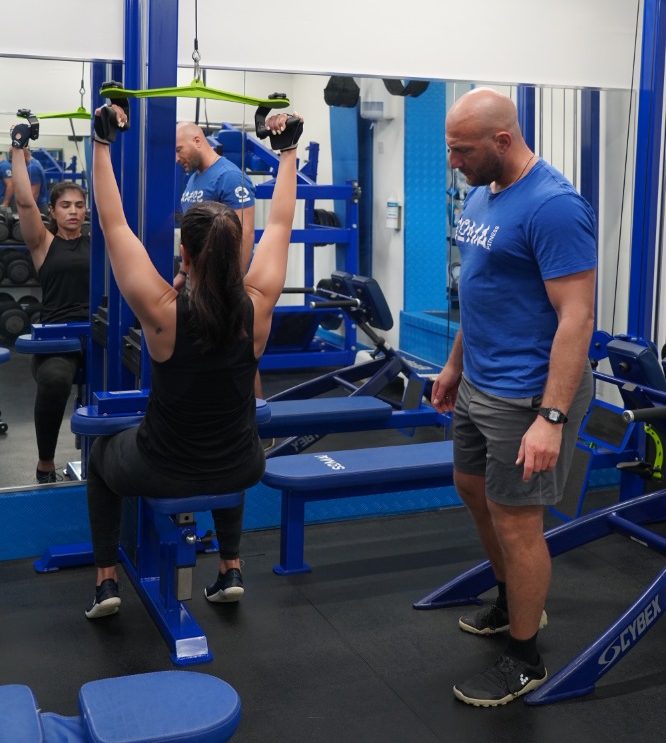
If you’re a woman looking for a personal trainer in Altrincham, you don’t necessarily need:
A “women’s workout.”
A female-only exercise programme.
Endless glute exercises.
Light weights.
Or hours of cardio.
You need good coaching.
Because while there are physiological and life-stage considerations that can influence how an individual woman trains, the fundamentals of effective exercise don’t suddenly change because you’re female.
You still need a programme built around:
Your goals.
Your starting point.
Your training experience.
Your strength.
Your fitness.
Your injury history.
Your schedule.
And your preferences.
At Soma Fitness, we provide private one-to-one personal training from our studio on Hale Road in Altrincham, working with both men and women from Altrincham, Hale, Bowdon, Hale Barns, Timperley, Sale and surrounding South Manchester.
So if you’re looking for personal training as a woman, what should you actually be looking for?
Let’s break it down.
Start With Your Goal – Not Your Gender
Two women can walk into Soma Fitness on the same day and require completely different programmes.
One might want to:
Lose body fat.
Another:
Build muscle.
Another:
Get stronger.
Another:
Improve cardiovascular fitness.
Another:
Return to exercise after years away.
Another:
Train around previous injuries.
Another:
Improve physical capacity as she gets older.
That’s why the starting question shouldn’t simply be:
“What’s the best workout for women?”
It should be:
“What are you trying to achieve?”
Women Don’t Need to Train With Tiny Weights
One of the longest-standing myths in women’s fitness is that women should use:
Very light weights.
Very high repetitions.
And avoid lifting anything heavy.
Usually because of the fear of becoming:
“Too bulky.”
Resistance training doesn’t work that way.
Building substantial amounts of muscle requires:
Time.
Progressive training.
Adequate nutrition.
And consistency.
You don’t accidentally wake up after three strength sessions looking like a competitive bodybuilder.
Women Can Benefit Enormously From Strength Training
Resistance training can help develop:
Strength.
Muscle.
Physical function.
Confidence.
Bone-loading stimulus.
And the ability to perform everyday tasks.
And those benefits aren’t reserved for:
Athletes.
Bodybuilders.
Or twenty-year-olds.
Women can resistance train throughout adulthood.
Strength Training Isn’t Just About Appearance
A lot of women’s fitness marketing focuses almost entirely on:
Weight loss.
Smaller waistlines.
And aesthetics.
Those goals are completely valid if they’re important to you.
But resistance training can offer much more.
There’s something valuable about becoming:
Stronger.
More capable.
More physically confident.
And able to do things that previously felt difficult.
You Don’t Need to Be Fit Before Hiring a Personal Trainer
This is one of the biggest misconceptions we encounter.
Someone thinks:
“I’ll get a little fitter first, then I’ll contact a trainer.”
But that’s backwards.
You don’t need to:
Lose weight first.
Improve your cardio first.
Learn how to squat first.
Or understand gym equipment first.
That’s what coaching is there to help with.
What If You’ve Never Lifted Weights?
That’s absolutely fine.
A beginner programme doesn’t need to be complicated.
Initially, we might focus on learning movements such as:
Squatting patterns.
Pressing.
Pulling.
Hip-dominant movements.
Single-leg exercises.
Core exercises.
And basic cardiovascular work.
We gradually introduce:
Technique.
Load.
Effort.
And progression.
You don’t need to understand any of that before starting.
A Good Personal Trainer Should Teach You
This is important.
Personal training shouldn’t simply consist of somebody telling you:
“Do ten of these.”
A good coach should help you understand:
How to set up an exercise.
What you’re trying to achieve.
Where you should feel it.
How to control the movement.
How hard you’re working.
When to progress.
And why an exercise is in your programme.
Over time, you should become more knowledgeable about your own training.
Your Programme Should Be Individual
Be cautious if every client receives exactly the same programme.
A good programme should consider:
Your goals.
Training experience.
Current strength.
Mobility where relevant.
Injury history.
Exercise preferences.
Schedule.
Recovery.
And available training frequency.
Personal training should actually be personal.
What If Your Goal Is Weight Loss?
Fat loss is one of the most common reasons women approach personal trainers.
But weight-loss coaching shouldn’t simply mean:
More cardio.
Less food.
More cardio.
Even less food.
Fat loss requires an appropriate energy deficit over time.
But a well-designed programme may also consider:
Resistance training.
Protein intake.
Daily movement.
Cardiovascular exercise.
Sleep.
Eating habits.
And progress monitoring.
Resistance Training Is Valuable During Fat Loss
If you’re losing body weight, we generally want to retain as much useful lean tissue as reasonably possible.
Resistance training provides an important stimulus to maintain muscle.
That’s why our fat-loss clients don’t simply spend every session:
Running.
Cycling.
Sweating.
And trying to burn the maximum number of calories.
The gym is also where we train your body to remain:
Strong.
Capable.
And muscular.
You Don’t Need to Burn Hundreds of Calories in Every Session
Your smartwatch may tell you:
“You burned 487 calories.”
That doesn’t determine whether the workout was successful.
Firstly, calorie-expenditure estimates from wearable devices aren’t perfectly precise.
Secondly, the purpose of resistance training isn’t simply to maximise calorie burn.
We might use the session to improve:
Strength.
Technique.
Muscle.
Movement capacity.
Or training performance.
Fat loss is managed across the whole programme.
What If Your Goal Is Building Muscle?
Women can absolutely train specifically for hypertrophy—muscle growth.
That involves appropriately managing:
Exercise selection.
Training volume.
Effort.
Progression.
Frequency.
Nutrition.
And recovery.
Again, you don’t need a completely separate set of physiological rules because you’re female.
Good resistance-training principles still apply.
Glute Training Can Be Part of the Programme
Many women want to develop their glutes.
There’s nothing wrong with that.
But effective glute training involves more than performing endless:
Band walks.
Kickbacks.
And “booty circuits.”
The gluteal muscles can be trained through appropriately selected exercises involving hip extension and other relevant functions.
Depending on the person, that might include:
Hip thrust variations.
Squats.
Split squats.
Romanian deadlifts.
Back extensions.
Leg presses.
Cable exercises.
And other movements.
The programme depends on the individual.
You Can Train Your Upper Body Too
Another outdated idea is that women should:
Train legs.
Train glutes.
Do cardio.
And avoid developing the upper body.
There’s no reason for that.
A balanced resistance programme can train:
Back.
Shoulders.
Chest.
Arms.
Legs.
Glutes.
And trunk musculature.
Building upper-body strength can be incredibly useful.
Will Strength Training Make You Bulky?
This fear deserves addressing properly.
Developing substantial muscle naturally is generally a slow process.
Women also typically have substantially lower circulating testosterone concentrations than men.
That doesn’t mean women cannot build muscle.
They absolutely can.
It means the idea that a woman will accidentally become extremely muscular simply because she begins resistance training is unrealistic.
What About Menopause?
Menopause can introduce additional considerations.
Changes associated with the menopausal transition can influence:
Symptoms.
Sleep.
Body composition.
Bone health.
Recovery.
And how someone experiences training.
But menopause isn’t a reason to stop resistance training.
If anything, maintaining strength, muscle and physical activity becomes particularly valuable as we age.
We have a separate Soma Fitness guide specifically covering resistance training during menopause, which goes into this in greater detail.
Training After 40
Turning 40 doesn’t suddenly mean you need:
“Over-40 exercises.”
But your circumstances may have changed.
Perhaps you’re:
Working more.
Sleeping less.
Managing children.
Experiencing menopause or perimenopause.
Carrying old injuries.
Or returning after years away.
Those factors matter.
Your age alone doesn’t determine your programme.
Training After 50
The same applies after 50.
You can still:
Build strength.
Improve fitness.
Learn new exercises.
And make meaningful physical progress.
We simply start from your current capacity and progress appropriately.
What About Bone Health?
This becomes particularly relevant for women as they age.
Bone tissue responds to mechanical loading.
Resistance training and appropriate weight-bearing activity can therefore form part of a broader strategy supporting musculoskeletal health.
Individual medical circumstances still matter.
If you have diagnosed:
Osteoporosis.
Osteopenia.
Or another relevant medical condition,
your training should account for that and appropriate clinical guidance where necessary.
What If You Have Knee Pain?
Knee pain doesn’t automatically mean:
“Never squat again.”
But it also isn’t something a personal trainer should casually diagnose.
Depending on the situation, we may be able to modify:
Exercise selection.
Range of motion.
Load.
Volume.
Or technique.
Persistent, unexplained or concerning pain should be assessed by an appropriate healthcare professional.
What About Back Pain?
The same principle applies.
Back pain doesn’t automatically mean you should avoid all resistance training.
But there are many potential causes of back pain, and a personal trainer isn’t there to diagnose them.
Where appropriate, training can be adapted.
Where clinical assessment is required, we refer appropriately.
Shoulder Problems?
Again:
We don’t simply force everyone through identical exercises.
One person may tolerate:
Overhead pressing.
Another may prefer:
Landmine pressing.
Machine pressing.
Dumbbells.
Or another variation.
Exercise selection is a tool.
There’s rarely a requirement to force one particular exercise into everybody’s programme.
Look for a Coach Who Understands Scope of Practice
This is something prospective clients often overlook.
A good personal trainer should know what they’re qualified to do.
And what they’re not qualified to do.
If someone has a medical problem requiring diagnosis or treatment, that belongs with an appropriate healthcare professional.
A coach can then work alongside clinical recommendations where appropriate.
Qualifications Matter – But So Does Coaching Ability
A certificate alone doesn’t make someone an excellent coach.
When choosing a personal trainer, consider:
Qualifications.
Experience.
Communication.
Programming ability.
Professionalism.
Track record.
And whether they actually listen to you.
Soma Fitness has been coaching clients locally for almost two decades, and members of our coaching team also hold additional qualifications relating to injury rehabilitation and corrective exercise.
You Should Feel Comfortable Asking Questions
Personal training is a relationship.
You should feel comfortable saying:
“I don’t understand this.”
“That doesn’t feel right.”
“Why are we doing this exercise?”
“I’m struggling with my nutrition.”
“My sleep has been terrible this week.”
A coach needs information to coach effectively.
Communication matters.
A Coach Should Listen Before Prescribing
If you meet a trainer and within thirty seconds they already know exactly what programme you need…
without asking anything about you…
that’s worth questioning.
Before building your programme, we’d want to understand:
What you want.
What you’ve done before.
What worked.
What didn’t.
What your schedule looks like.
What you enjoy.
And what barriers you’re dealing with.
What Should Happen During a Consultation?
At Soma Fitness, your initial consultation gives us an opportunity to discuss:
Your goals.
Training history.
Lifestyle.
Current activity.
Previous injuries.
Nutrition where relevant.
Availability.
And what you want from coaching.
It also gives you an opportunity to decide whether Soma feels right for you.
A consultation isn’t only about us assessing you.
You’re assessing us too.
What If You Feel Intimidated by Gyms?
This is extremely common.
Commercial gyms can feel overwhelming if you’re unfamiliar with:
The equipment.
Gym etiquette.
Exercise technique.
Or simply being surrounded by experienced gym users.
That’s one reason Soma Fitness operates differently.
Soma Fitness Is a Private Personal Training Studio
We aren’t an open-membership commercial gym.
Our studio is focused on one-to-one coached sessions.
You’re not arriving and trying to work out:
Which machine is free.
What exercise to do.
Whether somebody is watching you.
Or whether you’re using something incorrectly.
Your coach is there with you.
Privacy Can Make Starting Easier
For some clients, the private environment isn’t important.
For others, it’s one of the main reasons they choose us.
Particularly if they’re:
New to exercise.
Returning after years away.
Self-conscious.
Uncomfortable in busy gyms.
Or simply prefer a quieter training environment.
The best environment is the one where you can train consistently.
Do You Need a Female Personal Trainer?
Some women specifically prefer working with a female coach.
Others don’t have a preference.
There isn’t a right or wrong answer.
What matters is that you’re comfortable with your coach and confident in their ability to help you.
If you have a preference when enquiring, tell us and we can discuss current coaching availability.
Male and Female Coaches Should Still Individualise Your Training
A competent coach shouldn’t rely on stereotypes such as:
“She’s a woman, so we’ll just do glutes and cardio.”
The programme should reflect the person standing in front of them.
Not assumptions about what women supposedly want.
Your Training Should Progress
Personal training shouldn’t look identical six months later.
We want to see progress.
That could involve:
More repetitions.
More load.
Better technique.
Improved range of motion.
Better cardiovascular fitness.
Greater work capacity.
Or increased training confidence.
The exact markers depend on your goal.
Your Programme Should Be Recorded
If every session is random, progression becomes difficult to measure.
We want to know:
What you did last week.
What you achieved.
What needs progressing.
And what we’re working towards.
That creates continuity.
Don’t Judge Training by Soreness
Being extremely sore doesn’t prove a session was effective.
Likewise:
Sweating.
Feeling exhausted.
Or struggling to walk downstairs
doesn’t automatically mean you had a better workout.
The goal is adaptation.
Not punishment.
Training Should Challenge You
That doesn’t mean training should always feel easy.
If your goal is improving strength and muscle, your working sets need to provide an appropriate stimulus.
Part of coaching is helping you learn:
What genuine effort feels like.
When to push.
When to stop.
And when fatigue is no longer productive.
A Coach Should Know When Not to Push
Sometimes the correct decision is:
Reduce the load.
Reduce the volume.
Change the exercise.
Or simply have a less demanding session.
Maybe you’ve:
Barely slept.
Been ill.
Had an unusually stressful week.
Or accumulated significant fatigue.
Good coaching isn’t about screaming:
“No excuses!”
It’s about making appropriate decisions.
What About Nutrition?
Training is only one part of many fitness goals.
If you’re trying to:
Lose fat.
Build muscle.
Improve recovery.
Or support performance,
nutrition matters.
That doesn’t mean you need a rigid meal plan containing:
Chicken.
Rice.
Broccoli.
Six times per day.
Nutrition should fit your goal and lifestyle.
Protein Is Particularly Useful
Protein supports muscle repair and adaptation.
For women who resistance train, consuming an appropriate amount of protein across the day can support:
Muscle building.
Muscle retention during fat loss.
Recovery.
And satiety.
We’ve published a separate guide explaining how much protein you actually need per day.
You Don’t Need to Eliminate Carbohydrates
Carbohydrates aren’t uniquely responsible for fat gain.
They can also provide useful fuel for training.
You don’t need to choose between:
Being healthy.
And eating carbohydrates.
Overall dietary intake matters.
Cardio Still Matters
Strength training is extremely valuable.
But cardiovascular fitness matters too.
A balanced programme may include:
Walking.
Cycling.
Running.
Rowing.
Incline treadmill work.
Zone 2-style aerobic training.
Higher-intensity exercise where appropriate.
Or other modalities.
The exact balance depends on your goal.
You Don’t Have to Spend Hours on a Treadmill
If your goal is fat loss, cardio can help increase energy expenditure.
But you don’t need to build your entire programme around it.
We can combine:
Resistance training.
Daily activity.
Cardiovascular exercise.
And nutrition.
That’s generally a more complete approach.
Daily Steps Can Make a Big Difference
If you work at a desk, your daily activity may be relatively low even if you train several times per week.
Increasing general movement can support:
Energy expenditure.
Health.
And overall activity.
Again, there isn’t one magical number everybody must hit.
Start with your current baseline.
Personal Training for Busy Women
A major barrier isn’t knowledge.
It’s time.
Between:
Work.
Children.
Family.
Social commitments.
And everything else,
training often gets pushed down the list.
That’s why your programme needs to fit the life you actually have.
You Don’t Need to Train Six Days Per Week
For many women, two or three well-structured resistance-training sessions each week can provide an excellent foundation.
The exact frequency depends on:
Goals.
Experience.
Available time.
And other activity.
More isn’t automatically better.
Scheduled Appointments Can Help
One benefit of personal training is that your session is:
Booked.
In your diary.
And expected.
You’re not relying on:
“I’ll go to the gym if I get time.”
For a busy person, that structure can be extremely valuable.
Our Sessions Are 60 Minutes
All Soma Fitness one-to-one personal training sessions are 60 minutes.
That gives us time for:
Preparation.
Resistance training.
Appropriate rest periods.
Technique coaching.
Cardiovascular work where programmed.
Progress discussion.
And communication with your coach.
The objective isn’t to cram as many exercises as possible into the hour.
It’s to make the session productive.
What If You’re Completely Unfit?
Then we start there.
You don’t need to keep up with anybody else.
Your first session might look completely different from someone who has trained for ten years.
That’s exactly how it should be.
What If You’re Overweight and Self-Conscious?
You don’t need to lose weight before you’re “allowed” to start training.
You don’t need to fit into a certain size.
You don’t need special gym clothes.
And you don’t need to prove anything.
We begin with your current ability and build from there.
What If You’ve Tried Before and Stopped?
That’s useful information.
Rather than treating previous attempts as failures, we can ask:
What made you stop?
Was the programme unrealistic?
Were you doing too much?
Did work become busy?
Was nutrition too restrictive?
Did you lose motivation?
Were you unsure what to do?
Those answers help us build a better strategy this time.
Personal Training Should Eventually Increase Your Confidence
At first, you may rely heavily on your coach.
That’s fine.
Over time, we’d like you to understand more about:
Exercise.
Technique.
Training effort.
Nutrition.
Progression.
And your own body.
Good coaching shouldn’t deliberately keep you confused.
How Do You Know If Your Personal Trainer Is Good?
Look beyond:
Instagram followers.
Physique.
Before-and-after photographs.
And how hard they can make you sweat.
Ask:
Do they listen?
Can they explain what they’re doing?
Do they track your programme?
Can they adapt?
Do they understand their scope?
Do they communicate professionally?
Do you feel comfortable working with them?
Those things matter.
What Does Women’s Personal Training at Soma Fitness Look Like?
There isn’t one “Soma women’s programme.”
That’s the point.
Your programme is built around you.
Broadly, the process can include:
1. Free consultation
Understand your goals and starting point.
2. Training assessment
Discuss previous experience, injuries and current ability.
3. Individual programme
Select exercises and training structure appropriate for your goals.
4. Technique coaching
Learn how to perform exercises effectively.
5. Progressive training
Gradually increase the challenge as you adapt.
6. Cardiovascular fitness
Include appropriate cardio where relevant.
7. Nutrition guidance
Support your body-composition or performance goals.
8. Progress tracking
Monitor relevant outcomes.
9. Regular adjustments
Change the programme based on how you’re responding.
That’s personal training.
Personal Trainer for Women Near Altrincham
Soma Fitness is based on Hale Road in Altrincham.
Our private studio is conveniently positioned for women living or working throughout:
Altrincham.
Hale.
Bowdon.
Hale Barns.
Timperley.
Sale.
And surrounding South Manchester.
We’ve been coaching clients locally since 2007.
Frequently Asked Questions
Do you offer personal training for women in Altrincham?
Yes. Soma Fitness provides private one-to-one personal training for both women and men from our studio on Hale Road in Altrincham.
Do I need to be fit before starting?
No. Your programme begins from your current level of fitness and experience.
Can beginners do personal training?
Absolutely. Personal training can be particularly useful for beginners because your coach can teach exercise technique and gradually build your programme.
Can women lift heavy weights?
Women can perform progressive resistance training just as men can. The appropriate load depends on the exercise, individual and goal rather than gender alone.
Will lifting weights make me bulky?
Building substantial muscle is a gradual process requiring consistent training and appropriate nutrition. Beginning resistance training doesn’t suddenly produce an extremely muscular physique.
Can personal training help with weight loss?
Personal training can provide structured resistance training, cardiovascular exercise, activity guidance, progress monitoring and appropriate nutrition support. Fat loss still requires an energy deficit over time.
Can I train during menopause?
Many women continue to benefit from resistance and cardiovascular training during and after menopause. Individual symptoms, health and circumstances should be considered when programming.
What if I have an old injury?
Training can often be adapted around previous injuries, depending on the circumstances. Persistent or concerning symptoms may require assessment by an appropriate healthcare professional.
Do I need a female personal trainer?
Not necessarily. Some women prefer a female coach, while others don’t have a preference. What’s important is feeling comfortable with your coach and confident in their ability to help you.
How often should I train?
It depends on your goals and circumstances. Many clients make excellent progress with two or three structured resistance-training sessions per week.
How long are Soma Fitness personal training sessions?
All our one-to-one sessions are 60 minutes.
Can I visit before deciding?
Yes. We offer a free consultation, allowing you to visit the studio, meet one of our coaching team and discuss your goals before making a decision.
Looking for a Personal Trainer for Women in Altrincham?
You don’t need a:
“Women’s workout.”
Punishment diet.
Six-day gym programme.
Or someone simply counting your repetitions.
You need a programme built around:
Your body.
Your goals.
Your experience.
Your lifestyle.
And your starting point.
At Soma Fitness, we provide private one-to-one personal training from our studio on Hale Road in Altrincham.
Whether your goal is:
Losing body fat.
Building strength.
Developing muscle.
Improving fitness.
Returning to exercise.
Or simply feeling physically capable again…
we start with you.
Your first step is a free consultation.
Come and see the studio.
Meet one of our coaching team.
Tell us what you’d like to achieve.
Ask questions.
And we’ll explain how we’d approach your training.
You don’t need to get fit before you start.
You start and we build from there.
Contact Soma Fitness today to arrange your free consultation.
Recent Comments