
How to Get Stronger Without Getting Injured – A Practical Guide to Progressive Strength Training
Getting stronger sounds simple.
Lift weights.
Add more weight.
Repeat.
And to some extent, that’s true.
But there’s a problem.
If your entire approach to strength training is:
“Put more weight on the bar every week.”
Eventually something gives.
Maybe your technique deteriorates.
Maybe fatigue accumulates.
Maybe your joints start complaining.
Maybe you stop progressing.
Or maybe every session becomes a battle against numbers you aren’t ready to lift.
Getting stronger isn’t simply about lifting heavier.
It’s about progressively increasing what your body can tolerate and produce over time.
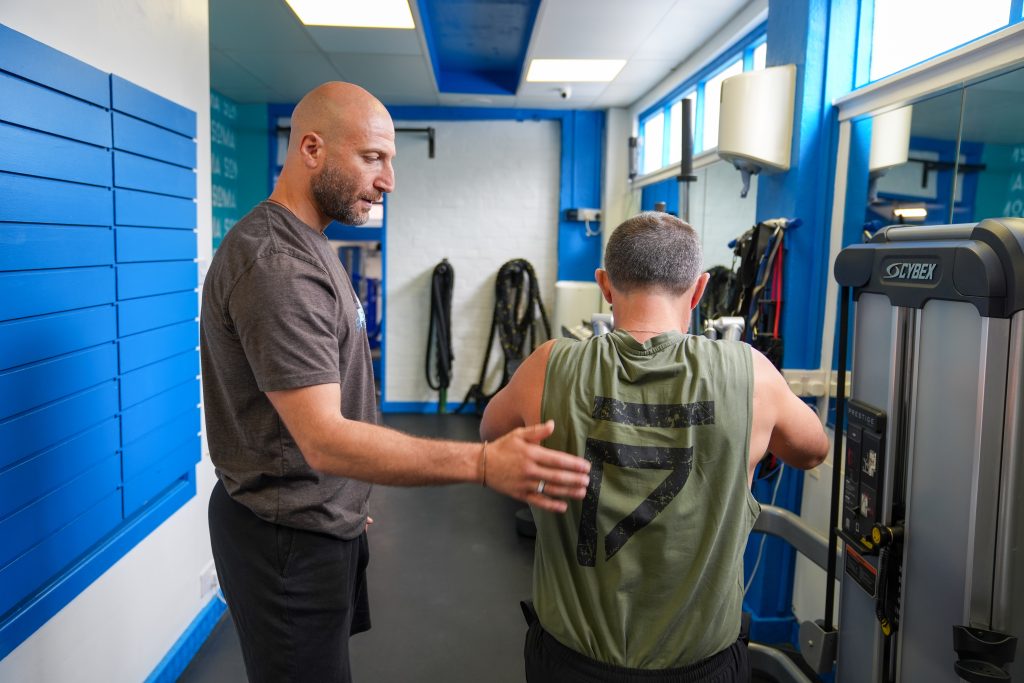
At Soma Fitness, we coach men and women from our private personal training studio on Hale Road in Altrincham.
And one of the biggest things we teach clients is this:
Progression should be earned not forced.
Here’s what that actually means.
What Does Getting Stronger Actually Mean?
Strength is your ability to produce force.
In the gym, we often measure improvements in strength through performance.
Perhaps you previously performed:
60kg × 6 repetitions.
Several months later, you can perform:
70kg × 6.
That’s a fairly obvious improvement.
But strength development isn’t always that straightforward.
You could also improve from:
60kg × 6
to:
60kg × 10.
Or perform the same load with:
Better technique.
Greater range of motion.
Better control.
Less perceived effort.
Those can all represent meaningful progress.
Strength Isn’t Just Your One-Rep Max
You don’t need to test your absolute maximum every week to know you’re getting stronger.
For most general-population clients, we’re rarely concerned with constantly testing:
“What’s the heaviest thing you can lift once?”
We’re much more interested in whether training performance is improving over time.
That gives us information without continually exposing you to maximal efforts.
Progressive Overload: What Does It Actually Mean?
Progressive overload is one of the fundamental principles of training.
But it’s often misunderstood.
People hear:
“Progressive overload.”
And translate it into:
“Add weight every session.”
That’s only one form of progression.
Progressive overload simply means that the training stimulus needs to develop appropriately over time if continued adaptation is the goal.
You Can Progress in Several Ways
Progress might involve:
Increasing load.
Performing more repetitions.
Performing additional productive sets where appropriate.
Improving range of motion.
Improving exercise execution.
Using a more challenging variation.
Increasing training frequency where appropriate.
Or performing the same work with less perceived effort.
The important point is:
Something improves over time.
Why You Can’t Add Weight Forever
Imagine you begin squatting with 40kg.
If you could simply add 2.5kg every week indefinitely, eventually you’d become the strongest human being who ever lived.
Obviously that doesn’t happen.
The more trained you become, the slower progress generally becomes.
Beginners can often progress relatively quickly.
Intermediate lifters progress more slowly.
Advanced lifters may work extremely hard for relatively small improvements.
That’s normal.
Beginners Often Progress Quickly
When you first begin resistance training, several things improve simultaneously.
You become:
More coordinated.
More confident.
More technically competent.
Better at producing force.
And more familiar with the movements.
Some early strength gains therefore aren’t simply the result of building enormous amounts of new muscle.
You’re also getting better at performing the task.
Technique Is a Skill
A squat is a skill.
A deadlift is a skill.
A press is a skill.
A row is a skill.
Just like any skill, they generally improve with:
Practice.
Feedback.
Repetition.
And appropriate progression.
That’s one reason constantly changing exercises can sometimes slow down skill development.
Good Technique Doesn’t Mean Everyone Looks Identical
This is important.
There isn’t always one universally perfect-looking squat.
People differ in:
Limb lengths.
Joint structure.
Mobility.
Training history.
And proportions.
That means exercise technique can vary between individuals.
Good coaching isn’t about forcing everyone into one textbook shape.
It’s about finding effective execution for the person performing the movement.
Technique Should Serve the Goal
Imagine you’re performing a squat to improve:
Quadriceps strength.
Your technique should allow you to train that movement productively.
If you’re powerlifting, the technical priorities may differ somewhat because you’re preparing to maximise performance under competition rules.
Context matters.
There isn’t one “perfect technique” independent of the goal.
Does Perfect Technique Prevent Injury?
This is where we need to be careful.
You’ll sometimes hear:
“If you have perfect form, you won’t get injured.”
That’s too simplistic.
Injuries are multifactorial.
They can be influenced by:
Training load.
Fatigue.
Previous injury.
Sport participation.
Recovery.
Individual anatomy.
Accidents.
And many other factors.
Technique matters.
But no technique guarantees you will never experience an injury.
Strength Training Isn’t Inherently Dangerous
Resistance training can be performed safely by a wide range of people when it is appropriately programmed and coached.
The key phrase is:
appropriately programmed.
Problems can arise when:
Load increases too quickly.
Technique deteriorates significantly.
Fatigue isn’t managed.
Pain is ignored.
Or people repeatedly attempt workloads beyond their current capacity.
Your Body Adapts to What You Expose It To
Training is essentially an organised stress.
You apply a stimulus.
Your body responds.
With sufficient recovery, adaptation occurs.
Then you’re capable of tolerating a little more.
That’s why sensible progression matters.
We don’t want:
No challenge.
But we also don’t want:
More challenge than you can reasonably recover from.
Think Capacity, Not Fragility
People sometimes become frightened of resistance training because they’re told:
“Don’t bend like that.”
“Don’t lift anything heavy.”
“Your knees shouldn’t do that.”
“Your back is vulnerable.”
The human body is adaptable.
Our goal isn’t to treat you as fragile.
Our goal is to gradually increase your capacity.
But Capacity Has to Be Built
There’s a difference between saying:
“The body can adapt to load.”
and:
“Therefore any amount of load is fine immediately.”
That’s obviously not true.
Your tissues and physical abilities adapt over time.
That’s why we progressively expose you to training rather than jumping from:
Nothing
to:
Extremely demanding training.
The Biggest Mistake: Too Much, Too Soon
This often happens when someone returns to training.
They remember what they could do five years ago.
So on week one they try to train like the person they used to be.
But their current capacity isn’t the same.
They haven’t trained consistently for:
Two years.
Five years.
Maybe ten years.
The solution isn’t to prove what you once could do.
It’s to establish where you are now.
Your Previous Best Isn’t Your Current Starting Point
Maybe you used to bench:
100kg.
But you haven’t trained for three years.
That doesn’t mean your first session back should be built around getting back to 100kg as quickly as possible.
We establish:
Current technique.
Current strength.
Current tolerance.
Then progress from there.
Leave Your Ego Outside the Gym
This is one of the most useful things you can learn.
The weight doesn’t care what you lifted:
Last year.
When you were 25.
At university.
Or before you had children.
Training should reflect your current capacity.
Not your ego.
More Weight Isn’t Always More Progress
Imagine last week you performed:
80kg × 8
with controlled technique and good range.
This week you perform:
90kg × 8.
But now:
Your range is shorter.
You’re using momentum.
Your position has changed.
And somebody is helping every repetition.
Did you actually become stronger?
Maybe.
But the comparison isn’t clean.
We want progression while maintaining the characteristics that make the exercise useful.
Your Training Log Matters
One of the simplest things you can do to improve your strength training is record it.
Write down:
Exercise.
Load.
Repetitions.
Sets.
And anything relevant about performance.
You don’t need a complicated spreadsheet.
You simply need enough information to know:
What did I do last time?
What Gets Tracked Can Be Progressed
If last week you performed:
Leg press:
100kg × 10
100kg × 10
100kg × 9
and this week:
100kg × 12
100kg × 11
100kg × 10
that’s progress.
Maybe next week we add load.
That’s much more objective than:
“I think I’m getting stronger.”
Repetition Ranges Give You Room to Progress
One simple programming method is using a repetition range.
For example:
8–12 repetitions.
Perhaps you begin with:
80kg × 8.
Over time you reach:
80kg × 12.
At that point, we may increase the load and begin building repetitions again.
This can provide a simple progression structure without forcing weight increases every session.
How Hard Should You Train?
This depends on the exercise, goal and individual.
But if you’re trying to improve strength and muscle, your working sets need to be sufficiently challenging.
If you finish every set knowing you could easily have performed another:
Ten repetitions…
the stimulus may be limited.
What Are Reps in Reserve?
Reps in reserve—often abbreviated to RIR—is a way of estimating how many additional repetitions you could have completed.
For example:
3 RIR = you believe you could have completed approximately three more repetitions.
1 RIR = perhaps one more good repetition.
0 RIR = you don’t believe another complete repetition was available.
It’s an estimate.
But with practice, it can become useful.
Do You Need to Train to Failure?
No.
Not every set needs to reach absolute failure.
Training to failure can be useful in certain contexts.
But it also creates fatigue.
Particularly on demanding compound exercises, continually pushing every set to absolute failure may not be necessary.
Training effort should be programmed—not simply maximised.
Harder Isn’t Always Better
This applies to the entire training programme.
If your coach’s only method of progression is:
More weight.
More sets.
More exercises.
More intensity techniques.
More pain.
More exhaustion…
eventually there’s nowhere left to go.
Good programming includes knowing:
When to add.
When to maintain.
And when to reduce.
Volume Matters
Training volume broadly refers to how much training you’re performing.
There are several ways to quantify it.
For practical resistance training, we often pay attention to the number of productive working sets being performed.
Too little training may provide insufficient stimulus.
But more isn’t automatically better.
Every Set Has a Cost
A productive working set can contribute to adaptation.
But it also creates fatigue.
If you perform:
10 useful sets,
then add:
20 more simply because you believe more must be better…
those additional sets aren’t free.
They can affect:
Recovery.
Performance.
Motivation.
And your ability to train effectively later in the week.
Fatigue Management Is Part of Strength Training
Getting stronger isn’t simply about what happens during today’s session.
We’re also thinking about:
Tomorrow.
Next week.
Next month.
And six months from now.
If today’s workout destroys your ability to train productively for the rest of the week, was it really optimal?
Your Programme Needs to Be Recoverable
A programme might look brilliant on paper.
But if you’re:
Working 60 hours per week.
Sleeping five hours.
Playing football twice.
Doing jiu-jitsu.
Running.
And raising young children…
your recoverable training volume may differ from someone whose entire lifestyle revolves around the gym.
Programming exists within your life.
Sleep Matters
Sleep affects:
Recovery.
Performance.
Mood.
Cognition.
And many other physiological processes.
You don’t need perfect sleep every night to progress.
But consistently inadequate sleep can make training harder to recover from.
If you’re exhausted, sometimes the intelligent training decision isn’t:
“Push harder.”
Nutrition Supports Adaptation
Resistance training provides the stimulus.
Nutrition helps provide the resources needed for recovery and adaptation.
Important considerations include:
Total energy intake.
Protein.
Carbohydrate availability.
Dietary fat.
Micronutrients.
And hydration.
You don’t need a perfect diet.
But training and nutrition shouldn’t be treated as completely unrelated.
Protein Is Particularly Relevant
Protein provides amino acids used in numerous physiological processes, including the maintenance and development of muscle tissue.
If you’re resistance training regularly, consuming adequate protein is sensible.
We’ve published a separate Soma Fitness guide covering how much protein you need per day in more detail.
Carbohydrates Can Support Training
Carbohydrates contribute to muscle glycogen and can support resistance-training performance.
You don’t need enormous quantities.
And individual requirements vary.
But automatically eliminating carbohydrates because you’re strength training isn’t necessary.
Recovery Doesn’t Mean Doing Nothing
Recovery isn’t simply:
Sitting on the sofa for six days.
You can still:
Walk.
Perform cardiovascular exercise.
Move.
Train other muscle groups.
And live normally.
We’re simply managing overall stress so the programme remains productive.
Cardio Doesn’t Automatically Ruin Strength
Resistance training and cardiovascular training can coexist.
For most general-population clients, developing both:
Strength.
And cardiovascular fitness
is a sensible objective.
The key is managing:
Frequency.
Intensity.
Volume.
And recovery.
Your Warm-Up Should Prepare You to Train
A warm-up doesn’t need to last thirty minutes.
The goal is preparation.
That might include:
General movement.
Exercise-specific preparation.
Gradually increasing load.
And practising the movement you’re about to perform.
The warm-up should make you more ready to train.
Not exhausted before you begin.
You Don’t Need 15 Mobility Drills Before Every Session
Mobility can be useful where it’s required.
But some people spend more time:
Rolling.
Stretching.
Activating.
Mobilising.
And preparing
than they do actually training.
Sometimes the exercise itself—performed progressively—is part of the preparation.
Exercise Selection Matters
You don’t have to perform:
Back squats.
Conventional deadlifts.
Barbell bench press.
Or any other specific exercise
to become stronger.
Those can be excellent movements.
But they’re tools.
Choose Exercises You Can Progress
A useful strength-training exercise should generally allow you to:
Perform it consistently.
Load it appropriately.
Execute it effectively.
Track performance.
And progressively improve.
That could involve:
Barbells.
Dumbbells.
Machines.
Cables.
Body weight.
Or combinations.
Machines Aren’t Cheating
Machines can be excellent resistance-training tools.
They may provide:
Stability.
Consistent setup.
Straightforward progression.
And the ability to target specific musculature.
You don’t earn bonus points because an exercise looks more complicated.
Free Weights Aren’t Dangerous Either
Likewise, dumbbells and barbells aren’t inherently dangerous.
They can provide excellent training options when appropriately selected and coached.
Again:
Context.
Individual.
Goal.
That’s what matters.
Should Your Knees Go Over Your Toes?
They can.
Your knees naturally move forward during many everyday and sporting activities.
A blanket rule stating:
“Your knees must never pass your toes”
isn’t necessary.
The appropriate movement depends on the exercise and individual.
The important issue is gradually developing tolerance to the positions and loads required.
Is Bending Your Spine Dangerous?
Human spines bend.
Again, the discussion is more nuanced than:
“Any spinal flexion causes injury.”
Different exercises and goals create different demands.
Loading strategy, tolerance, fatigue and individual circumstances all matter.
This doesn’t mean every possible loaded position is appropriate for every person immediately.
It means fear-based absolutes aren’t particularly helpful.
Pain and Training
Pain deserves context.
Muscular effort isn’t the same as joint pain.
Delayed-onset muscle soreness isn’t the same as an acute injury.
And not every ache means tissue damage.
But a personal trainer also shouldn’t dismiss persistent pain by telling you to:
“Push through it.”
When Should You Get Something Assessed?
If you experience:
Significant acute pain.
Persistent unexplained pain.
Neurological symptoms.
Substantial loss of function.
Or symptoms that concern you,
appropriate medical or physiotherapy assessment may be necessary.
Personal trainers don’t diagnose injuries.
What Can a Personal Trainer Do?
Within our scope, we can:
Modify exercises.
Adjust range of motion.
Alter load.
Manage volume.
Change training frequency.
Select better-tolerated variations.
Monitor symptoms.
And progressively rebuild training capacity where appropriate.
Members of the Soma Fitness coaching team also hold additional qualifications relating to injury rehabilitation and corrective exercise.
But those qualifications don’t replace appropriate medical diagnosis when it’s required.
What About Training After an Injury?
Returning from injury isn’t always about finding one magical “rehab exercise.”
Eventually, the goal is often to progressively rebuild:
Strength.
Capacity.
Confidence.
And tolerance to the activities you want to perform.
The exact process depends on the injury and clinical recommendations.
Progress Doesn’t Have to Be Linear
This is one of the biggest lessons in training.
Your performance won’t improve every single session.
Some weeks:
You’re stronger.
Others:
You match your previous performance.
Occasionally:
You perform worse.
That’s normal.
Progress is better viewed across:
Weeks.
Months.
And years.
Not individual workouts.
Life Affects Training
Maybe you slept badly.
Maybe work was stressful.
Maybe you’ve been travelling.
Maybe you’re recovering from illness.
Maybe your nutrition has been poor.
Maybe you simply had a bad session.
One poor workout doesn’t mean your programme has stopped working.
Look at trends.
What Is a Deload?
A deload is a planned period where training stress is temporarily reduced.
That might involve reducing:
Load.
Volume.
Effort.
Or some combination.
Not everyone needs rigidly scheduled deload weeks.
But periods of reduced training stress can sometimes be useful when fatigue has accumulated.
You Don’t Lose Everything by Taking an Easier Week
People sometimes panic:
“If I train lighter this week, I’ll lose all my progress.”
You won’t.
Training adaptations don’t disappear because you reduced workload for several days.
Sometimes backing off temporarily allows you to return performing better.
Consistency Beats Heroic Sessions
A single incredible workout means very little.
What matters is whether you can train:
Week after week.
Month after month.
Year after year.
The person who trains intelligently for five years will generally achieve far more than the person who repeatedly alternates between:
Extreme motivation.
Injury.
Time off.
And starting again.
Strength Training After 40
This becomes particularly relevant for many Soma clients.
You may not recover exactly as you did when you were:
But that doesn’t mean you need to stop training hard.
It means your programme should account for your current circumstances.
You Don’t Become Fragile at 40
There’s no switch that flips on your 40th birthday.
You can continue:
Getting stronger.
Building muscle.
Learning exercises.
And improving fitness.
But perhaps you now need to pay more attention to:
Recovery.
Exercise selection.
Training volume.
And lifestyle.
That’s intelligent programming.
Strength Training After 50
The same applies.
Resistance training can remain valuable throughout later adulthood.
The starting point simply needs to reflect the individual.
Someone beginning at 55 shouldn’t compare themselves with:
A 25-year-old athlete.
Or even another 55-year-old.
Training is individual.
How Often Should You Strength Train?
There isn’t one perfect frequency.
For many general-population clients:
Two or three well-structured resistance sessions each week can provide an excellent foundation.
Others may train:
Four.
Five.
Or more times.
Your appropriate frequency depends on:
Goals.
Training volume.
Experience.
Schedule.
And recovery.
More Days Doesn’t Automatically Mean More Results
Training six days per week isn’t automatically superior to three.
If three sessions allow you to:
Train hard.
Progress.
Recover.
And remain consistent,
that may be exactly what you need.
The programme should fit the person.
What Does Good Progress Look Like?
Over several months, you might notice:
You’re lifting more weight.
Performing more repetitions.
Moving with better control.
Using greater ranges of motion.
Feeling more confident.
Recovering better.
Building muscle.
And finding everyday tasks easier.
That’s progress.
What Does Strength Coaching at Soma Fitness Look Like?
At Soma Fitness, strength training isn’t based around simply making every workout harder than the last.
We want the programme to be progressive and sustainable.
Broadly, that can involve:
1. Establish your starting point
Understand your training history, goals and current ability.
2. Select appropriate exercises
Choose movements that suit you and your objectives.
3. Learn the movements
Build skill and confidence.
4. Establish appropriate volume
Enough training to stimulate progress without simply accumulating unnecessary fatigue.
5. Train with appropriate effort
Working sets need to be challenging enough to create adaptation.
6. Track performance
Record what you’re doing.
7. Progress when appropriate
Increase load, repetitions or another variable when you’ve earned it.
8. Manage fatigue
Adjust training when recovery requires it.
9. Review the programme
Keep what works.
Change what needs changing.
That’s progressive strength training.
Why Coaching Can Help
When you train alone, it can be difficult to objectively assess:
Technique.
Effort.
Progression.
Exercise selection.
And fatigue.
A coach gives you another set of eyes.
Sometimes they’ll tell you:
“You can do more.”
Other times:
“That’s enough today.”
Both are coaching.
Our Sessions Are 60 Minutes
All one-to-one sessions at Soma Fitness are 60 minutes.
That gives us time for:
Preparation.
Meaningful working sets.
Appropriate rest periods.
Technique coaching.
Progression.
And discussion.
Strength training doesn’t need to be rushed.
If you need three minutes between demanding sets, we don’t fill those three minutes with burpees simply because standing still looks unproductive.
Rest is part of training.
Private One-to-One Coaching
Soma Fitness is a private personal training studio.
We’re not an open-membership gym.
During your coaching session, the focus is on:
Your programme.
Your technique.
Your progression.
And your goals.
That can be particularly useful if you’re:
New to strength training.
Returning after years away.
Training around previous injuries.
Or simply tired of guessing what to do.
Personal Training in Altrincham & Hale
Our studio is based on Hale Road in Altrincham, conveniently serving clients throughout:
Altrincham.
Hale.
Bowdon.
Hale Barns.
Timperley.
Sale.
And surrounding South Manchester.
We’ve been coaching clients locally since 2007.
Frequently Asked Questions
What is the safest way to get stronger?
There isn’t a completely risk-free form of exercise. A sensible approach involves starting from your current ability, learning appropriate technique, progressing gradually, managing training volume and allowing adequate recovery.
How quickly should I increase my weights?
There’s no fixed timetable. Increase load when your performance, technique and current programme indicate that you’re ready rather than automatically adding weight every session.
Do I need to lift heavy to get stronger?
Strength development generally requires progressively challenging resistance, but “heavy” is relative. Beginners can become considerably stronger without continually performing maximal lifts.
Is strength training dangerous after 40?
Age alone doesn’t make resistance training inappropriate. Training should account for your current health, experience, recovery and physical capacity.
Should I train through pain?
Muscular effort and normal training discomfort differ from pain. Persistent, significant or concerning pain shouldn’t simply be ignored and may require appropriate clinical assessment.
Do I need perfect technique?
Technique matters, but there isn’t always one identical movement pattern that suits every person. Good technique should reflect the exercise, goal and individual.
How many days per week should I strength train?
Many people can make excellent progress with two or three well-structured sessions per week. Appropriate frequency depends on your programme and goals.
Should I train to failure?
Not necessarily on every set. Training close to failure can be useful for some goals, but effort should be managed according to the exercise and programme.
Can I do cardio while strength training?
Yes. Resistance and cardiovascular training can be combined when volume, intensity and recovery are managed appropriately.
Do I need to test my one-rep max?
No. You can monitor strength progress through repetitions, submaximal loads and other performance measures without frequently testing maximal lifts.
Can Soma Fitness help if I have an old injury?
We can often modify training around previous injuries and gradually build physical capacity where appropriate. Persistent or concerning symptoms may require assessment by an appropriate healthcare professional.
Where is Soma Fitness?
Soma Fitness is a private personal training studio on Hale Road in Altrincham, serving Hale, Altrincham and surrounding South Manchester.
Want to Get Stronger Without Constantly Starting Again?
Strength isn’t built by:
Chasing numbers.
Destroying yourself every session.
Ignoring pain.
Or trying to prove how tough you are.
It’s built through:
Appropriate challenge.
Progressive overload.
Good exercise selection.
Consistent training.
Recovery.
And most importantly:
Time.
At Soma Fitness, we provide private one-to-one personal training from our studio on Hale Road in Altrincham.
Whether you’re:
Completely new to strength training.
Returning after years away.
Over 40 or 50.
Frustrated because your progress has stalled.
Or simply want somebody to take the guesswork out of your programme…
we can help you build a structured approach.
Your first step is a free consultation.
Come into the studio.
Meet one of our coaching team.
Tell us what you want to achieve.
And we’ll explain how we’d approach your training.
Don’t chase strength.
Build it.
Contact Soma Fitness today to arrange your free consultation.
Recent Comments